Aldous Huxley Tells Mike Wallace What Will Destroy Democracy: Overpopulation, Drugs & Insidious Technology (1958)

1960s: Days of Rage's avatar1960s: Days of Rage


“Overpopulation, manipulative politics, imbalances of societal power, addictive drugs, even more addictive technologies: these and other developments have pushed not just democracy but civilization itself to the brink. Or at least author Aldous Huxley saw it that way, and he told America so when he appeared on The Mike Wallace Interview in 1958. (You can also read a transcript here.) ‘There are a number of impersonal forces which are pushing in the direction of less and less freedom,’ he told the newly famous news anchor, ‘and I also think that there are a number of technological devices which anybody who wishes to use can use to accelerate this process of going away from freedom, of imposing control.’ Huxley’s best-known novel Brave New World has remained relevant since its first publication in 1932. He appeared on Wallace’s show to promote Brave New World Revisited (first published as Enemies of Freedom)…

View original post 305 more words

A Lover’s Discourse: Fragments – Roland Barthes (1977)

1960s: Days of Rage's avatar1960s: Days of Rage


“In the slim volume of A Lover’s Discourse, French philosopher and literary critic Roland Barthes attempts to deconstruct one of the most powerful of human experiences: that of falling in love. Barthes claims that modern society lacks a language with which to discuss love – a notable change from times past in which it was the sexual, rather than the emotional aspects of love that were considered taboo. This should concern us as, without a system with which to analyse and interpret amorous experience, we are left to practice an unhealthy and unreflective form of love, which can do immense damage to all the parties involved. The stakes are particularly high: when tended properly, love can blossom into a deep and lasting contentment, or become a source of inexhaustible energy and inspiration. If mistreated, however, love can become a source of intense psychological pain, the cause of suicide, or…

View original post 323 more words

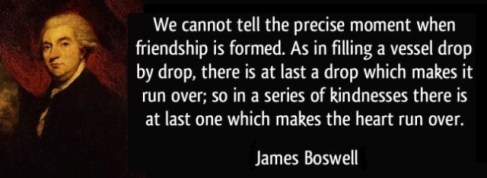
A Poem for the International Day of Friendship

wordcloud9's avatarFlowers For Socrates


In 2011, the International Day of Friendship was declared by the UN General Assembly, to be celebrated on July 30, as part of its Programme of Action on a Culture of Peace: “Recognizing the relevance and importance of friendship as a noble and valuable sentiment in the lives of human beings around the world.”

Naomi Shihab Nye (1952 –  ), born in St. Louis, Missouri. Daughter of a father who came to America as a Palestinian refugee, and a born-in-America mother. “I grew up in St. Louis in a tiny house full of large music – Mahalia Jackson and Marian Anderson singing majestically on the stereo, my German-American mother fingering ‘The Lost Chord’ on the piano as golden light sank through trees, my Palestinian father trilling in Arabic in the shower each dawn.” During her teens, Shihab Nye has lived in Ramallah in Palestine, the Old City in Jerusalem, and…

View original post 176 more words

Hackers: Heroes of the Computer Revolution – Steven Levy

1960s: Days of Rage's avatar1960s: Days of Rage


“There was the great chess showdown of 1965, when MacHack won a chess game against a critic of artificial intelligence named Herbert Dreyfus, who had bluntly asserted that no computer program would ever be able to beat even a 10-year- old. None of the computer specialists at the Massachusetts Institute of Technology cheered when the program won, because they knew it was going to happen. They lived in the world of hackers, a mere extension of the incredible computer environment. There was the Great Subway Hack, in which an M.I.T. student programmed a computer to figure out a route by which someone could ride the entire New York City subway system on a single token, and then a bunch of his fellow students went out and actually did it. And there was the incident when the security people in charge of M.I.T.’s Artificial Intelligence laboratory had to ask one of…

View original post 378 more words

Teach-Ins Helped Galvanize Student Activism in the 1960s. They Can Do So Again Today.

1960s: Days of Rage's avatar1960s: Days of Rage

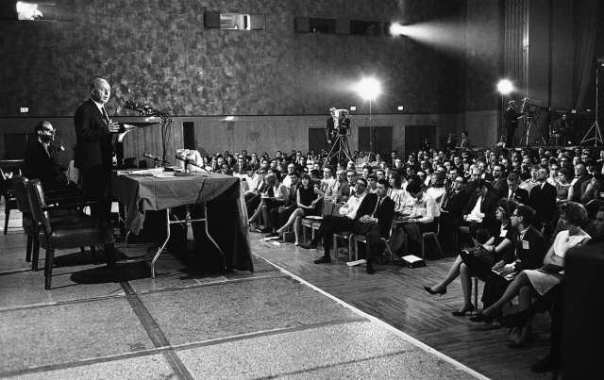
Hans Morgenthau leads a debate on Vietnam that was broadcast to teach-ins across the nation on May 15, 1965.

“When the teach-ins protesting the Vietnam War erupted on many campuses across the country in 1965, academic administrators complained that the professors were politicizing their universities. But it was the universities that had already politicized the professors. Large increases in federal funding throughout the Cold War, including projects sponsored by the CIA and the Department of Defense, led to a politically driven reorientation of teaching and research aimed at combating the ‘Communist threat’—as by purging professors suspected of affiliation with it. While the physical sciences were directly involved in military research, the social sciences were largely realigned in conformity with the global geopolitics of the conflict, developing an emphasis on geographies, languages, economies, anthropologies, and histories of strategic Third World regions that had previously been marginal to their concerns. … ‘Insurgency…

View original post 215 more words

Sun Ra ‎– The Eternal Myth Revealed Vol.1

1960s: Days of Rage's avatar1960s: Days of Rage


“… The Eternal Myth Revealed is a 14 disc docu-biography of Ra’s life and career, from his birth in 1914 up to 1959. In addition to his own music, it includes music he was influenced by, and a lot of stuff he may or may not have had a hand in as arranger, vocal coach, pianist or something else. Sun Ra’s output was as prolific as Ellington’s, and discographers have had nightmares and arguments attempting to document it accurately. This mammoth box set will raise as many questions as it sets out to answer, and will no doubt inspire controversy in a few corners. It’s 17 hours of history and music, and it’s riveting. I listened to it over a weekend, in two seven disc stretches. Then I dumped a bunch of the music into my iTunes. The auteur behind this landmark is Michael D. Anderson, whose knowledge of jazz…

View original post 224 more words

Why We Oppose Votes for Men – a Poem from 1915

wordcloud9's avatarFlowers For Socrates

Alice Duer Miller (1874-1942) was born on July 28, 1874, in Staten Island, New York. She was an American poet, novelist, screenwriter, satirist, and feminist. The New York Tribune published a series of her wonderful satirical poems lambasting the objections to women voting, which were then published in 1915 as a book called Are Women People?, which became a catchphrase of the women’s suffrage movement.

To read Alice Duer Miller’s poem, “Why We Oppose Votes for Men” click:

View original post 13 more words

Sylvia Plath’s Tarot Cards

1960s: Days of Rage's avatar1960s: Days of Rage


We celebrated my birthday yesterday: [Ted] gave me a lovely Tarot pack of cards and a dear rhyme with it, so after the obligations of this term are over your daughter shall start her way on the road to becoming a seeress & will also learn how to do horoscopes, a very difficult art which means reviving my elementary math. – Sylvia Plath, in a letter to her mother, 28 October 1956. Sylvia Plath’s Tarot cards, a 24th birthday present from her husband, poet Ted Hughes, just went for £151,200 in an auction at Sotheby’s. That’s approximately £100,000 more than this lot, a Tarot de Marseille deck printed by playing card manufacturer B.P. Grimaud de Paris, was expected to fetch. The auction house’s description indicates that a few of the cards were discolored —  evidence of use, as supported by Plath’s numerous references to…

View original post 301 more words

The Trials of Muhammad Ali – Bill Siegel (2013)

1960s: Days of Rage's avatar1960s: Days of Rage


“Muhammad Ali, born Cassius Clay, was not the only American to refuse to serve during the Vietnam War, but he was, by some measures, the most famous, the loudest and the baddest. Tracing the road to Mr. Ali’s act of defiance in 1967, Bill Siegel’s film ‘The Trials of Muhammad Ali’ tries to recover the cultural éclat of the moment after decades of pop-history shorthand have reduced it to sound bites about the Vietcong. Mr. Ali has already received his share of attention, not only in the annals of sports journalism but also through documentary (‘When We Were Kings’) and drama (‘Ali’ and ‘The Greatest’). But Mr. Siegel’s entry dwells on Mr. Ali’s embrace of Islam, and specifically the Nation of Islam, and how his stance on the war led him out of the ring and all the way to the Supreme Court. Sifting through the plentiful footage on…

View original post 239 more words

T-Bone Walker – Super Black Blues (1969)

1960s: Days of Rage's avatar1960s: Days of Rage


“… This included Bob Thiele’s new label. After leaving Impulse, following the musical equivalent of a coup d’etat Bob Thiele, formed Flying Dutchman Productions. He also believed the blues had a future. So, he started signing some of the biggest names in blues music to his nascent label. Before long, Flying Dutchman’s roster read like a who’s who of the blues. T-Bone Walker, Joe Turner and Otis Spann were all signed to Flying Dutchman Productions and would release comeback albums. In 1969, Joe Turner released The Real Boss Of The Blues on Flying Dutchman Productions. Otis Spann released Sweet Giant Of The Blues during 1969. A year later, T-Bone Walker released Every Day I Have The Blues, in 1970. However, a year earlier, in 1969, T-Bone Walker, Joe Turner and Otis Spann collaborated on on Super Black Blues, which was released by Flying Dutchman Productions in 1969. Super Black…

View original post 244 more words