Sun Ra ‎– The Eternal Myth Revealed Vol.1

1960s: Days of Rage's avatar1960s: Days of Rage


“… The Eternal Myth Revealed is a 14 disc docu-biography of Ra’s life and career, from his birth in 1914 up to 1959. In addition to his own music, it includes music he was influenced by, and a lot of stuff he may or may not have had a hand in as arranger, vocal coach, pianist or something else. Sun Ra’s output was as prolific as Ellington’s, and discographers have had nightmares and arguments attempting to document it accurately. This mammoth box set will raise as many questions as it sets out to answer, and will no doubt inspire controversy in a few corners. It’s 17 hours of history and music, and it’s riveting. I listened to it over a weekend, in two seven disc stretches. Then I dumped a bunch of the music into my iTunes. The auteur behind this landmark is Michael D. Anderson, whose knowledge of jazz…

View original post 224 more words

Why We Oppose Votes for Men – a Poem from 1915

wordcloud9's avatarFlowers For Socrates

Alice Duer Miller (1874-1942) was born on July 28, 1874, in Staten Island, New York. She was an American poet, novelist, screenwriter, satirist, and feminist. The New York Tribune published a series of her wonderful satirical poems lambasting the objections to women voting, which were then published in 1915 as a book called Are Women People?, which became a catchphrase of the women’s suffrage movement.

To read Alice Duer Miller’s poem, “Why We Oppose Votes for Men” click:

View original post 13 more words

Sylvia Plath’s Tarot Cards

1960s: Days of Rage's avatar1960s: Days of Rage


We celebrated my birthday yesterday: [Ted] gave me a lovely Tarot pack of cards and a dear rhyme with it, so after the obligations of this term are over your daughter shall start her way on the road to becoming a seeress & will also learn how to do horoscopes, a very difficult art which means reviving my elementary math. – Sylvia Plath, in a letter to her mother, 28 October 1956. Sylvia Plath’s Tarot cards, a 24th birthday present from her husband, poet Ted Hughes, just went for £151,200 in an auction at Sotheby’s. That’s approximately £100,000 more than this lot, a Tarot de Marseille deck printed by playing card manufacturer B.P. Grimaud de Paris, was expected to fetch. The auction house’s description indicates that a few of the cards were discolored —  evidence of use, as supported by Plath’s numerous references to…

View original post 301 more words

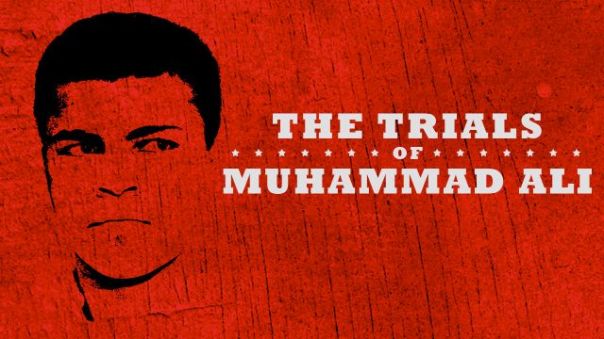
The Trials of Muhammad Ali – Bill Siegel (2013)

1960s: Days of Rage's avatar1960s: Days of Rage


“Muhammad Ali, born Cassius Clay, was not the only American to refuse to serve during the Vietnam War, but he was, by some measures, the most famous, the loudest and the baddest. Tracing the road to Mr. Ali’s act of defiance in 1967, Bill Siegel’s film ‘The Trials of Muhammad Ali’ tries to recover the cultural éclat of the moment after decades of pop-history shorthand have reduced it to sound bites about the Vietcong. Mr. Ali has already received his share of attention, not only in the annals of sports journalism but also through documentary (‘When We Were Kings’) and drama (‘Ali’ and ‘The Greatest’). But Mr. Siegel’s entry dwells on Mr. Ali’s embrace of Islam, and specifically the Nation of Islam, and how his stance on the war led him out of the ring and all the way to the Supreme Court. Sifting through the plentiful footage on…

View original post 239 more words

T-Bone Walker – Super Black Blues (1969)

1960s: Days of Rage's avatar1960s: Days of Rage


“… This included Bob Thiele’s new label. After leaving Impulse, following the musical equivalent of a coup d’etat Bob Thiele, formed Flying Dutchman Productions. He also believed the blues had a future. So, he started signing some of the biggest names in blues music to his nascent label. Before long, Flying Dutchman’s roster read like a who’s who of the blues. T-Bone Walker, Joe Turner and Otis Spann were all signed to Flying Dutchman Productions and would release comeback albums. In 1969, Joe Turner released The Real Boss Of The Blues on Flying Dutchman Productions. Otis Spann released Sweet Giant Of The Blues during 1969. A year later, T-Bone Walker released Every Day I Have The Blues, in 1970. However, a year earlier, in 1969, T-Bone Walker, Joe Turner and Otis Spann collaborated on on Super Black Blues, which was released by Flying Dutchman Productions in 1969. Super Black…

View original post 244 more words

The US Blockade on Cuba Must End

1960s: Days of Rage's avatar1960s: Days of Rage


Richard Nixon, then Dwight D. Eisenhower’s vice president, met with Cuba’s Fidel Castro on April 19, 1959, in Washington, DC.

“… The US blockade on Cuba has been a key part of Washington’s long-standing war on the country, launched shortly after Fidel Castro led a revolution overthrowing the country’s US-backed military dictatorship in 1959. Things didn’t start out entirely hostile. The Eisenhower administration publicly took a cagey wait-and-see attitude toward the new government. Meeting with Castro for three and a half hours, then–vice president Richard Nixon advised him, according to a post-meeting memo, ‘that it was the responsibility of a leader not always to follow public opinion but to help to direct it in proper channels, not to give the people what they think they want at a time of emotional stress but to make them want what they ought to have.’ With a tinge of regret, Nixon recounted…

View original post 243 more words

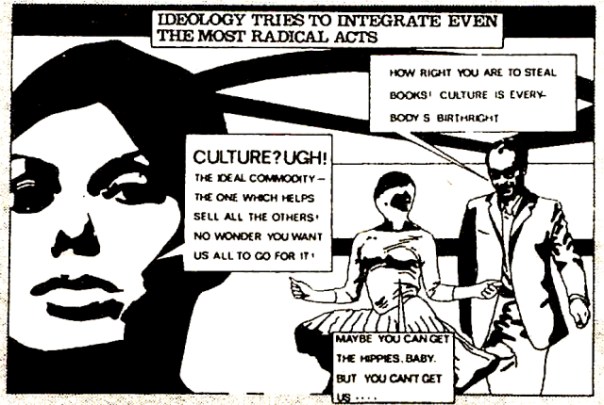
The Long Walk of the Situationist International by Greil Marcus

1960s: Days of Rage's avatar1960s: Days of Rage


“I first became intrigued with the Situ­ationist International in 1979, when I strug­gled through ‘Le Bruit et la Fureur,’ one of the anonymous lead articles in the first issue of the journal Internationale Situationniste. The writer reviewed the exploits of artistic rebels in the postwar West as if such matters had real political consequences, and then said this: ‘The rotten egg smell exuded by the idea of God envelops the mystical cretins of the American Beat Generation, and is not even entirely absent from the declarations of the Angry Young Men… They have simply come to change their opinions about a few social conventions without even noticing the whole change of terrain of all cultural activ­ity so evident in every avant-garde tendency of this century. The Angry Young Men are in fact particularly reactionary in their attribution of a privileged, redemptive value to the practice of literature: they are…

View original post 282 more words

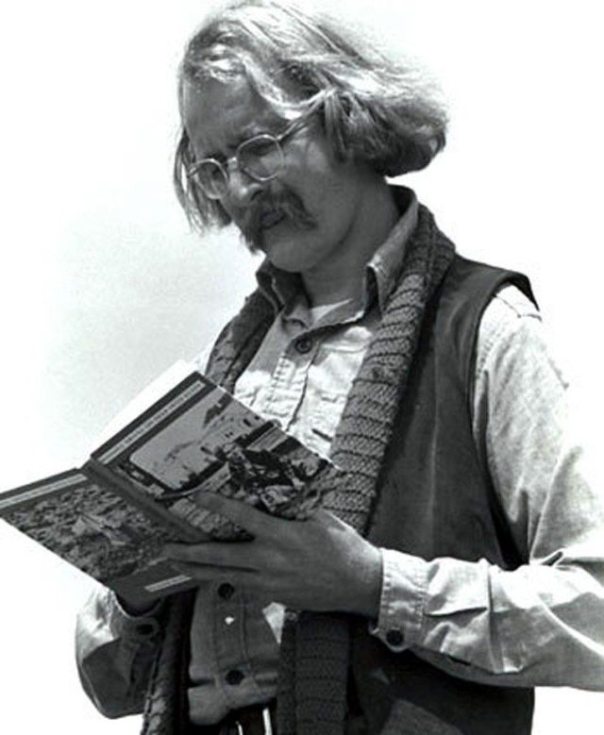
Richard Brautigan: Resurgence of an American absurdist

1960s: Days of Rage's avatar1960s: Days of Rage


“Richard Brautigan would have turned 85 this year had he not steeled himself against the barrel of a .44 Magnum revolver in a remote Californian cabin on September 16, 1984. The American author and humourist, best known for his 1967 classic Trout Fishing in America, died like one of the oddly drawn characters in his novels, in that strange and lonely place between the tragic and the absurd. The writer’s body decayed on the floor of his log cabin for several weeks until he was finally found, almost unrecognisable, by a pair of friends. A culmination of mental health issues, alcoholism and a receding literary relevance had been the undoing of the post-Beat author. He took his life aged 49. Brautigan, who began his career as a poet, published 10 novels in his lifetime, with an 11th, An Unfortunate Woman: A Journey, having been published posthumously. A true master…

View original post 310 more words

Paul Bowles: ‘Here’s My Message. Everything Gets Worse’ by Paul Theroux

1960s: Days of Rage's avatar1960s: Days of Rage


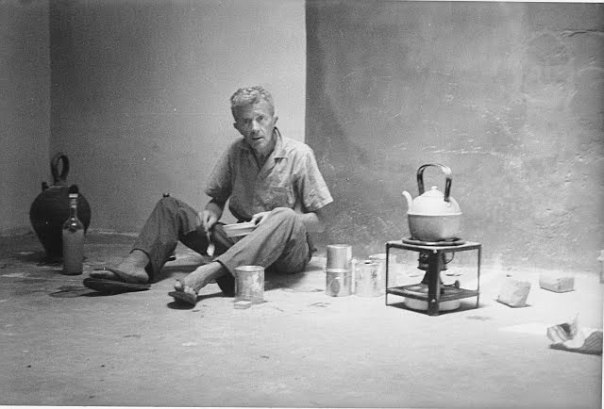
The Sheltering Sky was Paul Bowles’s first novel, and although he honed his art almost to his dying day—novels, poems, stories, translations, as well as musical scores—it was this strange, uneven, and somewhat hallucinatory novel, and a handful of disturbing short stories written around the same time, that seemed to locate his fictional vision for good in the minds of his readers. So at the age of 38 he was defined, and that definition dogged him for the rest of his life. Even in his eighties he was pestered about details in the novel. I know this to be true because I was one of the people pestering him when he was that great age. I found him sitting on the floor of a back room in a large chilly apartment in a gray building on a back street in Tangier. It was October and clammy cold. To drive…

View original post 363 more words

Heather Cox Richardson: A History Lesson About Reconstruction and the Rights of Black People

dianeravitch's avatarDiane Ravitch's blog

Heather Cox Richardson is an American historian who teaches at Boston College. She writes an informative blog called “Letters from an American.” This one appeared recently.

She writes:

On July 9, 1868, Americans changed the U.S. Constitution for the fourteenth time, adapting our foundational document to construct a new nation without systematic Black enslavement.

In 1865, the Thirteenth Amendment to the Constitution had prohibited slavery on the basis of race, but it did not prevent the establishment of a system in which Black Americans continued to be unequal. Backed by President Andrew Johnson, who had taken over the presidency after an actor had murdered President Abraham Lincoln, white southern Democrats had done their best to push their Black neighbors back into subservience. So long as southern states had abolished enslavement, repudiated Confederate debts, and nullified the ordinances of secession, Johnson was happy to readmit them to full standing in the…

View original post 1,013 more words