William Burroughs and Cigarettes

1960s: Days of Rage's avatar1960s: Days of Rage


“Everything counts in small amounts. Everything, everything. Everything, everything. All the minutiae matters. El hombre invisible comes into focus only if you shift through enough details. It has always struck me that Ted Berrigan drank Pepsi, not Coke. He is emphatic on this point. It is one of the ten things he did every day along with eat lunch and make noises. You can tell a lot about a man in observing what he drinks. An alternative to Coca-Cola, Pepsi sales first rose during the Great Depression when marketed as a drink for the price conscious. ‘Twice as much for a nickel, too.’ Drinking Pepsi was a sign of class, economically speaking. In the 1940s, it became a sign of race as well when Pepsi began inroads into the ‘Negro market,’ selling specifically to the previously neglected African American consumer. Coca-Cola was viewed as racist as the company, based in…

View original post 203 more words

Angel Hair

1960s: Days of Rage's avatar1960s: Days of Rage


“The poets and New York natives Anne Waldman and Lewis Warsh met at the Berkeley Poetry Conference in 1965, while absorbing the Zen-influenced poems of San Francisco-based writer Robert Duncan. This chance encounter begat a romantic and creative partnership that, back across the country in the East Village, lit a spark within the Downtown poetry scene. Lewis remembers: ‘we were going on nerve, all of twenty years old, but trusting in our love, which was less tricky and in the moment defied all uncertainty.’ Angel Hair, the beloved yet short-lived magazine and small press, was, he says, ‘our way of giving birth — as much to the actual magazine and books as to our selves as poets.’  … Anne and Lewis were living at 33 St. Marks’ Place, between Third and Second Avenues in a ‘skinny railroad apartment,’ which, as Lewis notes in one interview, is now a…

View original post 202 more words

President Zelensky’s Moving New Year’s Speech to the Ukrainian People

dianeravitch's avatarDiane Ravitch's blog

We have seen President Zelensky’s oratory on several occasions, most recently when he addressed the U.S. Congress. He is a master at communicating the plight of his nation, which has been under nonstop assault since last February 24. Putin thought that he would quickly decapitate the leadership, send Zelensky fleeing or kill him, and take control of Ukraine in a matter of days or weeks.

That didn’t happen. Shocking the world, Ukraine pushed Russian forces away from Kyiv, then slowly but surely pushed them out of many of its cities and towns. Now Ukraine endures a daily flood of missiles and drones aimed at destroying its infrastructure—a war crime—intended to cut off power, heat, and water to the civilian population. The point of the Russian onslaught is to terrorize the population.

Please watch and read President Zelensky’s inspiring words to the Ukrainian people. His message: we are united and…

View original post 4 more words

Existential Comics

1960s: Days of Rage's avatar1960s: Days of Rage


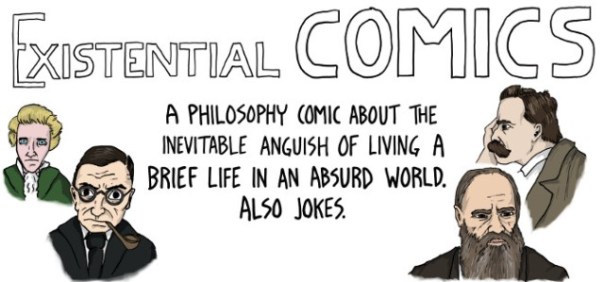
“Portland-based software developer Corey Mohler never took a philosophy class in college. But when it comes to popular philosophy, his Existential Comics rule the Internet. He’s made well over 100 of them since 2013, encompassing thinkers from the pre-Socratic Greeks to contemporary philosophers like Peter Singer and Robert Nozick. The existentialists do tend to appear the most, as you’d expect from the site’s name (and the fact that its logo is a cartoon of Jean-Paul Sartre), but Mohler showcases an extensive knowledge of every topic his works cover. Most importantly, he shares that knowledge easily and openly with uninitiated readers. You can click a ‘Didn’t Get The Joke?’ tab below each comic for a brief explanation of the concepts that comic explores, and on the blog section of the website, there’s an excellent beginner’s guide to philosophy—what books to read, how to read them, and other web resources to explore…

View original post 81 more words

Another Roundup of Round-Number Anniversaries

Dave Astor's avatarDave Astor on Literature

With the New Year here, it’s time for my annual post focusing on some of the novels that will reach round-number anniversaries in the next 12 months.

I’ll work chronologically backwards, starting with 1998-published books turning 25 in 2023. I’ll only mention novels I’ve read, except for two of which I’ve only seen the movie version.

Not sure this qualifies, but Harry Potter and the Sorcerer’s Stone was first published in the United States a quarter-century ago, in 1998. That novel initially came out in the United Kingdom the previous year under the title of Harry Potter and the Philosopher’sStone — kicking off J.K. Rowling’s outstanding, wildly popular seven books of wizard world-building. The second novel, HarryPotter and the Chamber of Secrets, made its page-turning debut everywhere in ’98.

Perhaps the best novel of ’98 was The Poisonwood Bible, about a very problematic American missionary in…

View original post 457 more words

October Revolution in Jazz

1960s: Days of Rage's avatar1960s: Days of Rage


“The October Revolution in Jazz was a four-day festival of new jazz music which took place at the Cellar Café in New York City. It occurred from October 1–4, 1964, and was organized by composer and trumpeter Bill Dixon. The success of the festival was directly responsible for the formation of the Jazz Composers Guild. During a trip to Helsinki, Finland with Archie Shepp in the summer of 1962, Dixon began to develop embouchure difficulties. The situation deteriorated to the point where, by the following summer, Dixon stopped playing in public in order to focus on correcting the issue. He also began concentrating on writing and arranging. Shepp, meanwhile, began collaborating with John Tchicai, with whom he would soon form the New York Contemporary Five. Dixon composed and arranged a number of the pieces that would be performed and recorded by the NYCF, and also…

View original post 250 more words

“The Work Is Never Done:” Judson Dance Theater Transforms MoMA

1960s: Days of Rage's avatar1960s: Days of Rage

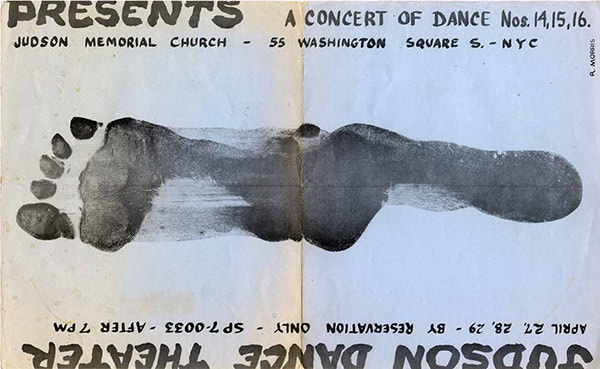
A Concert of Dance Nos. 14, 15, 16, by Robert Morris. New York: Judson Dance Theater, 1964.

“In 1968, Village Voice critic Jill Johnston proclaimed that between 1962 and 1964 a ‘revolution’ had occurred at Judson Memorial Church. With its exhibition Judson Dance Theater: The Work is Never Done, MoMA brings visitors into this seminal moment when a collective of choreographers and downtown artists across disciplines came together to create and show new works in non-commercial spaces, works that transformed the definitions of art and how we experience it. MoMA pushes the boundaries and conventions of the museum space as well, beginning the exhibition in the Atrium, where a video installation and a series of live performances take place daily, showing the work of preeminent choreographers from Judson Dance Theater: Yvonne Rainer, Deborah Hay, David Gordon, Lucinda Childs, Steve Paxton, and Tricia Brown. As the subtitle suggests, ‘the work…

View original post 238 more words

The 1959 Project

1960s: Days of Rage's avatar1960s: Days of Rage

May 2, 1959

“…. What is The 1959 Project? Most jazz fans find themselves suffering from golden age syndrome at some point or another; for the casual listener it might define their relationship with the music, given that so many of the genre’s seminal (and best-selling) records are now well-worn classics. A fair number of them, in fact, were released or recorded 60 years ago, and thus form the inspiration for this (quite probably foolhardy) endeavor. But for me, and I imagine for others, the best thing about jazz music isn’t the albums. It’s the privilege of getting to witness musicians’ search for authentic expression in real time; to see their masterful technique in service of some fleeting, genuine thought that will never be heard again in the exact same way. It’s a fundamentally live experience, which makes the golden age syndrome more painful — we might listen to Kind Of…

View original post 246 more words

Albert Camus – The Fall (1956)

1960s: Days of Rage's avatar1960s: Days of Rage


“The Fall (French: La Chute) is a philosophical novel by Albert Camus. First published in 1956, it is his last complete work of fiction. Set in Amsterdam, The Fall consists of a series of dramatic monologues by the self-proclaimed ‘judge-penitent’ Jean-Baptiste Clamence, as he reflects upon his life to a stranger. In what amounts to a confession, Clamence tells of his success as a wealthy Parisian defense lawyer who was highly respected by his colleagues. His crisis, and his ultimate ‘fall’ from grace, was meant to invoke, in secular terms, the fall of man from the Garden of Eden. The Fall explores themes of innocence, imprisonment, non-existence, and truth. In a eulogy to Albert Camus, existentialist philosopher Jean-Paul Sartre described the novel as ‘perhaps the most beautiful and the least understood’ of Camus’ books. Clamence often speaks of his love for high, open…

View original post 202 more words

Nazgûl, Black Riders, Nine Riders, etc.

1960s: Days of Rage's avatar1960s: Days of Rage


“The Nazgûl (from Black Speechnazg, ‘ring’, and gûl, ‘wraith, spirit’), introduced as Black Riders and also called Ringwraiths, Dark Riders, the Nine Riders, or simply the Nine, are fictional characters in J. R. R. Tolkien‘s Middle-earth. They were nine Men who had succumbed to Sauron‘s power through wearing Rings of Power, which gave them immortality but reduced them to invisible wraiths, servants bound to the power of the One Ring and completely under Sauron’s control. The Lord of the Rings calls them Sauron’s ‘most terrible servants’. Their leader, known as the Lord of the Nazgûl or the Witch-king of Angmar, had once been the King of Angmar in the north of Eriador. At the end of the Third Age, their main stronghold was the city of Minas Morgul at the entrance to Sauron’s realm, Mordor…

View original post 228 more words