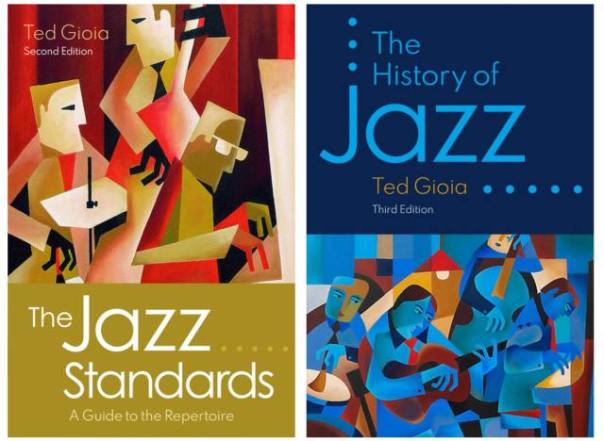
The Jazz Standards: A Guide to the Repertoire (2021), The History of Jazz (2021) – Ted Gioia

1960s: Days of Rage's avatar1960s: Days of Rage


“A few days ago, the revised and expanded edition of my book The Jazz Standards was published by Oxford University Press. I’ve never had more fun writing a book than in creating this guide to the jazz repertoire—which covers 267 essential songs. These were songs that I first learned in my earliest days as a jazz musician, and they’ve remained familiar friends over the decades. The first edition of The Jazz Standards, published in 2011, earned praise from Sonny Rollins, Dave Brubeck, Lee Konitz, and other jazz luminaries—a tough audience to please, because they know these songs intimately. I must have done something right to get their approval. But the full range of the response to The Jazz Standards went far beyond my expectations. In fact, more readers contacted me in response to this book than about anything I’ve ever published. These were more than fan letters, but smart…

View original post 190 more words

Irreconcilable Truths of Our Evolution: On Stanisław Lem’s The Truth and Other Stories

1960s: Days of Rage's avatar1960s: Days of Rage


“One cannot overstate how profoundly our relationship with computers has changed since the mid-twentieth century. Once upon a time, the notion of a mechanical brain was as alien as the notion of, well, an alien. Similar to research of extraterrestrial life, there were then a few elite scientists, sequestered in institutions, who were better informed to predict what an encounter with a mechanical brain might entail than the general population, for whom such a concept was nothing more than fantasy. Stanisław Lem was of that class. Son of a doctor, he studied medicine until his transition to literature. As a newcomer to Lem’s copious body of work, what surprised me most about this collection of previously untranslated stories was how, with very little attention to character development, he manages to render this scientific class with as much fidelity as their fields of inquiry. I expected their curiosity and ambition, even…

View original post 220 more words

Do Not Forget the True Purpose of School

dianeravitch's avatarDiane Ravitch's blog

Mother’s first class, around 1950, at Skabersjöskolan, where I myself also went to school.

A friend in Sweden sent this article via Twitter. It was written by Jenny Maria Nilsson. I went to Google and asked for a translation from Swedish to English. Sweden is even farther down the road to privatization than we are. A conservative government in the early 1990s opened the way to public funding of independent schools, many of which operate for profit.

She writes:

The goal for primary school is not millions of different things but first and foremost education. If that goal is achieved, it certainly also provides other things: life opportunities, education and freedom, social interaction, a place for children to be and so on, but the school’s goal is teaching a basic curriculum.

In the book about the digitalisation of the Swedish school, which I have contributed to, I write: “What is…

View original post 249 more words

An Anniversary Appreciation of Emile Zola

Dave Astor's avatarDave Astor on Literature

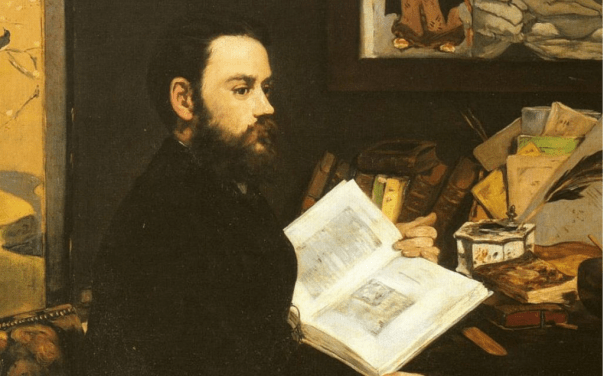
Emile Zola, painted by Edouard Manet, in 1868.

The almost-over 2021 is the 150th anniversary of the first of the 20 novels in EmileZola’s Rougon-Macquart cycle. So, I’m writing this appreciation of the French authorjust in time. 🙂

Zola is nowhere near the best-known novelist of the 19th-century, but he’s in the top couple dozen — and I’m a big fan.

While Zola had some writing success before 1871, notably with the 1868 potboiler Therese Raquin, it’s the Rougon-Macquart cycle for which he’s most remembered. Those vivid novels are considered “naturalist” and realistic, with each heavily researched book focusing on a specific theme — art, trains, laborers, retailing, alcoholism, prostitution, etc., in 19th-century France — while also offering gripping plots and compelling three-dimensional characters. The Rougons and Macquarts are two family branches, the first more upper class and the second more working class, whose members share various hereditary tendencies…

View original post 438 more words

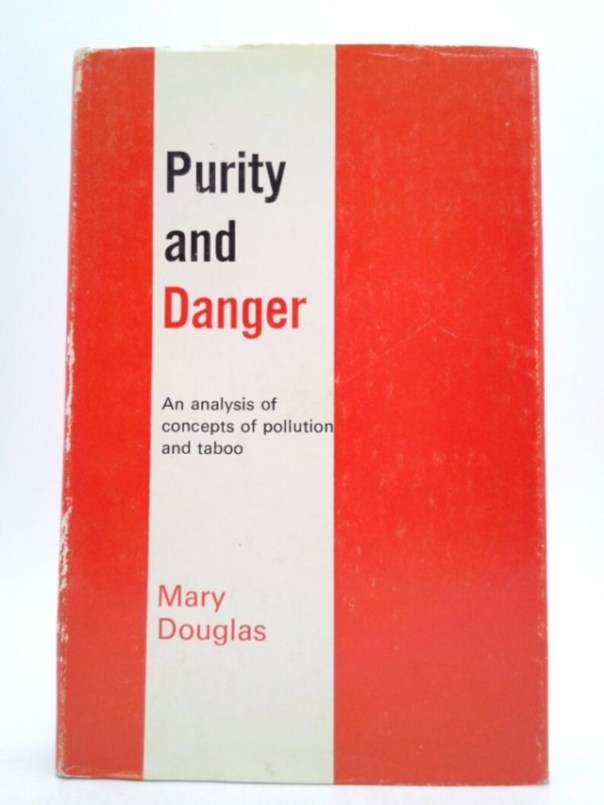
Purity and Danger: An Analysis of Concepts of Pollution and Taboo – Mary Douglas (1966)

1960s: Days of Rage's avatar1960s: Days of Rage


“A sharp, comparative analysis of symbolic boundary maintenance across times and cultures, Mary Douglas’s Purity and Danger intervened in the anthropology of religion and ritual, as well as in the theoretical development of the field as a whole. It is a key text in symbolic anthropology, an approach that, in viewing symbols as the building blocks of socio-religious worlds, sought to analyze the ways symbolic constructions either generated order or disorder. Innovative for its time, Douglas follows E. E. Evans-Pritchard ethnographic account of The Nuer when she claims that we cannot understand ideas of purity or pollution—that is, hygiene—in isolation. Solid anthropological knowledge comes from an analysis that attends to the ways systems relate to one another and form the structural ‘backbone’ of a society. And so, Purity and Danger embarks on an historical ethnographic analysis of hygienic rituals, locating them as critical parts to classificatory systems that revolve around perceptions…

View original post 222 more words

Frantz Fanon quotes that resonate 60 years later

1960s: Days of Rage's avatar1960s: Days of Rage


“Frantz Fanon, the Martiniquan born psychiatrist, committed Algerian revolutionary and pan-African thinker, died 60 years ago on 6 December 1961 just after the publication of his last book, The Wretched of the Earth. To mark this 60th anniversary, Nigel C Gibson has just published his collection, Fanon Today: The Reason and Revolt of the Wretched of the Earth. He discusses some important quotes from Fanon’s global classic. In the first chapter of The Wretched of the Earth, ‘On Violence’, Fanon describes colonialism as a system of absolute violence that can only be opposed through violence. He references South Africa as he powerfully describes the colonial world expressed in space: ‘The colonist’s sector is built to last … a sector of lights and paved roads, where the trash cans constantly overflow with strange and wonderful garbage, undreamed-of leftovers … The colonist’s sector is a sated, sluggish sector…

View original post 219 more words

“Burroughs Is a Poet Too, Really”: The Poetics of Minutes to Go

1960s: Days of Rage's avatar1960s: Days of Rage


“The long and intimate association of William Burroughs with poets is well known: Ginsberg, most obviously, as well as Corso, Creeley, Ferlinghetti, Leroi Jones, John Giorno, and so on. But to talk of Burroughs’ own material engagement with poetic form and poetics in relation to historical and contemporary practices — this can really only mean one thing: the cut-up project that began in Paris at the end of 1959. As well as brief encounters with old luminaries such as Duchamp, Peret and Tzara, this was the place and the context in which his activities would bring Burroughs in contact with George Maciunas’ Fluxus Group, the Domaine Poetique of Bernard Heidsieck and Henri Chopin, the work of the Lettristes and poesie sonore. It’s easy to forget, but his first novel, Junkie, had been published as a pulp paperback on sale in rail stations only six years earlier. Now, to give just…

View original post 211 more words

Enter The Dream House of La Monte Young: the avant-garde pioneer who inspired The Velvet Underground

1960s: Days of Rage's avatar1960s: Days of Rage


“Walk along Church Street, just south of New York’s Tribeca Grand Hotel, and you’ll notice an iridescent pink glow emanating from the third floor of number 275, an apartment known to those who care to ask as The Dream House. With its pink walls and tin-foil floors, this trip-inducing sound and light installation was created by one of the most pioneering artists of the 1960s, La Monte Young, a man who sat in the centre of the avant-garde scene that flourished in the city during those years, and who’s incredible work in sound and visual art influenced everyone from Biran Eno and Yoko Ono to Lou Reed and John Cale. Young was always sensitive to the world of sound. From an early age, he was struck by the droning sound of the wind sweeping along the vast Idaho plains, a natural force that, although invisible, seemed to have as much…

View original post 280 more words

Deborah Jowitt on Jill Johnston

1960s: Days of Rage's avatar1960s: Days of Rage

Al Giese’s contact sheet of Jill Johnson and Robert Morris, New York, March 3, 1965.

“Jill Johnston was one of my most influential teachers, but I never told her that. In 1959, she began to write a radical, erudite, slangy column called Dance Journal for the Village Voice, four years after it was founded by Ed Fancher, Dan Wolf, and Norman Mailer. She embarked on a career as a critic at a time when, in her words, ‘the entire art world was entering a convulsion of dissolving boundaries.’ Happenings and other interdisciplinary events erupted onto the scene. The zeitgeist of the 1960s was one of rebellion. The question that permeated the air was, ‘Why not?’ When exuberant and fearless choreographers such as Yvonne Rainer, David Gordon, and Trisha Brown came together in 1962 to present their work at Judson Memorial Church, they redefined what dance could be. Robert Rauschenberg…

View original post 283 more words

citation blues #1-#4

pat thomson's avatarpatter

Blues- African-American musical form dealing with sorrows, trials and tribulations

Blue –Australian slang for making a mistake. As in “I made a blue”

So its possible, (particularly if you are Australian), to have the blues about making a blue. A state that academic writers want to avoid if at all possible. And particularly doctoral writers.

One place to avoid getting the blues about making blues is in citations. The references you make to other people’s work.

When examiners read dissertations and reviewers read papers, they are always aware of in-text citations. They don’t necessarily look for them but they see them. They will almost always pick up the four most common citation mistakes – if they are present. And if these citations are problematic and numerous, reviewers and examiners may well leap to the conclusion that the writer hasn’t done enough careful reading. They have been cavalier with the…

View original post 886 more words