Greenwich Village Theater in the 1960s

1960s: Days of Rage's avatar1960s: Days of Rage


“… In the 1950s, the West Village and, later, the newly designated, edgier East Village (rebranded from the northern part of the Lower East Side around 1964) became the cradle of New York’s Beat generation, with its new, raw, and mold-breaking style of poetry and writing; jazz, heard in Village night clubs and coffeehouses; challenging forms of painting and art such as Abstract Expressionism, especially ‘action painting’ (which was an impetus for the Happening) as exemplified by Jackson Pollock, a Village resident; and the revolutionary politics preached by its denizens and frequent visitors. With untried, non-commercial, or experimental plays or productions, using then-unknown talent and shoe-string budgets, Off-Broadway became an artistic magnet. … Such companies as the Living Theatre, New York Shakespeare Festival, Roundabout Theatre Company (1965), Chelsea Theatre Center (1965), Negro Ensemble Company (1967), and Circle Repertory (1969, as the Circle Theater Company), many of which started Off-Off-Broadway, presented…

View original post 229 more words

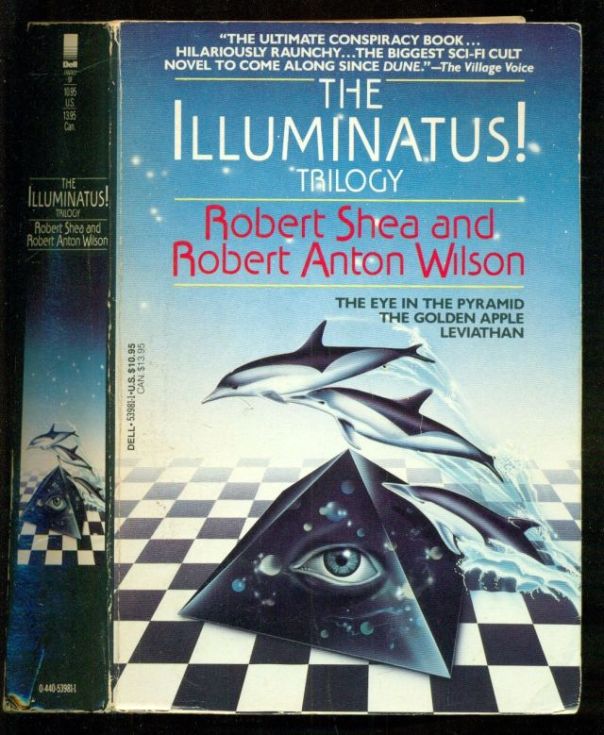
The Illuminatus! Trilogy – Robert Shea and Robert Anton Wilson

1960s: Days of Rage's avatar1960s: Days of Rage


The Illuminatus! Trilogy is a series of three novels by American writers Robert Shea and Robert Anton Wilson, first published in 1975. The trilogy is a satirical, postmodern, science fiction–influenced adventure story; a drug-, sex-, and magic-laden trek through a number of conspiracy theories, both historical and imaginary, related to the authors’ version of the Illuminati. The narrative often switches between third- and first-person perspectives in a nonlinear narrative. It is thematically dense, covering topics like counterculture, numerology, and Discordianism. The trilogy comprises three parts which contain five books and appendices: The Eye in the Pyramid (first two books), The Golden Apple (third and part of fourth book), Leviathan (part of fourth and all of fifth book, and the appendices). … The plot meanders between the thoughts, hallucinations and inner voices, real and imagined, of its many characters—ranging from…

View original post 217 more words

The Rise of a New American Cinema, 1959 – 1971 – Jonas Mekas

1960s: Days of Rage's avatar1960s: Days of Rage


“Back in the day when I was an aspiring young artist, one of my bibles was a well-worn copy (gotten at the late-great independent bookstore Paperbacks Unlimited) of Movie Journal, a collection of columns by filmmaker/impresario Jonas Mekas that had originally appeared in the Village Voice from 1959 to 1971, trumpeting trumpeting the rise of something called a ‘new American cinema.’ The working-class suburb northeast of Detroit where I grew up was hardly a hotbed of avant-garde culture, and Mekas’s compendium of rants and raves introduced me to a creative world I could only imagine via the descriptions he provided. The roll call of names—Stan Brakhage, Kenneth Anger, Jack Smith, Barbara Rubin, Carolee Schneeman, and dozens of others—was an elite group of underground luminaries to search out and from which to learn, not an easy task in the days before VCRs and DVDs, much less YouTube and Vimeo. ……

View original post 254 more words

The Proud Boys Are Menacing School Boards, Town Councils

dianeravitch's avatarDiane Ravitch's blog

The New York Times reports that the Proud Boys, the white nationalist group of the far-right, is now using its members to protest mask mandates at local school board meetings and other local events. Their presence will probably cause some people to leave their school board position or not to run. But their presence makes it all the more imperative that concerned parents and other citizens run for school board, show up for school board meetings, and support candidates who want to make local schools better.

They showed up last month outside the school board building in Beloit, Wis., to protest school masking requirements.

They turned up days later at a school board meeting in New Hanover County, N.C., before a vote on a mask mandate.

They also attended a gathering in Downers Grove, Ill., where parents were trying to remove a nonbinary author’s graphic novel from public school…

View original post 62 more words

Holding Parents Accountable When Their Children Kill

Yes!!

dianeravitch's avatarDiane Ravitch's blog

This very important story appeared in the Washington Post.

She had seen her grandson’s red, spiral-bound notebook before that night, but now, as Catherine O’Connor sifted through its pages for the first time, what she read astonished her.

“School Shootings,” Joshua O’Connor had titled the first page, above a reconstruction of the Columbine High School massacre that left 13 people dead. In the pages that followed, Joshua, who’d just turned 18, described a detailed plan to carry out his own massacre: the shotguns, pistols, assault rifle and ammunition he would buy and the bombs he would build; the doors he would zip-tie “so bitches can’t escape”; the spot by the bleachers where he would set off the first explosion; the route he would take on his killing spree; the moment, when it was over, that he would end his own life.

“I Need to make this shooting/ bombing… infamous,” he…

View original post 2,254 more words

Marguerite Duras

1960s: Days of Rage's avatar1960s: Days of Rage


“Marguerite Duras (1914–1996) is one of France’s most important and interesting intellectual figures. She excelled at being a writer, filmmaker and dramatist. After the Second World War she also worked for a number of years as a journalist for France-Observateur. She was often at the forefront of political movements, such as the opposition to the Algerian War, May ’68 and feminism. Surprisingly, Duras supported of the sinking, by the French secret service, of the Greenpeace vessel, The Rainbow Warrior in 1985, her view being at the time that any impediment – which Greenpeace represented – to French nuclear testing in the Pacific only encouraged Soviet expansionism. In her extensive oeuvre, Duras particularly explored the emotional disequilibrium brought by love, desire, suffering and death, especially as these affect women and propel them towards the abyss of madness. In addition, Duras’s writing explores the space between fusion and separation (e.g. in…

View original post 235 more words

Layered Research Assignments – Bloom’s Taxonomy of Learning

My Teaching Library's avatarLibrary of Learning Resources

A layered research assignment gives students the opportunity to delve deeply into a topic and give students a variety of tasks from which to choose, all designed to guide and build a meaningful learning experience. Also, when using this layered approach, students will move through Bloom’s Taxonomy of knowledge, comprehension, application, analysis, synthesis and evaluation.

My Teaching Library offers this easy to use resource that will guide students through (step by step) the three layers of research and can be used with any topic. Since this resource can be used for any topic, it can be used again and again!

The three layers of research:
* The first (bottom) layer will give students 9 tasks of which they will perform all of them. This layer will help students get a good grasp of the topic and begin to gather the materials they will need to create a great project, (knowledge…

View original post 186 more words

A Poem by George Santayana on His Birthday

wordcloud9's avatarFlowers For Socrates

George Santayana (1863-1952) was born in Spain as Jorge Ruiz de Santayana y Borrás; American philosopher, essayist, poet, and novelist. His mother had promised her first husband, an American, that their children would be raised in the U.S., and took them there in 1869. Jose (George) remained in Spain with his father, her second husband, until 1872, when they both joined the rest of the family in Boston, but his father soon returned to Spain, and his son did not see him again until he was at Harvard, and started going to Spain for his summer vacations. After graduating from Harvard, he studied for two years in Berlin, then returned to Harvard to write his dissertation on the philosopher Herman Lotze. He became a professor in Harvard’s philosophy department (1889-1912), and his students included T.S. Eliot, Robert Frost, Gertrude Stein, and W. E. B. Du Bois. Santayana never married. In…

View original post 319 more words

Louisiana: Homer Plessy Pardoned After 130 Years

dianeravitch's avatarDiane Ravitch's blog

At the end of the 19th century, Homer Plessy was arrested for trying to ride in an all-white train car in New Orleans, thus ignoring Louisiana’s segregation law. Plessy was a Black Creole. After a local judge found him guilty, he appealed the conviction all the way to the U.S. Supreme Court, which ruled against him in the Plessy vs. Ferguson decision, which ratified the “separate but equal” doctrine.

That ruling okayed racial segregation statutes that reduced millions of Black Americans to second-class status, since separate was never equal in a racist society. Separate but equal remained in place until it was overturned by the Supreme Court in 1954, a decision that was boldly resisted by the South for years.

Homer Plessy will be posthumously pardoned as a result of a sustained effort by his descendant Keith Plessy, and the descendant of the judge who found him guilty, John Howard…

View original post 392 more words

The Most Important Article You Will Read About the Attempted Coup of January 6

dianeravitch's avatarDiane Ravitch's blog

Barton Gellman is a staff writer for The Atlantic. He is amazingly prescient. Right before the election of 2020, he wrote an ominous article speculating that Trump, if the election results were close, might refuse to concede. He foresaw the chaos that Trump would indeed unleash, undermining the integrity of the election, which is the central mechanism of democracy.

Now he has written an equally astonishing article in The Atlantic, in which he warns that “Trump’s Next Coup Has Already Begun.” He summarizes Trump’s strategy to overturn the election of 2020 by trying to persuade Republican legislatures to overturn the popular vote (if the Democratic candidate wins it) and submit slates of Trump electors for certification by Congress.

Trump put pressure on Republican state officials in Pennsylvania, Michigan, Arizona, and Georgia to override the popular vote, but that didn’t work. Then he tried to stall the certification of the…

View original post 944 more words