W. S. Di Piero: “On Neighborhoods” – A Symposium on Neighborhoods

1960s: Days of Rage's avatar1960s: Days of Rage

49th Street at Woodland Avenue, Philadelphia

“In Hardy’s ‘The Self-Unseeing,’ he visits the remains of his childhood home and recalls where the door was, how the floor felt, how his mother sat ‘staring into the fire’ while her fiddler husband ‘bowed it higher and higher.’ The last two bittersweet lines, ‘Everything glowed with a gleam / Yet we were looking away,’ remind him they couldn’t possibly have been aware of the harmonious moment while living it. They were oblivious, happily so. The moment is what the poem tries to catch up on. We’re always late for consciousness, neuroscientists say. And there are durations and degrees of lateness. When conversations turn to the trials of keeping up with the accelerated present, I say I’m still trying to keep up with the past. If you grow up in a concentrated, tribal, old-style working-class neighborhood, as I did, you’re in the dream and…

View original post 182 more words

Heather Cox Richardson on the Ukraine Conflict

dianeravitch's avatarDiane Ravitch's blog

Historian Heather Cox Richardson has interesting insights on the Russian invasion of Ukraine. The overwhelming resistance to Putin is remarkable, and Putin has turned to carpet-bombing cities and devastating civilian areas. Despite Russian efforts to convince the Russian public that the war “to liberate Ukraine from fascists” is going well, she points to the growing number of anti-war protests in Russia.

She writes:

In Ukraine, Russian troops escalated their bombing of cities, including Kyiv, Kharkiv, Odesa, and Mariupol, in what Ukraine president Volodymyr Zelensky called a campaign of terror to break the will of the Ukrainians. Tonight (in U.S. time), airborne troops assaulted Kharviv, which is a city of about 1.5 million, and a forty-mile-long convoy of tanks and trucks is within 17 miles of Kyiv, although a shortage of gas means they’ll move very slowly.

About 660,000 refugees have fled the country.

But the war is not going well…

View original post 619 more words

Searching for Kemet: Malcolm X in Egypt

1960s: Days of Rage's avatar1960s: Days of Rage


“We all know the name Malcolm X, but few of us have heard of Malik El-Shabazz, the name the civil rights activist adopted after his conversion to Islam and under which he journeyed to Cairo in the early 1960s. As those who travel in the pursuit of knowledge so often do, Malcolm travelled alone, arriving in the Egyptian capital just before embarking on a long journey through Africa. Malcolm’s time in Cairo is rarely touched upon. Still, it seems to have had an important impact on his politics towards the end of his life, sparking a new emphasis on Black unity and the importance of brotherhood in the face of white oppression. The year before Malcolm X’s last visit to Cairo, he’d left America to travel the Middle East and West Africa. When he returned on May 21st, 1963, he had visited Egypt, Lebanon, Saudi Arabia, Nigeria, Ghana, Morocco, and…

View original post 223 more words

The Ukraine Crisis

Nan's avatarNan's Notebook

soldier-g66889a515_640

In her latest newsletter, Heather asks a question related to the Ukraine crisis that I thought would be interesting to ask as a standalone to see how my readers would respond.

Prior to her question, she wrote about how in 2019, Trump tried to skew the 2020 election by withholding congressionally appropriated funding for Ukraine to support its defense against Russia — and how Republican senators declined to convict him of abuse of power and obstruction of Congress.

With this background in mind, she mused about how the Republican Party will respond to the Ukraine crisis.

She then went on to ask this question …

And how will America as a whole respond?

What are your thoughts? IF Putin does carry forward his plans to invade Ukraine, what do you think America should do? Biden talks about sanctions, but will this be enough? Many feel it will be. Or…

View original post 107 more words

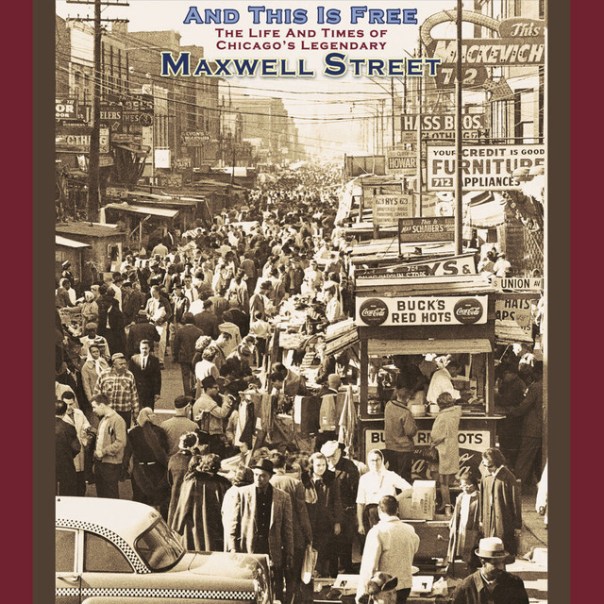
And This Is Free: The Life And Times Of Chicago’s Legendary Maxwell Street (1964)

1960s: Days of Rage's avatar1960s: Days of Rage


“After languishing out of print for many years, Mike Shea’s legendary film on Chicago’s Maxwell Street Market, And This Is Free, has finally been reissued by Shanachie and I imagine news of this will stir up quite a bit of excitement in blues circles. Shanachie has done an exemplary job with the packaging; housed in a soft covered fold out set is a two disc set containing the 50 minute documentary And This Is Free, the 30 minute documentary Maxwell Street: A Living Memory, some fascinating archival footage, an interview with sound man Gordon Quinn, a separate CD of performances by artists associated with Maxwell Street plus an illustrated 36 page booklet. The history of the film and music recorded by Mike Shea over the course of sixteen Sundays on Chicago’s Maxwell Street in 1964 has an interesting if convoluted history, and I find it odd that…

View original post 270 more words

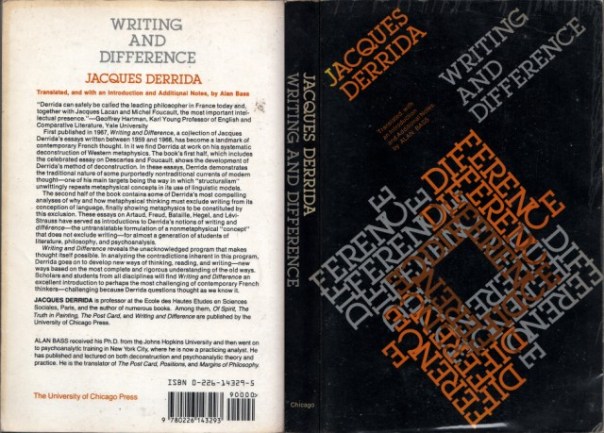
Writing and Difference – Jacques Derrida (1967)

1960s: Days of Rage's avatar1960s: Days of Rage


“‘Structure, Sign, and Play in the Discourse of the Human Sciences’ (French: La structure, le signe et le jeu dans le discours des sciences humaines) was a lecture presented at Johns Hopkins University on 21 October 1966 by philosopher Jacques Derrida. The lecture was then published in 1967 as chapter ten of Writing and Difference (French: L’écriture et la différence). ‘Structure, Sign, and Play’ identifies a tendency for philosophers to denounce each other for relying on problematic discourse, and argues that this reliance is to some degree inevitable because we can only write in the language we inherit. Discussing the anthropology of Claude Lévi-Strauss, Derrida argues that we are all bricoleurs, creative thinkers who must use the tools we find around us. Although presented at a conference intended to popularize structuralism, the lecture is widely cited as the starting point…

View original post 203 more words

Taking a Look at the Banning of Books

Dave Astor's avatarDave Astor on Literature

Angie Thomas with her compelling novel. (Teen Vogue photo.)

When a Tennessee school district last month removed from its curriculum Art Spiegelman’s Holocaust graphic novel Maus, book banning was once again in the news.

I, like most avid readers, oppose book banning. (No surprise there.) If you don’t like a book, don’t read it. Nothing would make me read, say, an Ayn Rand novel, but others are welcome to do so. Some will even survive the experience. 🙂

Then there’s the matter of book banning often making the banned book more popular — as exemplified by Maus climbing current best-seller lists despite it dating back to 1980 (when it started to be serialized). It’s not a banner day for a book banner when there’s a sales spike caused by curiosity and/or people wanting to push back against narrow-mindedness.

Of course, the vast majority of book banning is perpetrated by people…

View original post 708 more words

TCS: Valentines to the Fellowship of Books

wordcloud9's avatarFlowers For Socrates

Good Morning!

____________________________

Welcome to The Coffee Shop, just for you early risers
on Monday mornings. This is an Open Thread forum,
so if you have an off-topic opinion burning a hole in
your brainpan, feel free to add a comment.
____________________________

All poets are club-footed
with wings of ink and paper.

– Nona Blyth Cloud

View original post 1,802 more words

Chet: The Lyrical Trumpet of Chet Baker (1959)

1960s: Days of Rage's avatar1960s: Days of Rage


“… Despite all the grief Baker put record label executives (and club owners) through with his serial requests for cash, most of the people he dealt with had an abiding affection for him—partly because of his artistry, partly because of his charm and vulnerability. Riverside’s Orrin Keepnews, however, was an exception. He detested Baker. Baker was signed to Riverside by Keepnews’ business partner, Bill Grauer, who saw dollar signs when he heard Baker sing. In his liner notes for a posthumous reissue of Chet, Keepnews says he did not like Baker’s singing but felt obliged to go along with Grauer’s wishes. ‘Before long,’ Keepnews continued, ‘[Baker] had achieved the distinction of forcing me to switch my home phone to an unlisted number’ in order to avoid small-hours phone calls begging for immediate cash. Baker was one night caught trying to break into Riverside’s stockroom, from which he planned…

View original post 126 more words

Richard O. Moore’s poésie-vérité documentaries

1960s: Days of Rage's avatar1960s: Days of Rage

Anne Sexton

“For scholars writing on the poet Frank O’Hara, one of the most fascinating documents is the National Educational Television outtakes from Richard O. Moore’s documentary series USA: Poetry (1966). The O’Hara film itself was broadcast in August 1966, shortly after Frank O’Hara’s death, offering the American public exceptional footage of the poet. In 2015, poet and essayist Garrett Caples wrote a series of essays on Moore, the first of which, ‘Work, or the Man Who Shot Frank O’Hara,’ celebrated the publication of Moore’s first volume of poems, Writing the Silences (University of California Press, 2010). With subsequent articles published in 2015, Caples paid homage to Moore’s seminal work in the field of American letters: not only did Moore contribute to making American poetry better known to the general public from the mid-1960s onwards, but the poets he chose to shoot were, for the most part, far from…

View original post 188 more words