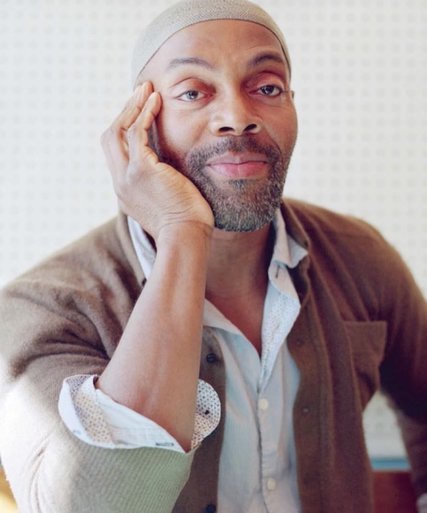
If you could look up “wonderful weirdo” in the 13th edition of The Chambers Dictionary of the Twentieth Century, I think you might very well find a photograph of Shel Silverstein.
Shel Silverstein (1930-1999), beloved children’s book author, poet, singer-songwriter, cartoonist, and screenwriter, has over 20 million books in print in 30 languages.
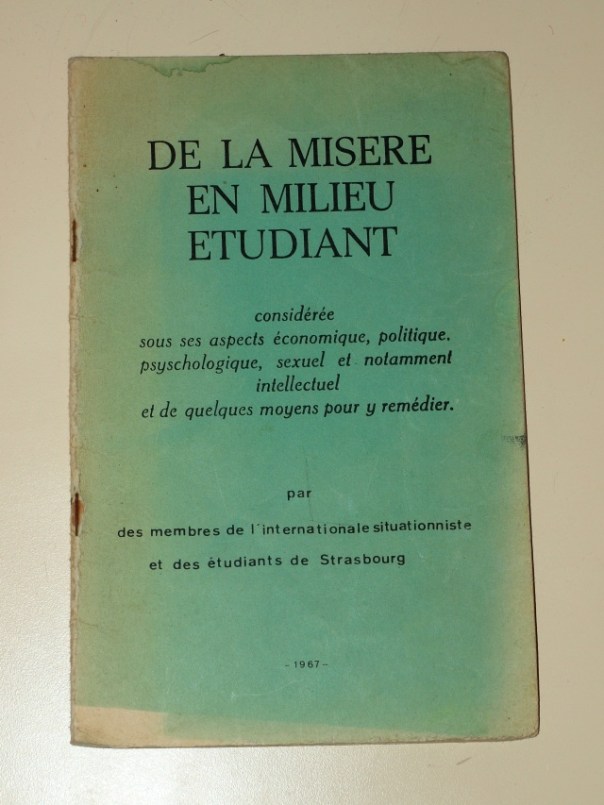
“On the Poverty of Student Life: A Consideration of Its Economic, Political, Sexual, Psychological and Notably Intellectual Aspects and of a Few Ways to Cure it … is a pamphlet first published by students of the University of Strasbourg and the Situationist International (SI) in 1966. Attacking the subservience of university students and the strategies of student radicals, it caused significant uproar, led to the dissemination of Situationist ideas, and precipitated the events of May 1968 in France. Taking advantage of the apathy of their colleagues, five ‘Pro-situs’, Situationist-influenced students had been elected to the University of Strasbourg’s students’ union in November 1966 and began scandalising the authorities. Their first action was to form an ‘anarchist appreciation society’ called The Society for the Rehabilitation for Karl Marx and Ravachol; next they appropriated union funds to flypost ‘Return of the Durruti Column’, André Bertrand’s détourned comic strip. They then…
“… How did the book come to be published by Ted Berrigan and C Press? For some reason, Ted liked my writing. The first thing he saw by me was a first-person novel called The Transfigured, which Lorenz Gude showed him in late 1961 or early 1962. He loved it, and we immediately became friends. In fact, I was welcomed into the ‘Tulsa circle’, so to speak, which at that time was headquartered in Ted’s apartment near Columbia University. By the time Ted started C Magazine, I was living in Vermont, and he wrote me saying I ought to come back to New York and join the fun. I did, and we immediately began Malgmo’s End. After he had published C Magazine for a while he wanted to do chapbooks and pamphlets, and so he put together Literary Days, which was the first C Press…
“Sam Shepard’s plays are performed on and off Broadway and in all the major regional American theatres. They are also widely performed and studied in Europe, particularly in Britain, Germany and France, finding both a popular and scholarly audience. A leader of the avant-garde in contemporary American theatre since his earliest work. Sam’s plays are not easy to categorize. They combine wild humor, grotesque satire, myth and a sparse, haunting language to present a subversive view of American life. His settings are often a kind of nowhere, notionally grounded in the dusty heart of the vast American Plains; his characters are typically loners, drifters caught between a mythical past and the mechanized present; his work often concerns deeply troubled families. Before he was thirty, Shepard had over thirty plays produced in New York. In his works Shepard has repeatedly examined the moral anomie and spiritual starvation that characterize the world…
“I first met the poet Frank O’Hara in the early 1990s. I was in the process of abandoning the writing program I was enrolled in at a local university for the much less muddied waters of the religious studies department; and, for his part, Frank had been dead for a little over twenty-five years. Frank O’Hara died at 8:50 p.m. on July 25, 1966 at Bayview General Hospital on Long Island. Mark Ford, editor of O’Hara’s Selected Poems (2008) [not to be confused by The Selected Poems of Frank O’Hara, 1974], succinctly describes the events of the previous evening, a night O’Hara spent with his friends Morris Golde, J. J. Mitchell, and Virgil Thomson clubbing on Fire Island. ‘The beach taxi in which he and his friend J. J. Mitchell were traveling broke down. As they waited for a replacement to arrive, a Jeep approaching from the opposite direction swerved…
“By the 1960s, San Francisco’s widespread racist employment patterns ushered in a series of social protest movements led by the city’s progressives aimed at promoting equal rights and job opportunities for African American residents of the city. The Civil Rights Movement was expanding northward after major protests in the American South where most of the African American population was concentrated at the time. African Americans were a minority in San Francisco, but racism limited job opportunities and had been prompted the creation in 1958 of a largely ineffective municipal Fair Employment Practices Committee. Among the local businesses in the Bay Area targeted for their discriminatory hiring practices was Mel’s Drive-In, a restaurant chain with locations in San Francisco and Berkeley co-owned by Mel Weiss and City Supervisor Harold Dobbs. The sit-in at Mel’s Drive-In garnered a large number of participants, from local college students to community activists, and became the…
Howard Zinn (left) and Daniel Berrigan (right) in Hanoi, Vietnam, in February 1968.
“A ‘rare act in the great madness of this war’ was how forty-five-year-old historian Howard Zinn described North Vietnam’s decision to release three American pilots during the Tet Offensive. Standing beside Jesuit priest, poet, and anti-war activist Daniel Berrigan in front of a room full of US reporters, Zinn read from one of his notebooks and declared their recent trip to Hanoi a success. The two anti-war activists met with the North Vietnamese government in February 1968 and helped transport the three prisoners back to the United States. The exchange was largely symbolic but was an extension of his radical internationalism and opposition to foreign wars. Reexamining his provocative trips behind enemy lines during the Vietnam War — on what would have been his hundredth birthday today — serves as a reminder that Zinn was both an…
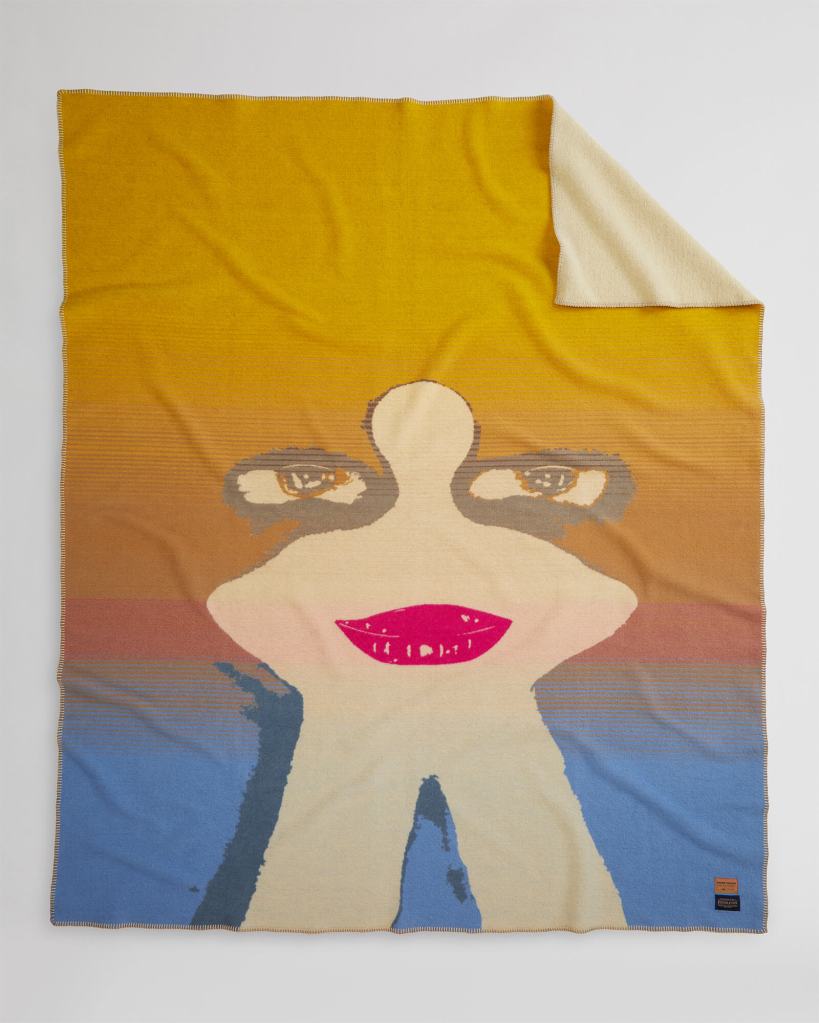
We are excited to once again work with renowned designer Andre Walker, as he brings his singular sense of style to the Pendleton looms for the very first time.
Walker imagined, painted and designed “Voice of the Body” in his Brooklyn-based studio with the desire to have it tangibly come to life, and invited Pendleton to transform his artwork for the loom.
The limited edition blanket feature a striking set of deep brown eyes, vibrant pink lips in fellowship with a pictogram-like figure overlaying a cornflower blue, tan and yolk gradient.
Inspiration for the “Voice of the Body” painting and blanket came from Walker thinking about God and existence. “It’s about the spirit in the gut of our intuition as it remains hopeful in our expression of the voice of the body,” explained Walker. He views the painting and blanket as a muse for the singularity of humanity’s…
“When a body of work is inherently made up of intricately layered themes and hidden caches of ideas, surmising the work as a whole can be extremely difficult. This is never more prescient than in the BFI’s release of six films by French film writer and director, Alain Robbe-Grillet; a seemingly missing link in French cinema of the 1960s and 1970s. His work is so ingrained within the era’s dismissal of formal ideas and overcoming paranoia over narrative conjecture that it’s surprising that his name is not bandied about in the same manner as Jean-Luc Godard, Agnès Varda, and Alain Resnais, but Robbe-Grillet’s work violently defies its role as a hyper-active pilot fish of the new wave. Robbe-Grillet may perhaps be best known for writing Resnais’ Last Year in Marienbad (1961) but his work as director begins to showcase the real ideas behind his role as…
Harvard law professor Laurence Tribe was interviewed by the Washington Post about the Supreme Court. His answers were very informative. He refers to the current Court as “the Thomas court.”
Do you consider the Supreme Court to be in crisis now?
Yes. I have no doubt that the court is at a point that is far more dangerous and damaging to the country than at any other point, probably, since Dred Scott. And, in a way, because we even find Justice [Clarence] Thomas going back and citing Dred Scott favorably in his opinion on firearms, the court is dragging the country back into a terrible, terrible time. So I think that it’s never been in greater danger or more dangerous….
You testified against [failed 1987 conservative Supreme Court nominee] Robert Bork a long time ago and alluded to the kind of vision that he would have brought had he…
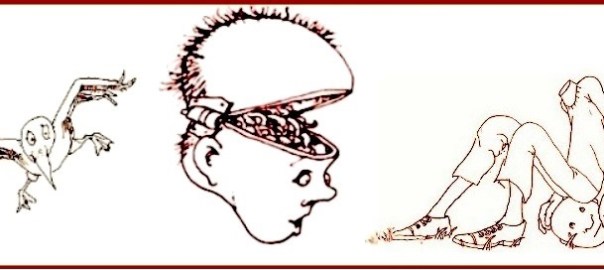


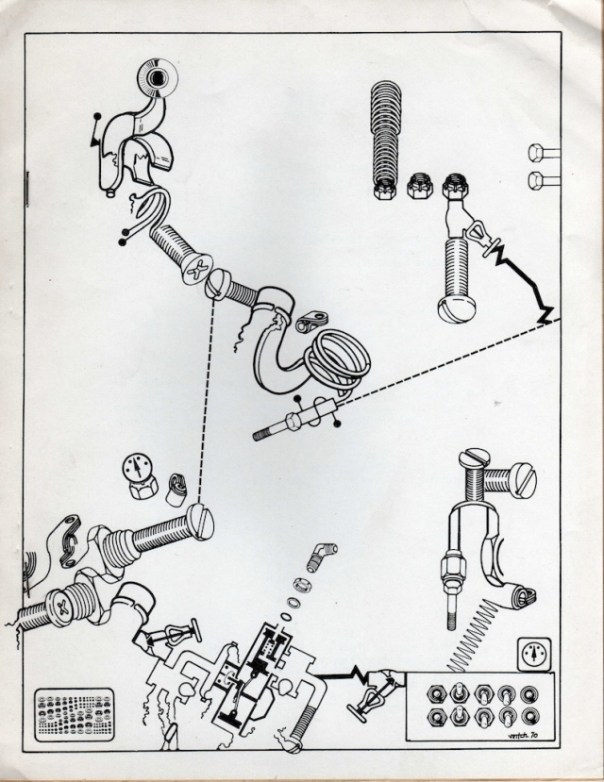 Tom Veitch Magazine #2