Jan Resseger: The Unfair Attack on Randi Weingarten and Unions in the New York Times

dianeravitch's avatarDiane Ravitch's blog

Last Sunday’s New York Times Magazine, the same publication that bravely published The 1619 Project, had a cover story about Randi Weingarten. It raised (and implied) the question of whether she is “the most dangerous person in the world.” The cover illustration had several placards, the most prominent saying “Stop Randi Weingarten.” My immediate thought, before reading the story, was that Randi’s life might be in danger, because the illustration and the title made her a target. This is no joke.

Randi has been a friend of mine for many years, and we don’t always agree. I have never persuaded her, and she has never persuaded me. We have had some strong arguments, but she’s still my friend. I believe passionately in the importance of unions, especially in a society with such deep economic inequality as ours. I wrote a letter to the editor about my objections to the article…

View original post 1,454 more words

Chicano Moratorium

1960s: Days of Rage's avatar1960s: Days of Rage

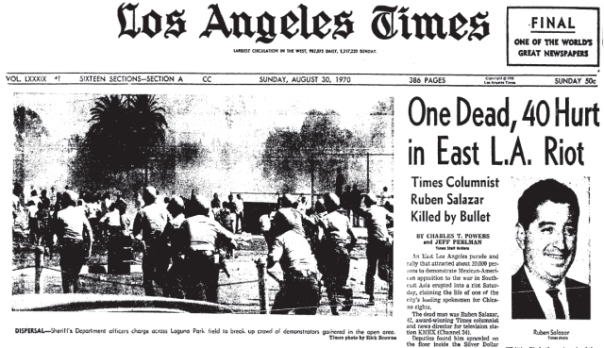
August 29, 1970: A Day Every Chicana/o Must Always Remember
“The Chicano Moratorium, formally known as the National Chicano Moratorium Committee Against The Vietnam War, was a movement of Chicanoanti-war activists that built a broad-based coalition of Mexican-American groups to organize opposition to the Vietnam War. Led by activists from local colleges and members of the Brown Berets, a group with roots in the high school student movement that staged walkouts in 1968, the coalition peaked with a August 29, 1970 march in East Los Angeles that drew 30,000 demonstrators. … The NCMC’s largest march took place on August 29, 1970 at Laguna Park (now Ruben F. Salazar Park). Between 20,000 and 30,000 participants, drawn from around the nation, marched down Whittier Boulevard in East Los Angeles. The rally was broken up by local police, who said that they had gotten reports that…

View original post 340 more words

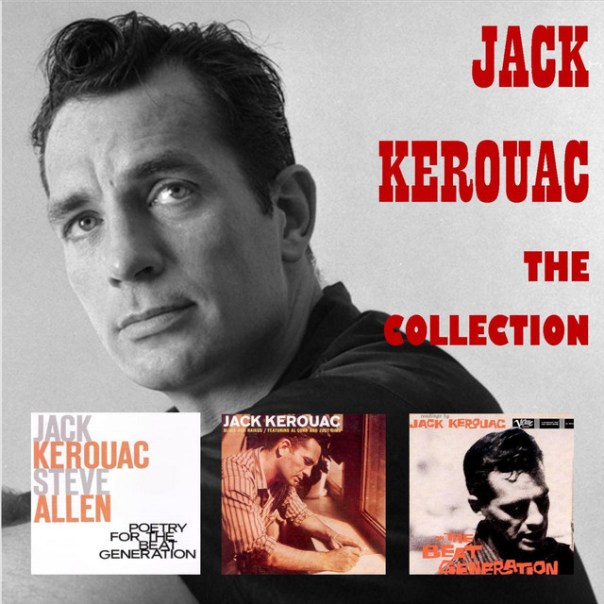
Hear All Three of Jack Kerouac’s Spoken-World Albums: A Sublime Union of Beat Literature and 1950s Jazz

1960s: Days of Rage's avatar1960s: Days of Rage


“At the epicenter of three explosive forces in 1950s America—the birth of Bebop, the spread of Buddhism through the counterculture, and Beat revolutionizing of poetry and prose—sat Jack Kerouac, though I don’t picture him ever sitting for very long. The rhythms that moved through him, through his verse and prose, are too fluid to come to rest. At the end of his life he sat… and drank, a mostly spent force. But in his prime, Kerouac was always on the move, over highways on those legendary road trips, or his fingers flying over the typewriter’s keys as he banged out the scroll manuscript of On the Road in three feverish weeks (so he said). After the publication of On the Road, Kerouac ‘became a celebrity,’ says Steve Allen in introduction to the Beat writer on a 1959 appearance, ‘partly because he’d written a powerful and successful book, but partly…

View original post 238 more words

TCS: Ada Limón’s Instructions on Not Giving Up

wordcloud9's avatarFlowers For Socrates

Good Morning!

_______________________

‘Love ends. But what if it doesn’t?’
Ada Limón, from “The Hurting Kind”

‘I want to give you something, or
I want to take something from you.
But I want to feel the exchange,
the warm hand on the shoulder,
the song coming out and the ear
holding onto it.’
 Ada Limon, U.S. Poet Laureate,
from “How Far Away We Are”

View original post 2,583 more words

the planning fallacy and the PhD

pat thomson's avatarpatter

Planning. We all have to do it to get by. A lot of us hate it. Many of us overdo it. Some of us are serial planners while others make a plan and then sigh as it slips past.

This post is for the planners who fail and the continual plan-adjusters. Some of the more successful planners might find it of interest, even if it only makes you feel better about your own relative prowess with the plan. It’s the first of a few on planning and this one’s about the PhD.

I guess you know there’s this thing called the planning fallacy. That’s when we make predictions about how much time something is going to take but underestimate the time. Sometimes what we are planning actually takes much longer to do than we thought. Our plan was wildly inaccurate. It gave us a false sense of being organised.

View original post 902 more words

Ash Grove

1960s: Days of Rage's avatar1960s: Days of Rage


“The Ash Grove was a folk music club located at 8162 Melrose Avenue in Los Angeles, California, United States, founded in 1958 by Ed Pearl and named after the Welsh folk song, ‘The Ash Grove.’ In its fifteen years of existence, the Ash Grove altered the music scene in Los Angeles and helped many artists find a West Coast audience. Bob Dylan recalled that, ‘I’d seen posters of folk shows at the Ash Grove and used to dream about playing there.’ The club was a locus of interaction between older folk and blues legends, such as Mississippi John Hurt, Son House, Earl Hooker and Muddy Waters, and young artists that produced the ‘Sixties music revolution. Among those Pearl brought to the Ash Grove were Canned Heat, Doc Watson, Pete Seeger, Bill Monroe, June Carter, Johnny Cash, Jose Feliciano,

View original post 216 more words

How Film Forum Became the Best Little Movie House in New York

1960s: Days of Rage's avatar1960s: Days of Rage

SoHo, NYC

“… Outside on West Houston Street, the glow of the marquee — ‘Film Forum’ written in curving, blue neon letters — beckons like a spaceship. Upon seeing it, I feel the thrill of catching a movie in an actual cinema: It’s my first visit to Film Forum since it reopened in 2021 following a nearly 13-month closure on account of Covid-19. In the lobby, there’s anticipatory chatter: film students talking into their phones and older Greenwich Village and SoHo locals (like me) discussing the state of the world. The reserved seating system — a measure instigated during the pandemic — ended this month, and the first-come-first-served rule resumed, bringing back with it the kvetching about grabbing a preferred seat. The theater director, filmmaker and painter André Gregory, a devout Film Forum fan, once left sweaters on a pair of chairs while he and his wife, the filmmaker Cindy…

View original post 183 more words

Diamonds Are Forever: Artists and Writers on Baseball; Baseball I Gave You All the Best Years of My Life; Into the Temple of Baseball

1960s: Days of Rage's avatar1960s: Days of Rage


“… I ended up with exactly that, an immaculate gem of a book. The book is called Diamonds are Forever: Artists and Writers on Baseball and, just as the title suggests, it’s a rich collection of artwork, poetry, and essays on the eternal aura of the game of baseball. It’s a pretty large book, soft-cover but the size of an art book or so-called ‘coffee table’ book (I’ve never owned a coffee table but I’ve got a bunch of these type of books) and it was published by Chronicle Books, a San Francisco-based publisher who seems to produce just about every highly awesome artsy book I come across. … The apparent polar opposite of most of the baseball literature I read which contains lots of stats and objective analysis, this is an aesthetic appraisal of the game’s archetypal and timeless aspects. I’ve been buried in it for the last couple…

View original post 194 more words

Craft Vs. Conscience: How the Vietnam War destroyed the friendship between Robert Duncan and Denise Levertov.

1960s: Days of Rage's avatar1960s: Days of Rage


1. One day in early September 1966, the poet Robert Duncan, then 47, was walking to a streetcar stop in San Francisco when lines of verse began drifting to him out of nowhere. He held onto the phrases until he could scribble them down at the stop. The rest of what would become two poems—’Passages’ 28 and 29—occurred ‘in rushes on the streetcar and on the Berkeley bus, me muttering ecstatically. All there by the time I reacht Berkeley.’  These poems would appear toward the end of what may be Duncan’s finest book, Bending the Bow (1968), which was written largely in response to the Vietnam War. He laid out their impetus in a letter to one of his dearest friends, Denise Levertov: he had been dwelling on Victor Hugo’s visionary poem in which the angel Liberty is born from a single feather falling from Satan’s wings as…

View original post 200 more words

James Harvey: How We Cooked the Books to Produce a Deeply Flawed “A Nation at Risk”

dianeravitch's avatarDiane Ravitch's blog

This is the 40th anniversary of the Reagan-era report called “A Nation at Risk.” The report was immediately hailed as a “landmark,” blasting the quality of the nation’s public schools. President Reagan wanted the report to endorse school prayer and vouchers. It didn’t. But it castigated the nation’s public schools as failures and complained about their low standards and mediocrity. The report had a dramatic effect. States reacted with commissions and plans to raise standards and toughen tests.

James Harvey, a member of the staff that wrote the report, argues that the misleading rhetoric, diagnosis, and recommendations of the “Nation at Risk” report led to an obsession with test scores, undermined vocational education, and cemented the simplistic mindset that produced “No Child Left Behind” and “Race to the Top,” while ignoring the serious social and economic conditions that hinder children’s lives. Even today’s culture wars targeting the schools can be…

View original post 2,863 more words