Paul Bonner: How to Build Public Trust in Public Schools

dianeravitch's avatarDiane Ravitch's blog

Paul Bonner is a retired teacher and principal. He suggests a way to undermine the complaints about CRT, WOKE, and other scarecrows.

Perhaps the greatest injustice of all of this sound and fury for nothing, is that few of the individuals who are the most outspoken concerning cultural disinformation have set foot in a school in the last decade, much less observed or engaged in classroom instruction. Most of the right wing celebrities who profit from all of this noise send their children to private schools. Well intentioned policy makers and Washington politicians also opt for private schools when they are available. It is my experience that when school officials open their doors the reception from the public is very positive. I was principal of an elementary school where my predecessors actually barred members of the community from the building. There was a metal pull down door at the front…

View original post 264 more words

WSJ: A Day in the Life of Jeffrey Epstein

dianeravitch's avatarDiane Ravitch's blog

Jeffrey Epstein, sexual predator and child abuser, became a very rich man as a financial advisor to the rich and famous. When he died awaiting trial, he was allegedly worth $600 million. His estate paid off claims to more than 100 women whom he had abused.

Due to his notoriety and his many powerful friends, he continues to be a fascinating figure. The Wall Street Journal somehow obtained his daily diaries and has written several stories about his interactions with his important friends.

This one was published a few weeks ago in the Wall Street Journsl:

On Monday, Sept. 8, 2014, Jeffrey Epstein had a full calendar. He was scheduled to meet that day with Bill Gates, Thomas Pritzker, Leon Black and Mortimer Zuckerman, four of the richest men in the country, according to schedules and emails reviewed by The Wall Street Journal.

Epstein also planned meetings that day with…

View original post 1,186 more words

Paul Schrader Creates a Diagram Mapping the Progression of Arthouse Cinema: Ozu, Bresson, Tarkovsky & Other Auteurs

1960s: Days of Rage's avatar1960s: Days of Rage


“The dozens of filmmakers in the diagram above belong to a variety of cultures and eras, but what do they have in common? Some of the names that jump out at even the casual filmgoer — Andrei Tarkovsky, Jim Jarmusch, Pier Paolo Pasolini, Terrence Malick — may suggest a straightforward connection: cinephiles love them. Of course, not every cinephile loves every one of these directors, and indeed, bitter cinephile arguments rage about their relative merits even as we speak. But in one way or another, all of them are taken seriously as auteurs by those who take film seriously as an art form — and not least by Paul Schrader, one of the most serious auteur-cinephiles alive. Schrader first made his name as a film critic, with his 1972 book Transcendental Style in Film: Ozu, Bresson, Dreyer. In it he argues that the work of Yasujirō Ozu,

View original post 192 more words

Movie Poster of the Week: The Posters of Francesco Rosi

1960s: Days of Rage's avatar1960s: Days of Rage


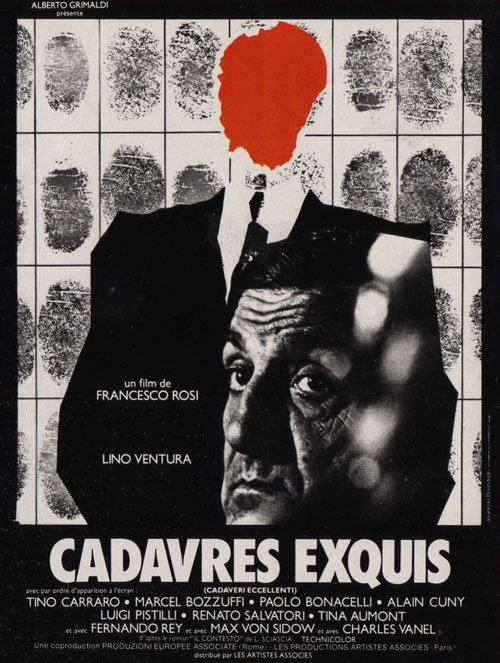
“An essential retrospective has just started at BAMcinématek in New York of the films of the great Italian chronicler of crime and punishment (or lack of), Francesco Rosi. One of the least talked about of the great Italian directors, Rosi, now aged 88, has been making films since the late 1950s and is mostly known for his canonical Salvatore Giuliano (1962). Both that film and its superb follow-up Hands Over the City (1963) are available from Criterion, but there is precious little else available here. (One exception is Illustrious Corpses, my favorite Rosi film, illustrated above with its French poster, which I only just discovered is streamable on Netflix under the name The Context and, sadly, dubbed. I highly recommend ignoring that and seeing the film on screen on August 20th, along with the rest of this unmissable series.) The best Rosi posters come from all over the globe, and though…

View original post 104 more words

Story structure 2 – research writing

pat thomson's avatarpatter

How is writing research like story? Last post I wrote about Kurt Vonnegut’s man in hole structure and how that might help you think at a very macro level about how to organise your material. This post is also about structure – this time a four part structure I’ve called C3REC.

The C3REC structure is an academic writing version of the creative writing ERCR.

Well who doesn’t love an impossible acroynym… C3REC is no easier to say than ERCR. But let’s go back to the original ERCR. Put simply ERCR means Exposition, Rising action, Climax and Resolution.

ERCR goes like this: Exposition is all the stuff you, the reader, needs to know before you start the story proper. Next the Rising Action – that’s where the writer offers you a series of events – this then this then this. And all of the this then this then this builds up…

View original post 724 more words

Memorial Day: Dangers to Our Democracy

dianeravitch's avatarDiane Ravitch's blog

Memorial Day is a day to remember and pay tribute to the men and women who gave their lives to defend our democracy. Because of their sacrifice, we enjoy our freedoms. We are called upon not only to respect them and their sacrifices, but to be alert to today’s threats to the freedoms and rights we treasure. Voting rights are under attack. Censorship and book banning are on the rise. Red state legislatures are trying to control the blue cities in their midst. Red state legislatures are passing cookie-cutter laws to fund private and religious schools despite the opposition of the public. A woman’s right to control her body has been eliminated by red states. In a sad irony, the U.S. Supreme Court—which has long been the ultimate defender of our rights—is eroding democracy, under the control of rightwing ideologues, three of whom were appointed by Trump after being chosen…

View original post 556 more words

Canterbury scene

1960s: Days of Rage's avatar1960s: Days of Rage


“The Canterbury scene (or Canterbury sound) was a musical scene centred on the city of Canterbury, Kent, England during the late 1960s and early 1970s. Associated with progressive rock, the term describes a loosely-defined, improvisational style that blended elements of jazz, rock, and psychedelia. These musicians played together in numerous bands, with ever-changing and overlapping personnel, creating some similarities in their musical output. Many prominent British avant-garde or fusion musicians began their career in Canterbury bands, including Hugh Hopper, Steve Hillage, Dave Stewart (the keyboardist), Robert Wyatt, Kevin Ayers, Daevid Allen, and Mike Ratledge. The Canterbury scene is largely defined by a set of musicians and bands with intertwined members. These are not tied by very strong musical similarities, but a certain whimsicality, touches of psychedelia, rather abstruse lyrics, and a use of improvisation derived from jazz

View original post 211 more words

Who’s Who On The Beatles’ ‘Sgt. Pepper’s Lonely Hearts Club Band’ Album Cover

1960s: Days of Rage's avatar1960s: Days of Rage


The Beatles Sgt. Pepper’s Lonely Hearts Club Band remains the most iconic album cover of all time. From Paul McCartney’s original concept to the final design, staged by British pop artist Peter Blake and his then-wife, Jann Haworth, it’s not just an album cover, but a dazzling display of modern art that defines its era. Not only a groundbreaking design for the time, the artwork also broke the bank, costing almost £3,000 to create – well over £50,000 in today’s money and more than any other pop album sleeve at that time. The concept was for the four Beatles themselves to appear in costume as Sgt. Pepper’s Lonely Hearts Club Band, surrounded by a gathering of influential people as if they had just performed a concert. A total of 58 different people are depicted on the final artwork, which was photographed by ​Michael Cooper. As Peter Blake…

View original post 166 more words

Blood On His Hands: Henry Kissinger

1960s: Days of Rage's avatar1960s: Days of Rage

May 23 2023:TA SOUS, Cambodia — At the end of a dusty path snaking through rice paddies lives a woman who survived multiple U.S. airstrikes as a child. Round-faced and just over 5 feet tall in plastic sandals, Meas Lorn lost an older brother to a helicopter gunship attack and an uncle and cousins to artillery fire. For decades, one question haunted her: ‘I still wonder why those aircraft always attacked in this area. Why did they drop bombs here?’ The U.S. carpet bombing of Cambodia between 1969 and 1973 has been well documented, but its architect, former national security adviser and Secretary of State Henry Kissinger, who will turn 100 on Saturday, bears responsibility for more violence than has been previously reported. An investigation by The Intercept provides evidence of previously unreported attacks that killed or wounded hundreds of Cambodian civilians during Kissinger’s tenure in the…

View original post 239 more words