The Telephone Call, 1974 by Tricia Marcella Cimera (I AM STILL WAITING Series)

silverbirchpress's avatarSilver Birch Press

john rehgThe Telephone Call, 1974
by Tricia Marcella Cimera

I am ten years old, sitting
on my bed with the Snoopy sheets,
surrounded by my Breyer horses.
My mother is in her room,
sleeping with her eyes open,
a glass of water on the nightstand.
She’s back from the psychiatric ward,
for the second time after another
week’s stay. I don’t know her;
I love her helplessly.
I can hear my father in his office
speaking on his black telephone
to my grandmother who lives
in another state. He calls her
by her first name, says
Please come. Please come.
I don’t know his voice, never heard
him plead before. There is a long
silence, then he hangs up.
Suddenly I feel like I am getting
smaller, becoming tiny, no one’s
girl. I want to ride away
on one of my Breyer horses.
Almost 47 years later, I am still
waiting…

View original post 351 more words

Why I Support Public Education

tultican's avatartultican

By Thomas Ultican 3/29/2021

The original cause for my supporting public education was that my rancher father married a school teacher. Growing up in southern Idaho, I learned many philosophical and theoretical reasons for supporting the establishment and maintenance of public schools from my mother. However, it was from watching mom and her dedicated colleagues in action that I learned to truly respect and appreciate public school.

I remember stories of my father being warned that he better not treat that woman wrong. For several years in a row she won the Elmore County sharp shooting contest. She didn’t like to chop a chicken’s head off so she would pull out her rifle and shoot it off.

Mom had some old school attitudes but maintained a mind of her own. There was a period in which she had to come home at lunch time and milk the cow. One Friday…

View original post 1,360 more words

Waiting for Home by Martina Gallegos (I AM STILL WAITING Series)

silverbirchpress's avatarSilver Birch Press

bungalow-1987Waiting for Home
by Martina Gallegos

Until the beginning of my teen years, I lived with my family in a modest two-bedroom, one small kitchen my parents built after marriage. Originally, our home was only one bedroom and no kitchen. We had no restroom either, and we took care of our business practically in the open, only to be ridiculed by our two-story home neighbors.

Eventually, mom divided our one bedroom into two and asked someone to build another bedroom to her specifications, and that, in turn, became dad’s bedroom, and I felt sad that my parents were in different bedrooms and no longer telling us bedtime stories, and I kept waiting for the day we could all share the same bedroom again.

Many times, I despaired when I saw that other families had parties and lots of good food my family didn’t and would never have, and I wanted…

View original post 272 more words

My Wife Says—by Shahé Mankerian (I AM STILL WAITING Series)

silverbirchpress's avatarSilver Birch Press

hokusai plumMy Wife Says—
by Shahé Mankerian

In your poems, you remember the kiss
your mother gave you under a loquat tree.

Pressed between stanzas, a blind dog
hides in the residue of a demitasse.

In the melted snow of Mount Ararat,
you always trace the face of God.

You’d rather describe death by skewers
in the sewers of Beirut than kiss me

in a steamy sonnet beneath the stained-
glass gown of the Virgin. I don’t need

morning walks on Champs-Élysées
or a blue heart pendant from Tiffany’s.

My needs are minimal like a haiku.
I’m still waiting for a poem, a pristine plum,

like the kind William Carlos Williams
stole from the fridge—so sweet and cold.

PAINTING:Plum Blossoms and Moon by Katshushika Hokusai (1803).

NOTE FROM THE AUTHOR: I’ve always loved and admired Charles Bukowski’s poem “one for old snaggle-tooth.” It’s an exquisitely vulnerable love poem dedicated to…

View original post 103 more words

required, desirable and delightful elements of academic writing

pat thomson's avatarpatter

This is the time of year that I run writing workshops and courses. And because I’m preoccupied with teaching, I’m also thinking about new and different strategies for authoring and revision. Authoring and revision strategies are inter-related – heuristics used for authoring can often be converted for revision purposes and vice versa.

I sometimes find inspiration for teaching in surprising places. Like the design literatures. This post features a modification of a tool used by designers to prioritise the features and attributes of an artefact and to assess potential user satisfaction. Meet the Kano Analysis.

Kano Analysis is a tool designers use instead of, or as well as, a cost-benefit analysis. I was initially interested in KA because one of its concerns is delight. Designers assess an artefact not simply on essentials such as durability, utility and ease of use, but also on whether it somehow pleases/excites the potential user.

View original post 1,139 more words

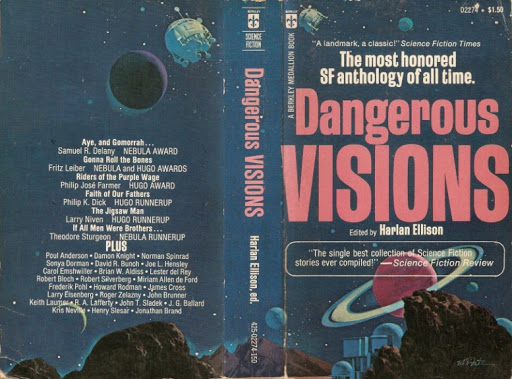
Dangerous Visions – Harlan Ellison (1967 – Editor)

1960s: Days of Rage's avatar1960s: Days of Rage


Dangerous Visions is a science fictionshort storyanthology edited by American writer Harlan Ellison and illustrated by Leo and Diane Dillon. It was published in 1967. A path-breaking collection, Dangerous Visions helped define the New Wave science fiction movement, particularly in its depiction of sex in science fiction. Writer/editor Al Sarrantonio writes how Dangerous Visions ‘almost single-handedly […] changed the way readers thought about science fiction.’ Contributors to the volume included 20 authors who had won, or would win, a Hugo, Nebula, World Fantasy, or BSFA award, and 16 with multiple such awards. Ellison introduced the anthology both collectively and individually while authors provided afterwords to their own stories. Advertisements described Dangerous Visions as ‘For the first time anywhere—33 great new stories by all the science fiction masters of our time’, and ‘Not collected from magazines, not collected from other books ……

View original post 325 more words

What Is a Poem?

wordcloud9's avatarFlowers For Socrates

Happy Birthday to Annie Dillard, born April 30, 1945

Annie Dillard is an American author, best known for her book Pilgrim at Tinker Creek, which won the 1975 Pulitzer Prize for General Nonfiction. While she is better known for her prose works – essays, literary criticism, and narratives often based on her journals, she also writes poetry.

Defining poetry was a lot easier up until the late 19th Century. The advent of “Modern Poetry” and “free verse” has considerably opened the field, but has also caused confusion among people more accustomed to rhymed iambic pentameter.

So a “found poem” gets really controversial. It is a prose text written by one author which struck a different author as poetical, so they then edited and sometimes rearranged the original text to turn it into a poem. Annie Dillard published a whole book of them, called Mornings Like This: Found Poems.

View original post 398 more words

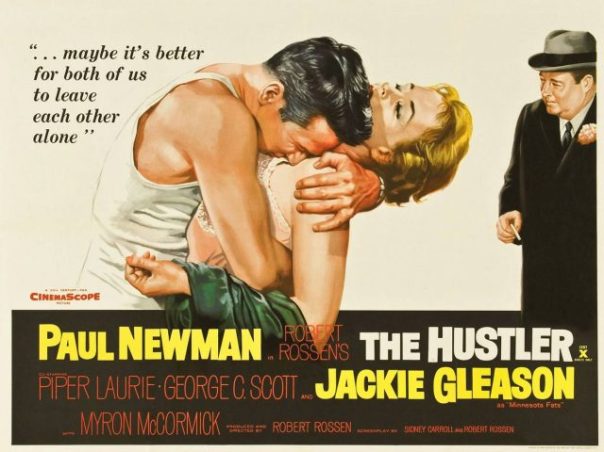
The Hustler – Robert Rossen (1961)

1960s: Days of Rage's avatar1960s: Days of Rage


The Hustler is a 1961 American CinemaScopedrama film directed by Robert Rossen from Walter Tevis‘s 1959 novel of the same name, adapted for the screen by Rossen and Sidney Carroll. It tells the story of small-time pool hustler ‘Fast’ Eddie Felson and his desire to break into the ‘major league’ of professional hustling and high-stakes wagering by high-rollers that follows it. He throws his raw talent and ambition up against the best player in the country, seeking to best the legendary pool player ‘Minnesota Fats‘. After initially losing to Fats and getting involved with unscrupulous manager Bert Gordon, Eddie returns to try again, but only after paying a terrible personal price. The film was shot on location in New York City and stars Paul Newman as ‘Fast’ Eddie Felson; Jackie Gleason as Minnesota Fats; Piper Laurie as Sarah; and George C. Scott

View original post 394 more words

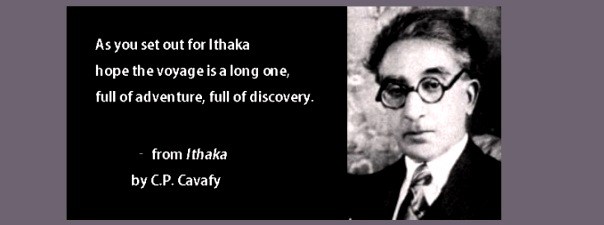
C.P. Cavafy – “Things impolitic and dangerous”

wordcloud9's avatarFlowers For Socrates

C.P. Cavafy (April 29, 1863 – April 29, 1933) the most distinguished and highly influential modern Greek poet, who never lived in Greece, whose work had been ridiculed and rejected early in the last century by the Athenian literati, then almost forgotten by Greece until publication of an anthology of his poems in 1935, two years after his death. He was born in Alexandria, Egypt, which he first left at age nine after his father died, and his mother moved their large brood to Liverpool so his elder brothers could run the family import business, a time when Cavafy learned English and discovered Shakespeare, Robert Browning, and Oscar Wilde. These years influenced his choice of the Anglicized “Cavafy” as his pen name. When he was sixteen, the business failed, and the family returned, in debt-ridden gentility, to the Greek community in Alexandria. He was exiled again when he was nineteen…

View original post 666 more words

“The Death of the Author” – Roland Barthes (1967)

1960s: Days of Rage's avatar1960s: Days of Rage


Ecclesiastes famously warns us that ‘Of making many books there is no end’ – the same, of course, applies to book commentaries. George Steiner has long denounced the ‘mandarin madness of secondary discourse’ which increasingly interposes itself between readers and works of fiction. For better or worse, the internet – with its myriad book sites – has taken this phenomenon to a whole new level. Since Aristotle’s Poetics, literature has always given rise to its exegesis, but now that no scrap of literary gossip goes untweeted, it may be time to reflect a little on the activity of literary criticism. I have chosen to inaugurate this series with a few considerations on ‘The Death of the Author’ because of its truly iconic nature: it symbolises the rise of what would come to be known as “theory”. Even if he never names them, Roland Barthes (like Proust before…

View original post 389 more words