New Hampshire: Majority of Governor’s Diversity Council Resigns in Protest

dianeravitch's avatarDiane Ravitch's blog

New Hampshire’s Republican legislature passed a bill banning teaching about racism, and Governor Chris Sununu signed it. The bill also included funding for vouchers and cuts for public schools.

Ten of the 17 members of the governor’s Diversity Council resigned in protest, citing censorship.

“It should not be taken lightly that nearly every member of the Council that is not part of your administration is resigning today, as we collectively see no path forward with this legislation in place,” the resigning members wrote in their letter to Sununu. The group includes the executive director of the New Hampshire ACLU, educators, doctors and children’s advocates. 

Sununu established the council in 2017, with a mission to “combat discrimination and advance the ends of diversity and inclusion.”

Last week, he signed House Bill 2, a policy-focused “trailer bill” that passed along party lines in the GOP-controlled legislature. Among other provisions, the…

View original post 86 more words

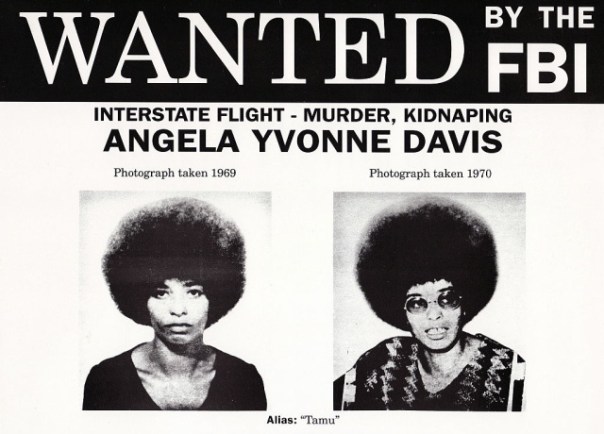
During the 1971 Prosecution of Angela Davis, I Fought the Law — And I Won

1960s: Days of Rage's avatar1960s: Days of Rage


February 1971 issue of Ramparts magazine: “It was 1971 and, being young, single, a political activist, and a New Yorker, I wasn’t home much at my third-floor walkup in Greenwich Village except to sleep. One night in March, my across-the-hall neighbor poked her head out of her apartment to nervously tell me that ‘federal marshals’ had been trying all day to find me. I couldn’t think why the feds wanted to talk to me but figured it couldn’t be anything good. So, the next morning, I packed a couple of things and moved into Susan Sontag’s vacant apartment on the Upper West Side for a few days. Susan and I had become close friends after being invited guests in Havana for the Cuban Revolution’s tenth anniversary celebrations in 1969. I had nowhere near her intellectual firepower — not many did — but I held my own with her in political…

View original post 410 more words

Trash, art, and the movies – Pauline Kael (1969)

1960s: Days of Rage's avatar1960s: Days of Rage


“Like those cynical heroes who were idealists before they discovered that the world was more rotten than they had been led to expect, we’re just about all of us displaced persons, ‘a long way from home.’ When we feel defeated, when we imagine we could now perhaps settle for home and what it represents, that home no longer exists. But there are movie houses. In whatever city we find ourselves we can duck into a theatre and see on the screen our familiars — our old ‘ideals’ aging as we are and no longer looking so ideal. Where could we better stoke the fires of our masochism than at rotten movies in gaudy seedy picture palaces in cities that run together, movies and anonymity a common denominator. Movies — a tawdry corrupt art for a tawdry corrupt world — fit the way we feel. The world doesn’t work the way…

View original post 363 more words

TCS: Reaching Out Into the World – Floyd Dell, Socialist

wordcloud9's avatarFlowers For Socrates

Good Morning!

______________________________

Welcome to The Coffee Shop, just for you early risers
on Monday mornings. This is an Open Thread forum,
so if you have an off-topic opinion burning a hole in
your brainpan, feel free to add a comment.

______________________________

Feminism is going to make it possible for the first time
for men to be free. At present the ordinary man has the
choice between being a slave and a scoundrel. That’s

about the way it stands.

– Floyd Dell, Feminism for Men (1914)

View original post 1,349 more words

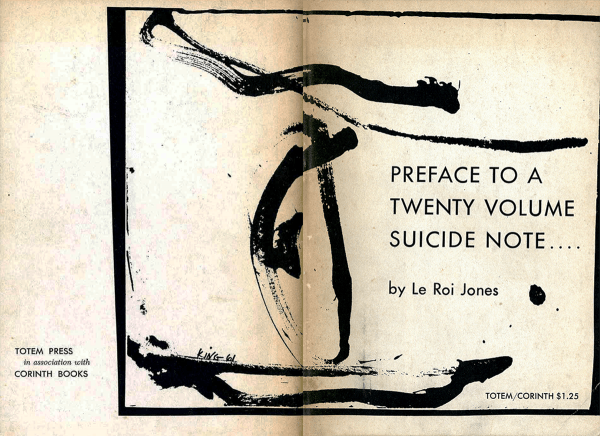
Preface to a Twenty Volume Suicide Note…. LeRoi Jones/Amiri Baraka (1961)

1960s: Days of Rage's avatar1960s: Days of Rage


“… An Introduction by William J. Harris. I am so delighted that Poets House’s online series Chapbooks of the Mimeo Revolution is making Amiri Baraka’s first book, Preface to a Twenty Volume Suicide Note …., available again in its totality. This splendid small volume loses so much by being selected. It isn’t so much that it is a unified whole but all of its parts together create a complex portrait of a young Black bohemian trying to find his way and himself. The book was published in 1961 by Baraka’s own Totem Press in association with the maverick book dealer Ted Wilentz’s Corinth Books. At the time of publication Baraka was still LeRoi Jones. Almost twenty-seven, editor of the influential avant-garde magazine Yugen, married to his co-editor Hettie Jones, a white Jewish woman, and living on the Lower East Side of Manhattan, he was a central figure of…

View original post 354 more words

4th Grade Teacher: Remote Learning Was a Disaster

dianeravitch's avatarDiane Ravitch's blog

Lelac Almagor teaches fourth grade in a charter school in Washington, D.C. The following article appeared in the New York Times.

She writes:

Our prepandemic public school system was imperfect, surely, clumsy and test-crazed and plagued with inequities. But it was also a little miraculous: a place where children from different backgrounds could stow their backpacks in adjacent cubbies, sit in a circle and learn in community.

At the diverse Washington, D.C., public charter school where I teach, and which my 6-year-old attends, the whole point was that our families chose to do it together — knowing that it meant we would be grappling with our differences and biases well before our children could tie their own shoes.

Then Covid hit, and overnight these school communities fragmented and segregated. The wealthiest parents snapped up teachers for “microschools,” reviving the Victorian custom of hiring a governess and a music master. Others…

View original post 812 more words

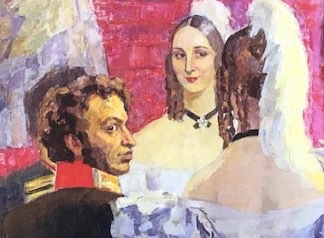
A Tribute to 1820s and 1830s Fiction, Including ‘Eugene Onegin’

Dave Astor's avatarDave Astor on Literature

From the cover of the Eugene Onegin edition I read.

When we look at literature from the first half of the 19th century, the 1810s and the 1840s first come to mind.

The 1810s of course saw the publication of all six classic Jane Austen novels, Mary Shelley’s Frankenstein, and well-known Sir Walter Scott works such as Rob Roy and Ivanhoe (the latter released in very late 1819), to name nine memorable books. The 1840s offered a bonanza of famous novels such as those by the Bronte sisters (including Jane Eyre and Wuthering Heights), Charles Dickens (including David Copperfield and A Christmas Carol), Alexandre Dumas (including The Count of Monte Cristo and The Three Musketeers), Nikolai Gogol (Dead Souls), William Thackeray (Vanity Fair), and Herman Melville (Typee, etc.).

The in-between 1820s and 1830s stand out less in the fiction realm…

View original post 376 more words

The Monster

Nan's avatarNan's Notebook

man-spooky-pumpkin-halloween-darkness-blue-1408181-pxhere.com

Remember my recent post entitled, “A Crazy Idea”? Well look at what Susan Collins (R-ME) said as related to voting rights during the For the People Act discussion:

“S1 would take away the rights of people in each of the 50 states to determine which election rules work best for their citizens.”

As Heather Cox Richardson commented in her most recent newsletter: Republicans insist that federal protection of voting rights is federal overreach; that the states should be in charge of their own voting rules.

(“The states,” of course, meaning the Republican-led states.)

It just seems so apparent to me that Republicans propose and vote for any and all measures that will benefit them and their states; whereas Democrats tend to approach government from a more egalitarian perspective. (This isn’t to say that everything they propose is going to be applauded by the nation as a whole, but…

View original post 179 more words

Out, Alone by Maria Nestorides (I AM STILL WAITING Series)

silverbirchpress's avatarSilver Birch Press

walking-woman-1949
Out, Alone
by Maria Nestorides

It’s a balmy spring afternoon
and I’m on my way to the craft shop
where I’ve booked a class
to make a heart-shaped wreath for my wall.
And I am still waiting…

I park my car wherever I find a spot,
but this is New York City, and
I need a good five minutes to walk to the shop.
A group of young men are huddled together
outside a shop, laughing and joking.
Ask any woman you know. These men
could be as harmless as a bee in the middle
of the ocean, but
to a lone woman, a group of men being loud
and raucous is a clear and present danger.
And I am still waiting…

Alert sounds scream in my mind,
my flight or fight signals are going crazy.
Adrenaline rushes through my body,
preparing me to do whatever I need to do—fast.

View original post 324 more words

The U.S. Has a Long History of Banning Controversial Topics and Blaming Teachers

dianeravitch's avatarDiane Ravitch's blog

Historians Gillian Frank and Adam Laats write in Slate about the long history of suppressing textbooks that discuss race and class and investigating or firing teachers who veer away from the standard patriotic view of American history.

They describe the classic story of the textbook series written by progressive educator Harold Rugg of Teachers College, Columbia. Rugg wanted students to learn about the social, economic and political problems of contemporary society in the 1930s. His books were widely adopted but fell victim to a rightwing campaign that labeled them as socialist or Communist, which they were not. The campaign was successful, and the Rugg books were ousted from classrooms across the nation.

The authors tie the current efforts to ban critical race theory (taught in law school) and The 1619 Project from being taught in schools to this long tradition of avoiding controversial subjects.

There is an even longer tradition…

View original post 73 more words