Paradise Now: The Living Theatre in Amerika, ’67-’68

1960s: Days of Rage's avatar1960s: Days of Rage


“In 1968 The Living Theatre, an anarcho-communalist troupe led by Julian Beck and Judith Malina, returned to America from years of self-imposed exile in Europe with what would become their best-known production: ‘Paradise Now,’ a post-Artaud play that sought to completely dissolve the boundaries of human interactions through a practice of live collective creation, forging a revolutionary harmony between actors and audience. ‘The purpose of the play is to lead to a state of being in which non-violent revolutionary action is possible,’ wrote Julian, and he meant it. What happened each night onstage-and offstage, and then out into the streets-was a series of purposefully provocative and interventionist actions, from marijuana smoking and full-body group nudity to screamed declarations, intense arguments, dance and (yes) orgies, sometimes involving audience members. They attracted the attention of the police, the derision of mainstream critics, and the devotion of many, including The Doors’ Jim Morrison…

View original post 163 more words

California: Culver City School District is First in State to Require All Eligible Students to Be Vaccinated

dianeravitch's avatarDiane Ravitch's blog

A sign of sanity, common sense, and responsibility: Culver City schools require all eligible students to be vaccinated. Superintendent estimates that about 1 in 20 parents object. Why should their objection override the public health of all students?

The Culver City Unified School District has issued a COVID-19 vaccine requirement for all eligible students — believed to be the first such requirement in California — a move the district superintendent said has the overwhelming support of parents, teachers and staff.
Currently, children 12 and older are eligible for the COVID-19 vaccine, which remains under emergency use authorization by the Federal Drug Administration. The Culver City requirement has a Nov. 19 deadline, and district officials hope the vaccine will have received full FDA approval by then.


California has ordered all K-12 school employees to be vaccinated or submit to weekly coronavirus testing — and a growing number of school districts, including…

View original post 99 more words

A Tribute to the Great Mike Rose

dianeravitch's avatarDiane Ravitch's blog

I received a notice a few days ago from a scholarly organization, informing me that Mike Rose had died. Mike was a beloved teacher, scholar, and author. He had keen empathy for working people. He taught at UCLA. I met him a decade ago, and we became friends. You may have met him through such books as Lives on the Boundary, or Why School?, or Possible Lives.

Other people knew Mike far better than I, and I invite you to read what they wrote about him.

His literary agent, Anna Sproul-Latimer, who worked with Mike on his latest book, wrote a deeply personal article about him.

She wrote, as part of a longer piece:

Five days ago, just hours before what was probably going to be the last of our four editor meetings, my beloved client Mike Rose dropped dead. He woke up at dawn, sent me a…

View original post 542 more words

Gene Ammons / Sonny Stitt – Boss Tenors: Straight Ahead From Chicago August 1961

1960s: Days of Rage's avatar1960s: Days of Rage

“Tenor saxophonists Gene Ammons and Sonny Stitt co-led a small group in 1950, and this follow-up, taped in the studio in 1961, finds the two picking up where they left off. The highlight of the date is the jointly written ‘Blues up and Down,’ a classic jam which has since inspired a number of other tenor match ups to record it, especially Eddie “Lockjaw” Davis and Johnny Griffin. Ammons‘ repetitious one-note melody within ‘The One Before This,’ like Duke Ellington‘s deceptively simple two-note theme ‘C Jam Blues,’ leads to some inspired improvising by both men. Stitt switches to alto sax for a loping take of ‘There Is No Greater Love,’ during which Ammons‘ tenor provides the perfect foil. The rhythm section includes bassist Buster Williams, along with the somewhat obscure pianist John Houston and drummer George Brown. This rewarding date has become hard to…

View original post 41 more words

TCS: Clearing the Clouded Brain – Seven Poets

wordcloud9's avatarFlowers For Socrates

. . . .Good Morning!

______________________________

Welcome to The Coffee Shop, just for you early risers
on Monday mornings. This is an Open Thread forum,
so if you have an off-topic opinion burning a hole in
your brainpan, feel free to add a comment.

______________________________

Ten thousand flowers in spring,
the moon in autumn,
a cool breeze in summer,

snow in winter –
if your mind is not clouded

by unnecessary things, this is
the best season of your life.

– Sharon Salzberg

View original post 2,365 more words

Carolee Schneemann (October 12, 1939 – March 6, 2019)

1960s: Days of Rage's avatar1960s: Days of Rage

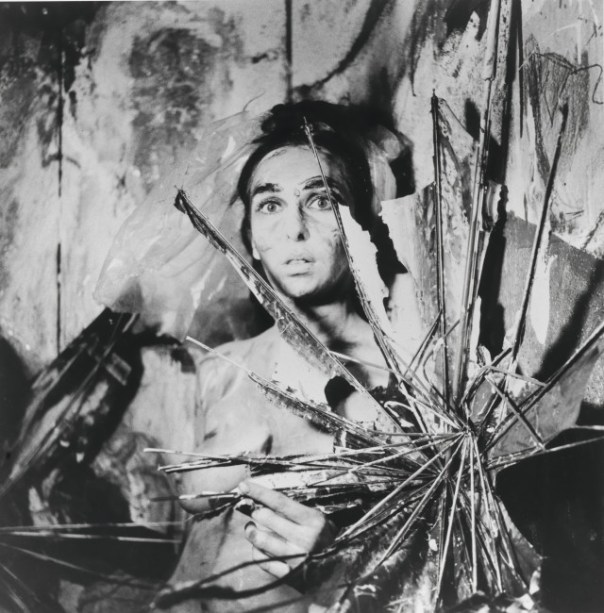
Eye Body # 24 from Eye Body: 36 Transformative Actions for Camera 1963

Carolee Schneemann (October 12, 1939 – March 6, 2019) was an American visual experimental artist, known for her multi-media works on the body, narrative, sexuality and gender. She received a B.A. in poetry and philosophy from Bard College and a Master of Fine Arts from the University of Illinois. Originally a painter in the Abstract Expressionist tradition, Schneeman was uninterested in the masculine heroism of New York painters of the time and turned to performance-based work, primarily characterized by research into visual traditions, taboos, and the body of the individual in relation to social bodies. Although renowned for her work in performance and other media, Schneemann began her career as a painter, stating, ‘I’m a painter. I’m still a painter and I will die a painter. Everything that I have developed has…

View original post 264 more words

The Surprising Non-Literary Jobs of Some Authors

Dave Astor's avatarDave Astor on Literature

Mark Twain

This is an updated, slightly edited rerun of a book piece I wrote back in 2012:

It’s not a big shock when novelists work as journalists or professors before, during, or after their book-producing years. But some famous writers have held rather unusual non-literary jobs.

On the positive side, stints of atypical-for-authors employment can inspire future books and/or give writers firsthand knowledge of the way non-writers live. On the negative side, need-the-money jobs can take away from precious prose-producing time.

My job is to now give examples of this multi-profession phenomenon, and I’ll start in the 19th century with the career arcs of a famous American literary trio: Mark Twain (born Samuel Clemens), Herman Melville, and Nathaniel Hawthorne.

Twain, from 1857 to 1861, worked as a riverboat pilot — a stint that inspired his pen name as well as the nonfiction book Life on the Mississippi and (to…

View original post 584 more words

Censoring “Persepolis”

dianeravitch's avatarDiane Ravitch's blog

Chicago Public Schools was first to ban the popular graphic novel Persepolis,” in 2013.

The book has sold millions of copies. The author, Marjane Satrapi, was born in Iran and used the book to tell her story. Chicago school officials decided to pull the book from classrooms and school libraries, after receiving complaints that the book was not “age-appropriate.” The officials saw two pages that circulated among them. There is no indication that any of them actually read the book. The Superintendent at the time was Barbara Byrd-Bennett, who was subsequently sent to prison for accepting bribes to buy services from vendors.

A graduate student asked for copies of internal emails about the decision to remove the book:

News of the ban broke on March 14, 2013, when a local education blogger got hold of anemailfrom the principal of Lane Tech College Prep High School which…

View original post 593 more words

In Honor of World Lizard Day

wordcloud9's avatarFlowers For Socrates

August 14th is World Lizard Day, so I am reposting  this report on the Gila Monster:

GILA MONSTER: His Myth is Worse than His Bite

“I have never been called to attend a case of Gila monster bite, and I don’t want to be. I think a man who is fool enough to get bitten by a Gila monster ought to die. The creature is so sluggish and slow of movement that the victim of its bite is compelled to help largely in order to get bitten.”

— Dr. Ward, Arizona Graphic, September 23, 1899

View original post 582 more words

Pale Fire

Jeanne's avatarNecromancy Never Pays

I read Pale Fire by Vladimir Nabokov recently with my son, Walker, who studies Russian Literature. It’s not a book that many people read just for fun, but they should. I started it at 3 am, during a bout of insomnia, and it took me no time at all to find out that the narrator is not only unreliable, he’s absurd, and the reader is meant to realize that at some point. The book is even funnier if you delve into the details.
We read the 1989 Vintage International paperback edition. Pale Fire was published in 1962, when Nabokov had been working on commentary and translation of the Russian classic Eugene Onegin for a decade (this was finally published in 1964). Writing Pale Fire was a break from his serious work, a parody, a way of making fun of himself for taking academic commentary so seriously.
Our purpose in discussing

View original post 2,309 more words