Category Archives: Uncategorized

Harold Rosenberg

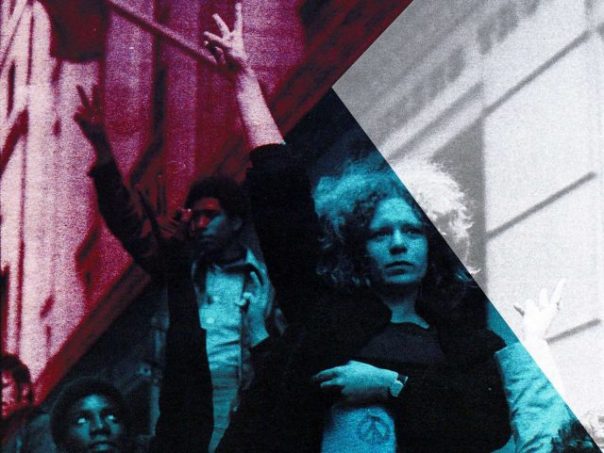
1960s: Days of Rage's avatar1960s: Days of Rage


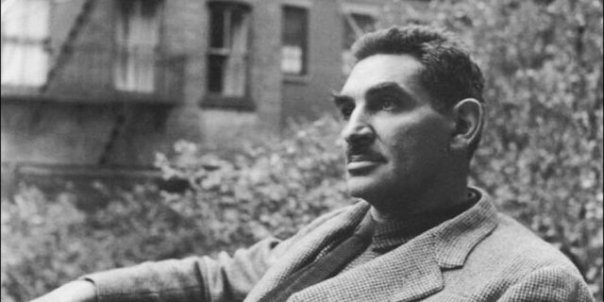
“A self-declared outsider, the renowned essayist and art critic Harold Rosenberg (1906-1978) rose to prominence in the 20th century to become one of the most essential voices in the discourse of American art. … The author’s ability to decipher the entanglements of a cultural milieu that emerged from this intellectual hotbed is remarkable, and her historical precision alongside some 15 years of research is especially noteworthy. Ms. [Debra Bricker] Balken’s writing is compelling and evenhanded, illuminating some of the last century’s most conspicuous intellectual scuffles, social convolutions, and cultural progress with stunning lucidity. … Often remarking that he got his education on those steps, Rosenberg studied Karl Marx, became a poet, and commenced the study of politics, literature, art, and culture while commingling within the political stew of Marxism, Trotskyism, and Stalinism, among other ideologies. Though he would continue to paint until his 30s, writing became his métier. … This…

View original post 196 more words

Ben Martin’s 1961 Caffe Cino Photos

Robert's avatarCaffe Cino Pictures

Buy Cino T-Shirt HERE, Cino Book HERE.
Buy DVD Lecture on the Cino
HERE

BEN MARTIN was TIME Magazine’s first staff photographer 1957, TIME Magazine Senior Photographer 1957-1989, photographed for all divisions of Time Inc., including LIFE, Fortune, People, Sports Illustrated, Money, Discover, Entertainment Weekly, Architectural Forum, House and Home, TIME LIFE Books, HBO, Book of the Month Club and Corporate. In February 1961 he took the photo below, the first published Caffe Cino performance photo, Time Magazine, Feb. 10, 1961. It was labeled in TIME as F. STORY TALBOT’s “Herrengasse.” Story says it is actually of the next show, Tennessee Williams’ “Camino Real.” The central figure is undeniably the great SHIRLEY STOLER. Photo originally shared by GARY FILSINGER. Mister Martin has graciously given permission for these fully copyrighted photos…

View original post 7 more words

Thinking About the Sixties by Richard Goldstein

1960s: Days of Rage's avatar1960s: Days of Rage


“The ’60s was was a decade without nostalgia, and thus a decade without irony. It’s only natural, then, that the current wave of nostalgia for the ’60s is suffused with irony — for we are looking back to a time when we most looked toward the future. The writers in this special section on the ’60s disagree about what kind of future that generation foresaw, yet all write on the assumption that rather than reduce our past to artifact we regard it as inspiration. Richard Goldstein, in his odyssey of sensibility [below], asks if it’s possible to reclaim ecstasy. Michael Thelwell, in recalling the traumas of the movement for black empowerment, explores the divergence between hope and naïvete. Jack Newfield’s memoir of Robert Kennedy portrays a man who knew loss yet never lost vision. In Paul Cowan’s ’60s quiz, what was so vivid then seems faded now —…

View original post 157 more words

Spy film

1960s: Days of Rage's avatar1960s: Days of Rage

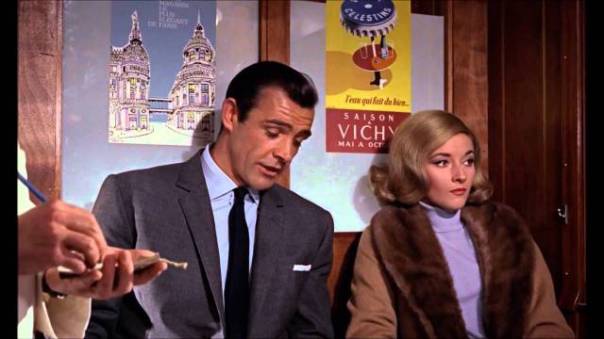
From Russia with Love (1963)

“The spy filmgenre, also known sometimes as an espionage film, deals with the subject of fictional espionage, either in a realistic way (such as the adaptations of John le Carré) or as a basis for fantasy (such as many James Bond films). Many novels in the spy fiction genre have been adapted as films, including works by John Buchan, le Carré, Ian Fleming (Bond) and Len Deighton. It is a significant aspect of British cinema, with leading British directors such as Alfred Hitchcock and Carol Reed making notable contributions and many films set in the British Secret Service. Spy films show the espionage activities of government agents and their risk of being discovered by their enemies. From the Nazi espionage thrillers of the 1940s to the James Bond films of the 1960s and to the high-tech…

View original post 289 more words

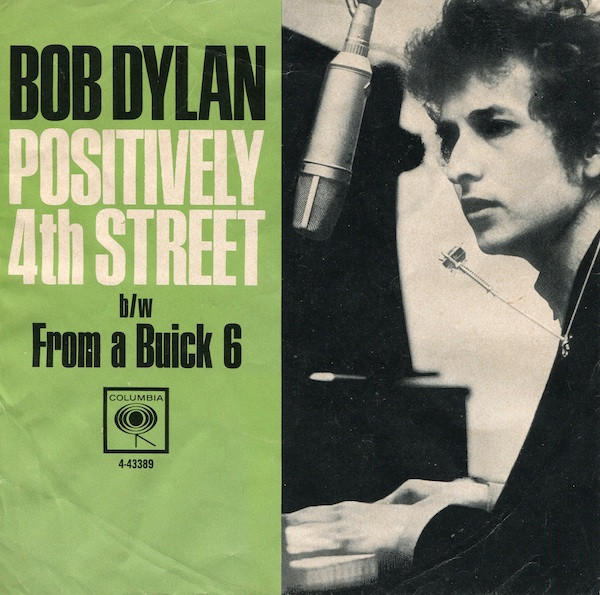
“Positively 4th Street” – Bob Dylan (1965)

1960s: Days of Rage's avatar1960s: Days of Rage


“‘Positively 4th Street’ is a song written and performed by Bob Dylan, first recorded in New York City on July 29, 1965. … The studio band on ‘Positively 4th Street’ featured Bobby Gregg (drums), Russ Savakus or Harvey Brooks (bass), Frank Owens or Paul Griffin (piano), Al Kooper (organ) and Mike Bloomfield (guitar), with the song initially being logged on the studio’s official recording session documentation under the working title of ‘Black Dally Rue’. … Critic Dave Marsh praised the song as ‘an icy hipster bitch session’ with ‘Dylan cutting loose his barbed-wire tongue at somebody luckless enough to have crossed the path of his desires.’ … Joni Mitchell has cited the song as one of her biggest inspirations at the dawn of her career: ‘There came a point when I heard a Dylan song called ‘Positively Fourth Street’ and I thought ‘oh my…

View original post 249 more words

The road well travelled: 100 years of Jack Kerouac

1960s: Days of Rage's avatar1960s: Days of Rage


“Jack Kerouac – anti-establishment icon, revolutionary author of the American classic On the Road, pioneer of the Beat Generation and, perhaps most of all, enduring symbol of cool. If a dog-eared paperback of On the Road slung in your back pocket was once the ultimate avant-garde accessory, 100 years after his birth, a Kerouac namecheck has become something of a trope on dating apps. New analysis by OkCupid has shown that mentions of the Beat poets and On the Road in profiles (more often on those belonging to men) have increased more than threefold in the past five years. With their themes of travelling, male friendship and flight from the nine-to-five to explore a world of sex, drugs and art, it’s easy to see why men want to align themselves with Kerouac’s books. The anarchist ideals of On the Road characters Dean Moriarty and Sal Paradise are ones that ‘alternative’…

View original post 218 more words

Angela Davis on the power of protest: ‘We can’t do anything without optimism’

1960s: Days of Rage's avatar1960s: Days of Rage


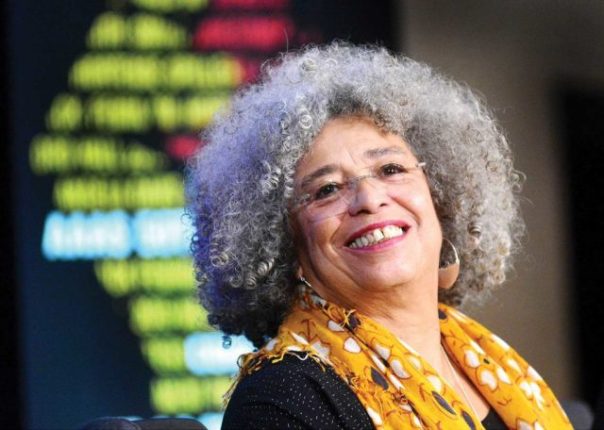
“The last time Angela Davis was in Birmingham, Alabama, she caught up with childhood friends and her Sunday school teacher. While many of us would reminisce about favourite classes and first kisses, they discussed bombs. ‘We talked about what it was like to grow up in a city where there were bombings all the time,’ she says. Most notoriously, in September 1963, the Ku Klux Klan bombed the 16th Street Baptist church, killing four girls. It wasn’t a one-off, says the legendary radical feminist, communist and former Black Panther. ‘People’s homes were bombed, synagogues were bombed, other churches were bombed. People think of that as a single event, but it was more indicative of the pervasive terror at that time in Birmingham.’ When the girls were killed, Davis was 19, a brilliant young scholar travelling through Europe. She read about the attack in newspapers. ‘It was one of the…

View original post 205 more words

Putin: The Bloody Tyrant

wordcloud9's avatarFlowers For Socrates

by IRENE FOWLER, Contributor

“Putin began a war against Ukraine, and against the entire democratic world. He wants to destroy our country, and everything we have been building. But we know the strength of the Ukrainian people.”

– Volodymyr Zelensky, President of Ukraine

“Let each of us if you’re able to stand, stand and send an unmistakable signal to Ukraine and to the world.”

– Joe Biden, U.S. President


To read Irene’s poem “Putin: The Bloody Tyrant” click:

View original post 231 more words

In the Beginning by Margaret Dornaus (HOW TO HEAL THE EARTH Series)

silverbirchpress's avatarSilver Birch Press

thanksgiving-g0c794d9db_1920 copyIn the Beginning
by Margaret Dornaus

Start with a prayer.
It might contain just one word.
Or many—

Length doesn’t matter so much
as intention. Rest assured
words can propagate

exponentially . . .
like the seeds you plant
in early spring

when the wind is still
at your back. When hope holds
scarcely long enough

to keep you and the future
together for at least another
season of growing

your own version of a victory
garden, filled with tomatoes
and eggplants and other humble

members of the nightshade
family. Without ever fearing
extinction. Without feeling even

the tiniest threat of devastation. Start
before the work commences—the hoeing,
the weeding, the careful cultivation of

sun and shade, the gentle
layering of compost and leaves,
the tender tamping down,

the turning of the earth in need
of additional nutrients and endless
watering. Start with a prayer,

then begin again.
And again—…

View original post 240 more words