All posts by Dr. Dean Albert Ramser

Unknown's avatar

About Dr. Dean Albert Ramser

Slava Ukraine! Supporting student success in Ukraine. Retired educator (English / Education: GED2EdD; "Ми будемо поруч один з одним як члени людства в найкращому сенсі цього слова". (Горан Перссон) Слава Україна 🇺🇦 "We will be there for one another as fellow members of humanity, in the finest sense of the word." (Goran Persson) https://cal.berkeley.edu/DeanRamser

A Different Tuning: Jean Follain

1960s: Days of Rage's avatar1960s: Days of Rage


“I own one book I’d truly grieve losing, D’Après Tout by Jean Follain. My reasons are partly sentimental—I went to great trouble to get the book, and it found me when I felt lost in my writing life. Most of all though, the poems inside are ones I wish I’d written. Jean Follain (1903-1971) was a barrister and eventually a judge in Paris but came there as a student from Canisy in Normandy. Those facts mean little to me, but Heather McHugh, in her introduction to her translation of D’Après Tout makes much of Follian’s origins. The intimacy of his upbringing, she suggests, contributes to the size of his poems and their use of the commonplace to illuminate ‘the monumental.’ Because of his early, circumscribed conditions, his poems are ‘miniatures.’  Calling them miniatures, however, belies their echoing expansiveness. They are miniature in the sense that Sherwood Anderson’s stories in Winesburg…

View original post 212 more words
Mad scientists of Stanisław Lem

1960s: Days of Rage's avatar1960s: Days of Rage


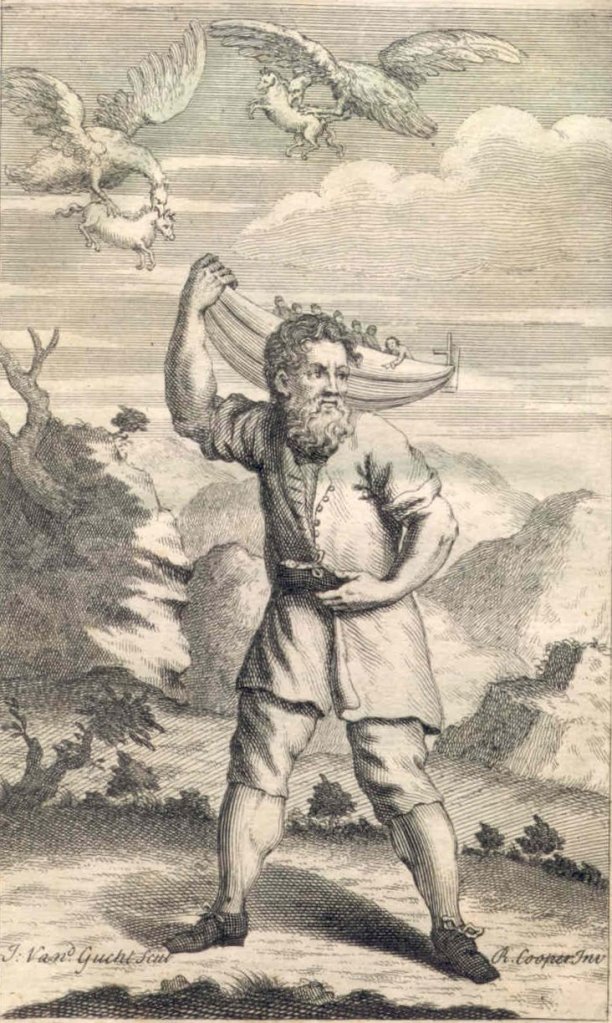
Mad scientists and inventors appear in the fiction of Stanisław Lem in the memoirs of Lem’s starfaring vagabond Ijon Tichy, collected in The Star Diaries and Memoirs of a Space Traveller, as well as in The Cyberiad. Most of Lem’s mad scientist stories fit into the format of stories about unusual inventions, known since the 19th century, most of them are devoid of ironic tone characteristic of most of Ijon Tichy’s stories and robots’ fables, and they are literary frames for various Lem’s theories. Lem’s mad scientists include professors Corcoran, who created several artificial universes in isolated lockers; Decantor, who created an immortal soul, Zazul, who cloned himself and was apparently killed by the clone who took his place; Diagoras, who created progressing makes of an ‘independent and self-perfecting device that is capable of spontaneous thought’ and was unwittingly used by two such devices…

View original post 225 more words

Flat Eggs by Cruz Villarreal (ONE GOOD MEMORY Series)

silverbirchpress's avatarSilver Birch Press

ellesi 1Flat Eggs
by Cruz Villarreal

In my kitchen,
I make breakfast for my granddaughter.
A small, wide-eyed girl with long brown braids.
She calls the two bright suns swimming in the frying pan,
flat eggs.
She says, no one makes them better.

I wonder
if she’ll look back
one day,
the same way I look back
and remember a small boy
in an adobe house
where the sound of a rooster
greets the morning,
and gentle rays of sunshine
make their way through
a small earthen window beside my bed
and gently caress my face.

Then
from under the wooden bed
comes the scuffle of tiny hoofs
as a baby goat scurries out to find his mother.

I rise and venture into the courtyard,
noisy chickens scatter beneath my feet,
angry that I’ve disturbed their breakfast.

Across the courtyard
is grandmother’s house
fashioned in the old way
of mud and…

View original post 239 more words

The Impressions – This Is My Country (1968)

1960s: Days of Rage's avatar1960s: Days of Rage


“… These statistics would have made disheartening, if familiar reading to the late Curtis Mayfield. As a driving force in black music from the early ’60s through the mid-’70s, he was a seasoned documentor of the struggle of black Americans through his music and lyrics, which blended fluid, at times lush, melodic funk/soul with measured social commentary. Before launching a highly successful solo career, Mayfield was a member and later leader of Chicago-based vocal group The Impressions. Of all the mid-60 R&B vocal group heavyweights, their music, despite significantly lighter radio rotation, is arguably the most enduring. While the likes of The Temptations only began to produce socially conscious records around 1968-69, Mayfield and The Impressions had been consistent in doing so since the departure of original lead vocalist Jerry Butler in 1962. Paralleling the Civil Rights movement, it took different forms, but was invariably dignified and gently righteous, whether…

View original post 225 more words

Patti Smith Makes a Pilgrimage to French Guiana in This Exclusive Excerpt From Her New Memoir

1960s: Days of Rage's avatar1960s: Days of Rage


“In 1965 I had come to New York City from South Jersey just to roam around, and nothing seemed more romantic than to write poetry in a Greenwich Village café. I finally got the courage to enter Caffè Dante on MacDougal Street. The walls were covered with printed murals of the city of Florence and scenes from The Divine Comedy. A few years later I would sit by a low window that looked out into a small alley, reading Mrabet’s The Beach Café. A young fish-seller named Driss meets a reclusive, uncongenial codger who has a café with only one table and one chair on a rocky stretch of shore near Tangier. The slow-moving atmosphere surrounding the café captivated me. Like Driss, I dreamed of opening a place of my own: the Café Nerval, a small haven where poets and travelers might find the simplicity of asylum. ……

View original post 242 more words

Virginia Woolf: A Room of One’s Own

wordcloud9's avatarFlowers For Socrates

January 25, 1882Virginia Woolf born, leading English modernist author and feminist; best known for her novels To the Lighthouse and Mrs. Dalloway, and her essay A Room of One’s Own.

“… a woman must have money and a room of her own
if she is to write fiction.”

A Room of One’s Own was published in September 1929. It is based on a pair of lectures she gave at Newnham and Girton, the women’s colleges at Cambridge. It remains a testament to the injustice of limiting women to childbearing and domestic duties, denying women’s intellectual potential.

She focuses on literature, contending that the absence of female fiction is a result of a lack of opportunity rather than a distinct absence of talent. Social problems may shift shape, but the absence of opportunity still causes isolation and inequality.

To read an excerpt from A Room of One’s Own click:

View original post 708 more words

Vittorio De Sica – Yesterday, Today and Tomorrow (1963)

1960s: Days of Rage's avatar1960s: Days of Rage


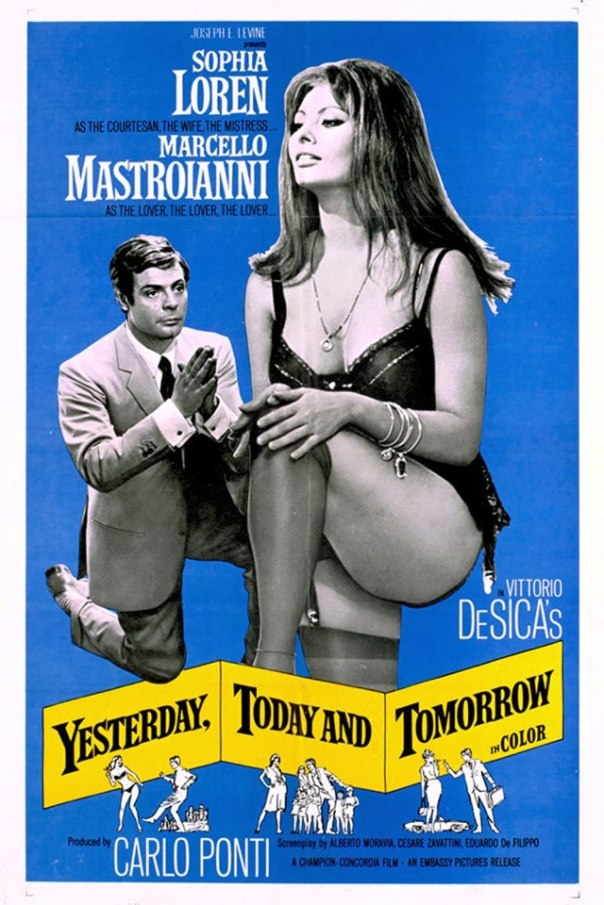
Yesterday, Today and Tomorrow (1963), winner of the 1965 Oscar for Best Foreign Film, is a trio of stories directed by Vittorio De Sica in the omnibus fashion so popular at the time (just the year prior, he had contributed to the similarly structured Boccaccio ‘70, alongside Federico Fellini, Mario Monicelli, and Luchino Visconti). Spearheaded by international super-producer Carlo Ponti—helping to ensure global distribution and award-worthy prestige—the film is, first and foremost, a collaborative compendium of what partially defined the popular perception of its versatile director and its two leads, Sophia Loren and Marcello Mastroianni. … Here, an exuberant Loren plays Adelina Sbaratti, a boisterous young woman who illegally hawks cigarettes on the street. Facing financial punishment and jail time for her unlawful transactions, she stumbles upon a legal exemption for pregnant women. Apparently, the powers that be cannot arrest one with child until six months after delivery…

View original post 215 more words

Brother by Mary McCarthy (ONE GOOD MEMORY Series)

silverbirchpress's avatarSilver Birch Press

feather-g7db1c8b46_1920Brother
by Mary McCarthy

I found you one day
at my kitchen door
holding the wild turkey
you’d shot that morning.
The fall of soft bronze
and brown feathers
all silk and spike
feet gnarled, long neck
hanging down, almost
like the live ones did
when my dog chased them
up into the tulip tree,
flying that creaking clumsy
way they have, to sit
on the high branches
and drop their heads down
to mock the dog’s frantic
fuss-barking up at them
so far out of reach.

You loved all things wild
and hard to find
would go into the woods
alone, just to be there
breathing in the air
trees breathed out
moving so soft and quiet
you almost faded
into the brown green
must of the thick-
leaved forest floor
felt more at home there
than behind walls and windows,
grounded in the silence
listening for every hush…

View original post 305 more words

Seven dirty words

1960s: Days of Rage's avatar1960s: Days of Rage


“The seven dirty words are seven English-languagecurse words that American comedian George Carlin first listed in his 1972 ‘Seven Words You Can Never Say on Television’ monologue. … At the time, the words were considered highly inappropriate and unsuitable for broadcast on the public airwaves in the United States, whether radio or television. As such, they were avoided in scripted material and bleep censored in the rare cases in which they were used. Broadcast standards differ in different parts of the world, then and now, although most of the words on Carlin’s original list remain taboo on American broadcast television. The list was not an official enumeration of forbidden words, but rather were compiled by Carlin to flow better in a comedy routine. Nonetheless, a radio broadcast featuring these words led to a Supreme Court 5–4 decision in 1978 in FCC v. Pacifica Foundation that the…

View original post 205 more words

Found in an NYC Junk Shop: Forgotten Postcards between Two Haiku Masters

1960s: Days of Rage's avatar1960s: Days of Rage


“Found at the bottom of an old mailbox in a New York antiques store, what’s written on the back of these postcards perfectly captures the iconic arts scene in New York’s early 1960s– a city that was hosting the likes of Bob Dylan, Andy Warhol, Jack Kerouac and countless more forgotten artists, jazz musicians and poets of an era gone by… The handwritten notes and unreleased poetry brought to life with illustrations, are all from a Haiku poet known as the Arizona Zipper, addressed to Cor Van de Heuvel, another Haiku poet particularly influential in bringing Haiku to New York and the United States in the 1960s. Together, the pair were the pioneers of American Haiku poetry in the 1960s. But for those that don’t know, by now you might very well be asking yourself– what the heck is Haiku?! Haiku is the ancient Japanese art of a very short…

View original post 297 more words