All posts by Dr. Dean Albert Ramser

Unknown's avatar

About Dr. Dean Albert Ramser

Slava Ukraine! Supporting student success in Ukraine. Retired educator (English / Education: GED2EdD; "Ми будемо поруч один з одним як члени людства в найкращому сенсі цього слова". (Горан Перссон) Слава Україна 🇺🇦 "We will be there for one another as fellow members of humanity, in the finest sense of the word." (Goran Persson) https://cal.berkeley.edu/DeanRamser

Gidra: The Monthly of the Asian American Experience

1960s: Days of Rage's avatar1960s: Days of Rage


Gidra: The Monthly of the Asian American Experience, the self-proclaimed ‘voice of the Asian American movement,’ was a revolutionary monthly newspaper-magazine that ran from 1969 to 1974. It was started by a group of Asian American students at the University of California, Los Angeles as a platform to discuss Asian American interests on campus and later expanded to address the entire Los Angeles Asian American community. Sixty issues of Gidra were published during its primary run, as well as a 1990 anniversary issue and five issues between 2000 and 2001. Gidra covered mainly issues affecting the Asian American community, including the anti-war movement; ethnic studies at universities; and the struggles of colonized people in Asia, Africa, and the Caribbean. Also crucial to the newspaper was art, mostly illustrations and poetry. Highly politicized, Gidra took stances that were anti-war, anti-imperialist, and anti-capitalist. One of the first newspapers of its…

View original post 168 more words

A Poem by Robert Browning on His Birthday

wordcloud9's avatarFlowers For Socrates


Robert Browning born on May 7, 1812 in Camberwell, a middle-class suburb of London. He was the only son of Robert Browning, a clerk in the Bank of England, and a devoutly religious German-Scotch mother, Sarah Anna Wiedemann Browning, who loved music. Browning’s father had amassed a personal library of some 6,000 volumes, many of them collections of arcane lore and historical anecdotes that the poet plundered for poetic material, including the source of “The Pied Piper.”

Browning has come to be regarded as a major Victorian poet, and his approach to dramatic monologue has influenced countless poets for almost a century. However, he is at least as famous for falling in love with Elizabeth Barrett, who began writing poetry at age 11, but by age 15, was suffering from intense head and spinal pain, and remained in frail health for the rest of her life. They met in 1845…

View original post 261 more words

SET – Gerrit Lansing (1961-64)

1960s: Days of Rage's avatar1960s: Days of Rage


“How to manage the heat”: On Gerrit Lansing: “Gerrit Lansing passed away February 11, 2018, in Gloucester, Massachusetts. A man of wider & deeper knowledge than almost anyone I have known, Lansing was as familiar with, & brought as much care to, contemporary poetry & poetics as to older literatures, to the traditionary sciences as to modern science, to the making of music as to the preparing of food. … 3. SET #1. In 1961, Lansing saw the need for a magazine of poetry, actions & community (see #5) & created SET—the polysemic title resonates from jazz to tennis (well, in a minor, more humorous way) to stance (I hear as the Olsonian term but also as Paul Celan’s ‘stehen,’ as equivalence to being alive, still) to Egyptian hermetic godhead—which will be ‘fix & dromenon / & to the poem.’ The inside front cover starts with the word ‘onset’…

View original post 212 more words

Wattstax

1960s: Days of Rage's avatar1960s: Days of Rage


Wattstax was a benefit concert organized by Stax Records to commemorate the seventh anniversary of the 1965 riots in the African-American community of Watts, Los Angeles. The concert took place at the Los Angeles Memorial Coliseum on August 20, 1972. The concert’s performers included all of Stax’s prominent artists at the time. The genres of the songs performed included soul, gospel, R&B, blues, funk, and jazz. Months after the festival, Stax released a double LP of the concert’s highlights, Wattstax: The Living Word. The concert was filmed by David L. Wolper‘s film crew and was made into the 1973 film titled Wattstax. … Stax Record’s West Coast director, Forrest Hamilton, came up with the idea for the Wattstax concert. Being in Los Angeles during the Watts Riots in 1965, Hamilton later became aware of the yearly Watts Summer Festival…

View original post 210 more words

Badge Man

1960s: Days of Rage's avatar1960s: Days of Rage

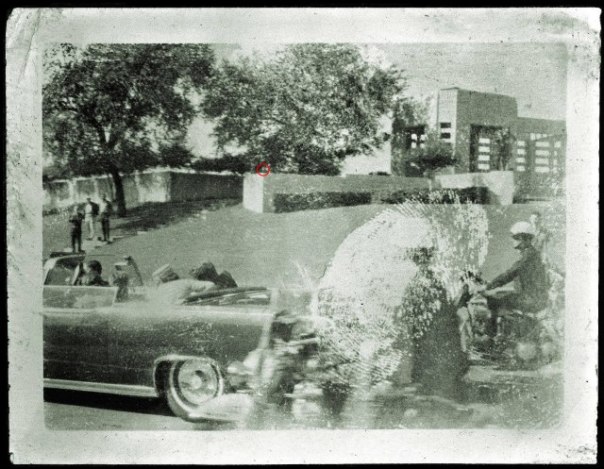
The degraded original version of the Moorman photograph: the Badge Man is purportedly located behind the stockade fence at photo center.
“The Badge Man is a figure that is purportedly present within the Mary Moorman photograph of the assassination of United States president John F. Kennedy in Dealey Plaza on November 22, 1963. Conspiracy theorists have suggested that this figure is a sniper firing a weapon at the president from the grassy knoll. Although a reputed muzzle flash obscures much of the detail, the Badge Man has been described as a person wearing a police uniform—the moniker itself derives from a bright spot on the chest, which is said to resemble a gleaming badge. The Moorman photograph was taken a fraction of a second after the fatal bullet struck Kennedy’s head. It was analyzed by the House Select Committee on Assassinations, but no evidence of hidden…

View original post 277 more words

New York Intellectuals

1960s: Days of Rage's avatar1960s: Days of Rage

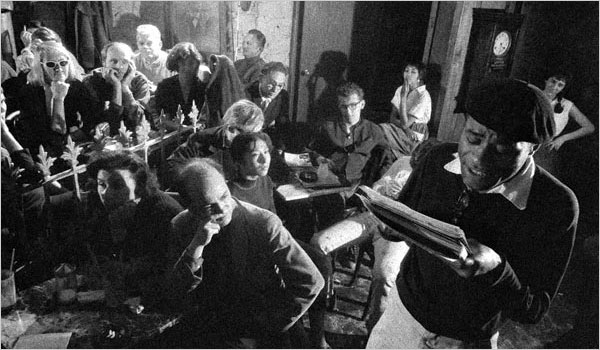
A late-‘50s poetry reading in New York City..

“The New York Intellectuals were a group of American writers and literary critics based in New York City in the mid-20th century. They advocated left-wing politics but were also firmly anti-Stalinist. The group is known for having sought to integrate literary theory with Marxism and socialism while rejecting Soviet socialism as a workable or acceptable political model. Trotskyism emerged as the most common standpoint among these anti-Stalinist Marxists. Irving Kristol, Irving Howe, Seymour Martin Lipset, Leslie Fiedler and Nathan Glazer were members of the Trotskyist Young People’s Socialist League. Writers often identified as members of this group include Lionel Abel, Hannah Arendt, William Barrett, Daniel Bell, Saul Bellow (despite his usual association with the city of Chicago), Norman Birnbaum, Elliot Cohen, Midge Decter, Morris Dickstein, Leslie Fiedler,

View original post 188 more words

Inside the Spiral: The Passions of Robert Smithson – Suzaan Boettger

1960s: Days of Rage's avatar1960s: Days of Rage

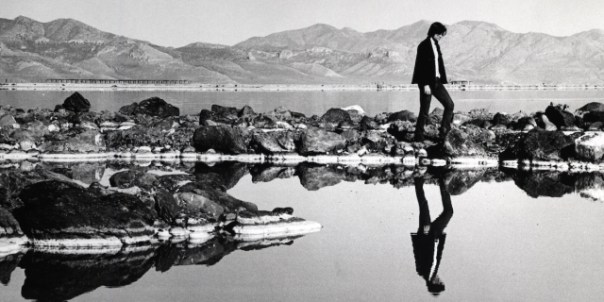
Robert Smithson, walking on Spiral Jetty, 1970, Great Salt Lake, Utah.
Mortal Coil: Resurrecting Robert Smithson • Zack Hatfield. “Astonishingly, it has taken fifty years since his death for a ‘life’ of Robert Smithson to emerge. Then again, the endlessly polysemous nature of Smithson’s art, the vertiginous heap of writing on him already out there, and his own profound ambivalence toward the very enterprise of history—collective and personal—make him a rather daunting subject. The prospective Smithson biographer, over the winding course of her inquiry, must advance despite so many taunting aphorisms like signs telling her to turn around: ‘The self is a fiction which many imagine to be real.’ ‘History is a facsimile of events held together by flimsy biographical information.’ ‘Vanished theories compose the strata of many forgotten books.’ Suzaan Boettger’s book is, fittingly, a counterhistory. The cover of Inside the Spiral: The Passions of Robert Smithson features…

View original post 164 more words

Jan Resseger: The Unfair Attack on Randi Weingarten and Unions in the New York Times

dianeravitch's avatarDiane Ravitch's blog

Last Sunday’s New York Times Magazine, the same publication that bravely published The 1619 Project, had a cover story about Randi Weingarten. It raised (and implied) the question of whether she is “the most dangerous person in the world.” The cover illustration had several placards, the most prominent saying “Stop Randi Weingarten.” My immediate thought, before reading the story, was that Randi’s life might be in danger, because the illustration and the title made her a target. This is no joke.

Randi has been a friend of mine for many years, and we don’t always agree. I have never persuaded her, and she has never persuaded me. We have had some strong arguments, but she’s still my friend. I believe passionately in the importance of unions, especially in a society with such deep economic inequality as ours. I wrote a letter to the editor about my objections to the article…

View original post 1,454 more words

Chicano Moratorium

1960s: Days of Rage's avatar1960s: Days of Rage

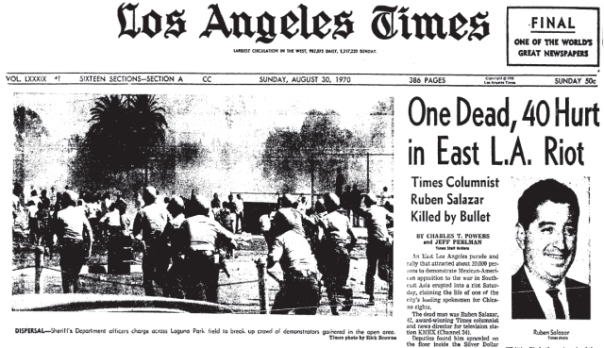
August 29, 1970: A Day Every Chicana/o Must Always Remember

“The Chicano Moratorium, formally known as the National Chicano Moratorium Committee Against The Vietnam War, was a movement of Chicanoanti-war activists that built a broad-based coalition of Mexican-American groups to organize opposition to the Vietnam War. Led by activists from local colleges and members of the Brown Berets, a group with roots in the high school student movement that staged walkouts in 1968, the coalition peaked with a August 29, 1970 march in East Los Angeles that drew 30,000 demonstrators. … The NCMC’s largest march took place on August 29, 1970 at Laguna Park (now Ruben F. Salazar Park). Between 20,000 and 30,000 participants, drawn from around the nation, marched down Whittier Boulevard in East Los Angeles. The rally was broken up by local police, who said that they had gotten reports that…

View original post 340 more words