All posts by Dr. Dean Albert Ramser

Unknown's avatar

About Dr. Dean Albert Ramser

Slava Ukraine! Supporting student success in Ukraine. Retired educator (English / Education: GED2EdD; "Ми будемо поруч один з одним як члени людства в найкращому сенсі цього слова". (Горан Перссон) Слава Україна 🇺🇦 "We will be there for one another as fellow members of humanity, in the finest sense of the word." (Goran Persson) https://cal.berkeley.edu/DeanRamser

Jesse Hagopian: We Will Not Teach Lies

dianeravitch's avatarDiane Ravitch's blog

Jesse Hagopian is an activist teacher in the Seattle Public Schools, a leader in Black Lives Matter at School and editor of the book More Than a Score: The New Uprising Against High-Stakes Testing. This article appeared in the Seattle Times:

State Republican Rep. Jim Walsh recently introduced HB 1807 and Republican Rep. Brad Klippert introduced HB 1886 for this legislative session — two bills designed to mandate educators lie to Washington’s students about structural racism and sexism.

This copycat legislation is lifted from a growing number of bills around the country that seek to ban an honest account of history in K-12 education, including many of the long struggles against oppression. These bills especially target the teaching of critical race theory (CRT), the 1619 Project, the Zinn Education Project and Black Lives Matter at School.

It’s fitting that Rep. Klippert’s bill is numbered “1886,” as that was…

View original post 432 more words

Jane Freilicher – Painter Among Poets

1960s: Days of Rage's avatar1960s: Days of Rage


“In August 1950, Jane Freilicher received a letter from John Ashbery in which he recommended she read Proust’s À la recherché du temps perdu. ‘One of Proust’s most exciting qualities,’ the twenty-three year old wrote to her, ‘is the way he demonstrates how circumstances of one’s life which seem casual and ephemeral can solidify for the rest of one’s life (i.e. Swann’s relation with Odette).’ His prescience is amusing. He had met Freilicher—as he put it, ‘a pretty and somewhat preoccupied dark-haired girl’—because she shared a kitchen in the same apartment building on Third Avenue and 16th Street with Kenneth Koch, a friend of Ashbery’s from Harvard. Koch, visiting his parents in Cincinnati for the summer, had sublet his apartment to Ashbery, and Freilicher let him into the building. The two were, as Koch put it in his later poem ‘A Time Zone,’ immediately ‘Afloat with ironies jokes sensitivities perceptions…

View original post 287 more words

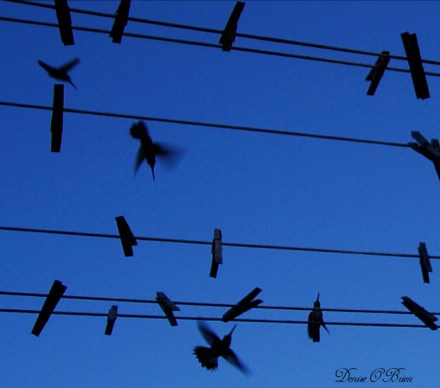
Clothespin Nightlife by Katrin Talbot (HOW TO HEAL THE EARTH Series)

silverbirchpress's avatarSilver Birch Press

D O'BRIENClothespin Nightlife
by Katrin Talbot

They hang like
ripe fruit,
waiting for a
twist, a
release, listening to
the owl song,
then back to
the morning’s joyful grip,
dancing, conserving
under the scallop of
goldfinch

PHOTO:Hummingbirds and Clothespins by Denise O’Brien (2007).

NOTE FROM THE AUTHOR: I’ve hung my laundry out for decades, composted since the 70s, and ridden my bike when I can, but I thought the clothesline might make the best poem!

katrin with chicken dress copyABOUT THE AUTHOR: Australian-born Katrin Talbot’s collection Wrong Number is forthcoming from Finishing Line Press, and she has six other chapbooks, including The Blind Lifeguard and Freeze-Dried Love from Finishing Line Press, Attached—Poetry of Suffix, The Little Red Poem and noun’d, verb, all from dancing girl press, and St. Cecilia’s Daze, published by Parallel Press. Her poetry has appeared in many journals, including Main Street Rag, Fresh Ink, Bramble, and Your Daily
View original post 18 more words

The sensational story of Mike Bloomfield: from prodigy to tragedy

1960s: Days of Rage's avatar1960s: Days of Rage


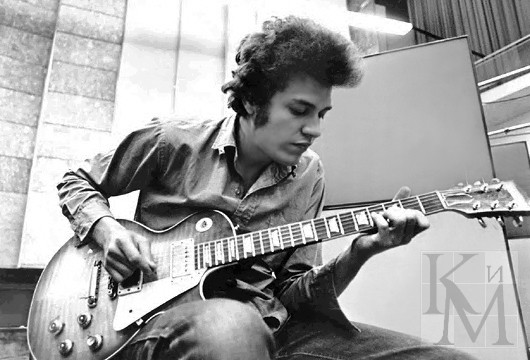
“Bob Dylan isn’t usually one for banter between songs, but tonight is an exception. It’s November 15, 1980 at San Francisco’s Warfield Theatre and he’s relating a story about a guitarist he first met in a Chicago blues club two decades previously: a skinny teenage hotshot with a towering stack of black curly hair and a dizzying arsenal of licks copped from Big Bill Broonzy and Sonny Boy Williamson. ‘He just played circles around anything I could play,’ marvels Dylan. ‘And I always remembered that.’ Dylan goes on to explain that, some years later, he was recording in New York and needed a guitar player. So he called him up. ‘Anyway,’ he concludes, ‘he played on Like A Rolling Stone and he’s here tonight. Give him a hand – Michael Bloomfield!’ The crowd roars its approval as Bloomfield, 37 years old, ambles on stage in his bedroom slippers and starts…

View original post 259 more words

Kimberlé Williams Crenshaw: Dr. King Understood “Critical Race Theory” Before It Had a Name

dianeravitch's avatarDiane Ravitch's blog

Kimberlé Williams Crenshaw is a professor of law at Columbia and UCLA and one of the leading figures in the field of critical race studies. She wrote the following article for the Los Angeles Times, where she demonstrates that the new laws banning the study of systemic racism simultaneously ban Dr. King’s views of America’s racial problems, which were not solved by passing civil rights laws. The furor over CRT shows that racism remains a powerful force today. Critics of CRT maintain illogically that teaching the history of racism is racist, that uncomfortable facts must not be taught at all, and that history must be scrubbed clean of divisive realities. As Crenshaw points out, King would have fought the current effort to cleanse U.S. history; his own words and works cannot be taught.

For the first time, we’re observing the Rev. Martin Luther King Jr. holiday under new laws in…

View original post 2,010 more words

Life is Absurd! Exploring Albert Camus’ Rebellious Philosophy

1960s: Days of Rage's avatar1960s: Days of Rage


“What is the absurd? For Algerian French existential writer Albert Camus, our desire for meaning in a meaningless universe arises in the absurd. In this article, we explore Camus’ philosophy of the absurd through a re-envisioned account of the Greek myth of Sisyphus, as well as his ideas about rebellion and what it means to be an existential hero. Alternative accounts are discussed to inspire you to form your own philosophy of the absurd. … Taking inspiration from existential writers and philosophers of the likes of Friedrich Nietzsche, Albert Camus’ writing explored existential themes of disillusionment and alienation in a war-torn period in which people felt abandoned (by God) and without meaning. His major contribution to philosophy is his views on ‘the absurd,’ a nihilistic outlook on life which he explored in his essays, novels and plays. To understand what ‘the absurd’ is, we must first look at what…

View original post 241 more words

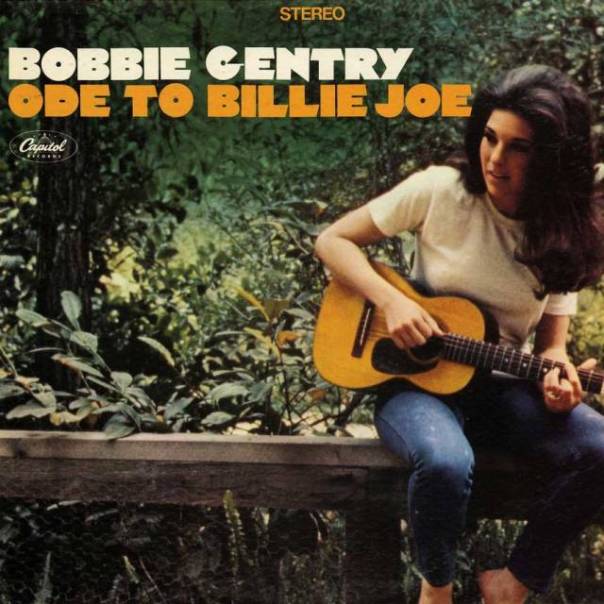
Ode to Billie Joe – Bobbie Gentry (1967)

1960s: Days of Rage's avatar1960s: Days of Rage


“Money, Mississippi, has a population of about 100. The settlement is famous for two things. One is real: in 1955, a 14-year-old boy, Emmett Till, was lynched, a murder referred to in songs by The Staple Singers and Bob Dylan. The other is fictional: Bobbie Gentry’s ‘Ode to Billie Joe’. An atmospheric production that mixed country music with funky R&B, ‘Ode to Billie Joe’ is an enigma. Its storyline is clear enough; some of the details are not. Billie Joe McAllister has jumped off the Tallahatchie Bridge in Money into the river below and, over dinner, a family offer opinions about their deceased acquaintance. Gentry sings of apple pie, cutting cotton, a prank involving frogs and, eventually, the death of the family’s father from a virus. Gradually the closeness of the song’s narrator to Billie Joe becomes apparent; she and Billie had been seen throwing something off the bridge on…

View original post 180 more words

Driving by the Lake With John Ashbery

1960s: Days of Rage's avatar1960s: Days of Rage


“It was convenient for John Ashbery, and dumb luck for me, that I was living in Rochester and could pick him up at the airport whenever he arrived from New York to visit his mother. Sometimes, because he didn’t like to fly, he’d arrive at the bus station instead; but I could meet him there too. It was an arrangement from which we both might profit, he explained, not profit in the American sense but in a way best expressed if you said it in French, profiter de. And thus we began my unexpected education, a kind of improvised fellowship with visiting tutor and bonus bits of wisdom delivered in French. John, as most anyone who follows poetry will know by now, was born in Rochester and raised on his father’s fruit farm in the next county to the east; though he spent a lot of time, as much…

View original post 253 more words

Bob Dylan: Brecht of the Juke Box, Poet of the Electric Guitar by Jack Newfield (January 1967)

1960s: Days of Rage's avatar1960s: Days of Rage


“Norman Morrison burned himself to death to protest the Viet­nam war, and when reporters visited his spare room they saw quotes from Bob Dylan scrawled on the peeling walls. Students at the University of California have organized a non-credit seminar on Dylan’s poetry. Esquire Magazine quotes Stokely Carmich­ael singing to himself — not an Otis Redding blues — but Dylan. In a recent peace demonstration a teenybopper marched with a home-made placard that bore the crayoned motto, ‘The hypnotic splattered mist is slowly lifting,’ a line from Dylan’s ‘The Chimes or Freedom.’  W. H. Auden, Howard Nemerov, and Norman Podhoretz say they have never heard of Dylan. Critic and poet John Ciardi says Dylan knows nothing about poetry. Even Norman Mailer, existentialist fight manager and white hope of the over-30 generation, says, ‘If Dylan is a poet, so is Cassius Clay.’ But 25-year-old Dylan, the Brecht of the juke box…

View original post 222 more words

Edward Albee’s Vortex of Violence (January 18, 1964)

1960s: Days of Rage's avatar1960s: Days of Rage

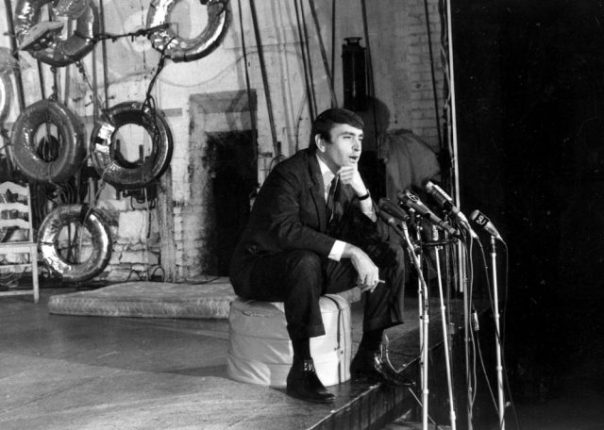
In this May 2, 1967, file photo, playwright Edward Albee, winner of the 1967 Pulitzer Prize for drama, for his play “A Delicate Balance,” talks to reporters during a news conference at the Cherry Lane Theater in the Greenwich Village section of New York.

“… The big woman greases her arms with hog fat. The man sullenly does the same. A lame dwarf lurches from one to the other like an evil Cupid, insane with glee. Townspeople whisper excitedly. When the woman and the man have finished readying themselves, they face each other, crouch, and spring. Their fight is brutal, and for a time it is even. Then the woman’s greater strength begins to tell. She has nearly strangled the man, when the dwarf shrieks and jumps on her back. The man recovers, clubs the woman to the ground, then gouges out her eyes. The Ballad of the Sad Café

View original post 310 more words