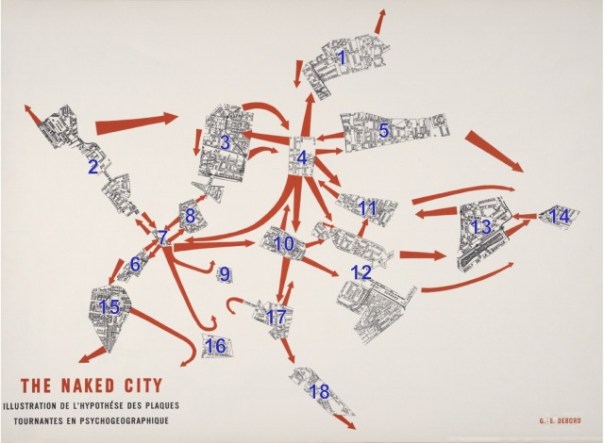
 Guy Debord’s “Naked City”, map of Paris
“Psychogeography is the exploration of urban environments that emphasizes interpersonal connections to places and arbitrary routes. It was developed by members of the Letterist International and Situationist International, which were revolutionary groups influenced by Marxist and anarchist theory as well as the attitudes and methods of Dadaists and Surrealists. In 1955, Guy Debord defined psychogeography as ‘the study of the precise laws and specific effects of the geographical environment, consciously organized or not, on the emotions and behavior of individuals.’ One of the key tactics for exploring psychogeography is the loosely defined urban walking practice known as the dérive. As a practice and theory, psychogeography has influenced a broad set of cultural actors, including artists, activists and academics. … The Lettrists’ reimagining of the city has its precursors in aspects of Dadaism and Surrealism. The concept of the flâneur
View original post 165 more words

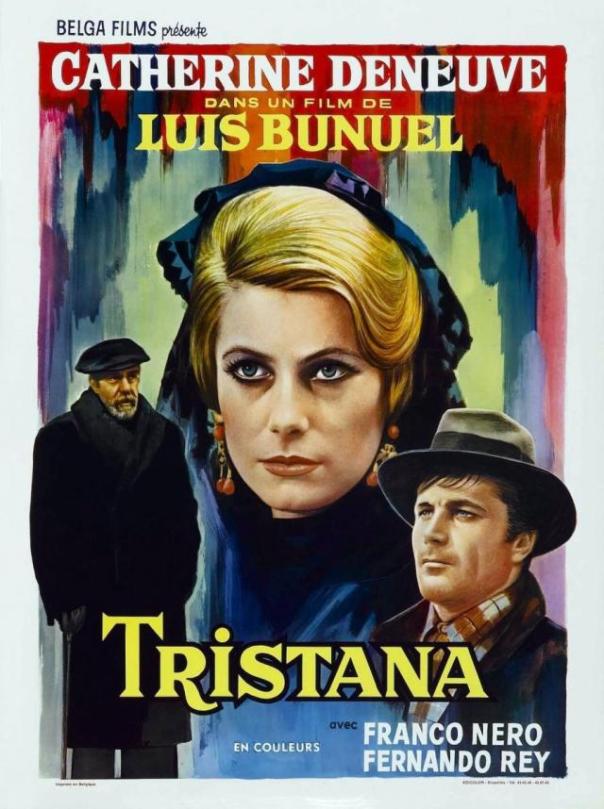 “The journal entry above, dated October 4, 1969, was written during the second week of shooting Tristana (1970), Catherine Deneuve’s second—and final—collaboration with Luis Buñuel after the enormous success of Belle de Jour (1967). Abounding in bizarre detail, the jotting succinctly captures Tristana’s impeccable balance of precision and perversion. As in Belle de Jour—in which Deneuve’s character, Séverine, a YSL-clad haute bourgeoise, finds erotic liberation through byzantine psychosexual fantasies and part-time work at a boutique bordello, where she is christened with the nom de pute of the title—Tristana hinges on the defilement of its eponymous character. When the film opens, Tristana is all in black, still in mourning for her recently deceased mother. The innocent, timid, orphaned teenager becomes the ward of Don Lope (Buñuel regular Fernando Rey), a lecherous, hypocritical, overweening Manchegan aristocrat who wastes no time in seducing her. ‘I’m your father and your husband,’ the…