academic writing as conversation


You’ll often hear that academic writing is entering a conversation. A journal article for example is an entry into an asynchronous conversation that has already been going on in the journal – or perhaps ought to have been going on – about a particular topic. Articles take turns in discussing the topic, each one referring back to other papers to make sure that the reader understands the ongoing and cumulative nature of the discussion.
It’s helpful to think that a paper or chapter or book is also entering a conversation in its own right. And that’s a conversation with the reader. And just as in the paper by paper conversation, the writer has to make connections with what has gone before. (Apologies to all of the conversation analysts out there reading this – I am about to simplify and gloss over complexities.)
People who study conversations understand them as social –…
View original post 1,022 more words
‘Fish Out of Water’ Are ‘C’ (Character) Creatures


Ten years ago, before I started this blog, I wrote a piece about characters who are “fish out of water.” Time to revisit that “fishional”…um…fictional topic by discussing some novels I’ve read since 2013 that are relevant to this theme.
As I noted back then, there’s often lots of drama and/or comedy when authors transport protagonists to a much different place. Those characters may initially “flounder” and have embarrassing moments — which is not good for them but interesting to read about. Then they might eventually get their bearings, experience new things, meet new people, and gain more confidence — which is good for them and also interesting to read about. Even if characters don’t adapt to new locales, there’s drama in that, too.
And readers — many of whom have been “fish out of water” themselves during vacations or after moving to new places — can compare their own…
View original post 627 more words
“All Watched Over by Machines of Loving Grace” – Richard Brautigan (1967)

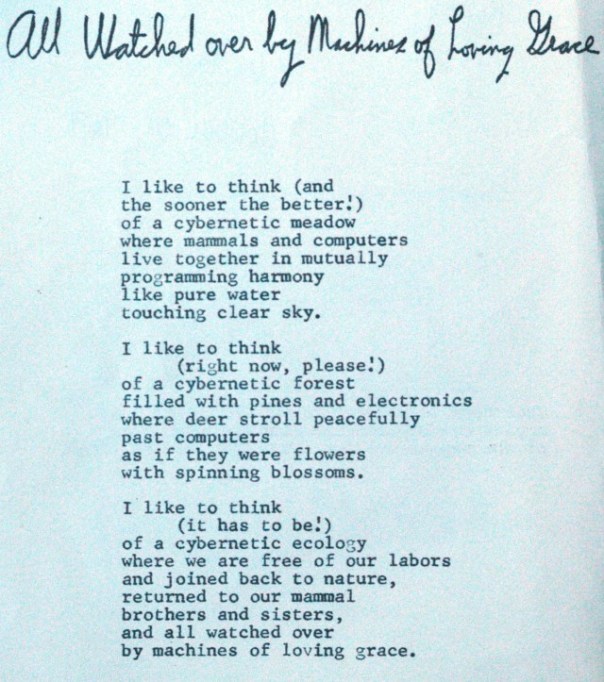 “‘All Watched Over by Machines of Loving Grace’ is a poem by Richard Brautigan first published in his 1967 collection of the same name, his fifth book of poetry. It presents an enthusiastic description of a technological utopia in which machines improve and protect the lives of humans. The poem has counterculture and hippie themes, influenced by Cold War-era technology. It has been interpreted both as utopian and as an ironic critique of the utopia it describes. It is Brautigan’s most frequently reprinted poem. Brautigan wrote the poem and eponymous collection between January 17–26, 1967, while a poet-in-residence at the California Institute of Technology in Pasadena, California. The poem is 99 words in 3 stanzas, and describes a technological utopia in which humans and technology work together for the greater good. Brautigan writes about ‘mammals and computers liv[ing] together in mutually programming harmony’, with…
View original post 184 more words
NYC: Token and change

“From the inauguration of IRT subway services in 1904 until the unified system of 1948 (including predecessor BMT and IND subway services), the fare for a ride on the subway of any length was 5 cents ($.05 in 1904 equivalent to $1.51 in 2021; $.05 in 1948 equivalent to $0.56 in 2021). … For the most part, token models were changed periodically as prices changed, but not always. The first token change occurred in 1953, but this change did not to reflect a change in fare cost. The NYCTA’s original design as proposed on July 25, 1953, for the 15 cent fare raise was the 16mm ‘Small Y Cutout’ token. However, due to the time the NYCTA actually received approval for a fare hike on June 14, it left them short of time ordering the tokens. … Due to the pressing need to get a token into service, the NYCTA…
View original post 250 more words
The ever-present influence of Frank O’Hara’s poetry on popular culture
 “Alongside poets such as Barbara Guest, John Ashbery, and Kenneth Koch, Frank O’Hara was a leading figure in the New York School of Poets, active during the 1950s and 1960s. As an art curator at the Museum of Modern Art, O’Hara bridged a gap between the city’s poets and artists, often writing during his lunch breaks, resulting in his seminal 1964 collection, Lunch Poems. His deep involvement in the art world informed his poetry, as did his life in New York, capturing everyday moments and conversations with beauty and celebration. Perhaps his most famous poem, ‘Having a Coke With You’ epitomises O’Hara’s delighting attitudes best. He writes: ‘I look at you and I would rather look at you than all the portraits in the world/ except possibly for the Polish Rider occasionally and anyway it’s in the Frick/ which thank heavens you haven’t gone to yet so we can…
View original post 235 more words
Join a Protest Against Ron DeSantis’ Attacks on Education!

MEDIA ADVISORY:
Tomorrow, on Saturday, parents and community members from the Alliance to Reclaim Our Schools (AROS) and HEAL Together, alongside organizations from Florida and Pennslyvania, will hold a press conference opposing Governor Ron DeSantis’ harmful policies attacking our children’s freedom to learn. The press conference will take place opposite the site of DeSantis’ keynote speech at the Pennsylvania Leadership Conference. Florida advocates will speak at the press conference to warn that DeSantis’ policies are bringing chaos to Florida families.
The full media advisory is below. Feel free to reach out to the media contact: Moira Kaleida | 412-760-0030 | moira@reclaimourschools.org
FOR IMMEDIATE RELEASE: March 31, 2023
**MEDIA ADVISORY**PARENTS, COMMUNITY FROM PA & FL STAND UP AGAINST DESANTIS ATTACKS ON EDUCATION AND OUR COMMUNITIES— PRESS CONFERENCE AND ACTION
Harrisburg, PA – Saturday, April 1, 2023, parents and community members from the Alliance to Reclaim Our Schools (AROS) and HEAL Together…
View original post 433 more words
Texas: Uh-Oh! The Book Banners Have Gone Too Far!
The latest wave of book banning in Texas high school libraries is led by people who don’t read much. Now, they’ve gone and set up a bar that even the beloved classic Texas novel—Lonesome Dove by Larry McMurtry—can’t get past.
In a recent legislative hearing, the book banners put their aliteracy on public display.
Christopher Hooks writes in the invaluable Texas Monthly:
State representative Jared Patterson has never claimed, through campaign literature or any other medium, to be a reader. If he had, he might not have walked into the trap set for him last night during a House Public Education Committee hearing on his inaptly named READER Act. That proposal would add several new bureaucratic controls on the kinds of books that could be kept in or borrowed from public-school libraries. When Democratic state representative James Talarico, of Round Rock, prodded the Frisco Republican during debate, Patterson…
View original post 708 more words
The Sun Came Out to Play

by IRENE FOWLER, Contributor
“I believe in liberty for all men: the space to stretch their arms
and their souls, the right to breathe and the right to vote, the
freedom to choose their friends, enjoy the sunshine, and ride
on the railroads, uncursed by color; thinking, dreaming,
working as they will in a kingdom of beauty and love.”
– W.E.B Du Bois

“Even for me life had its gleams of sunshine.”
– Charlotte Brontë, from Jane Eyre

“O, Sunshine! The most precious gold to be found on earth.”
– Thomas Mann

To read Irene’s new poem “The Sun Came Out to Play” click:
View original post 224 more words
Cultural Revolution: The Watts Renaissance
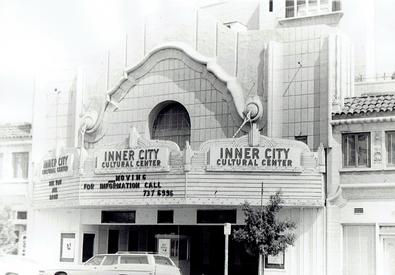
Inner City Cultural Center
The Art of Creative Survival: “During the 1960s and 1970s black Los Angeles produced dozens of cultural groupings that sought both to foster a new art and to generate a new relationship between creativity and community. These organizations were defined in part by their variety: theater companies like the Inner City Cultural Center and the Performing Arts Society of Los Angeles; community arts projects like the Mafundi Institute and St. Elmo Village; galleries like Brockman and Gallery 32; formal bodies like the Watts Writers Workshop and informal tendencies like the cohort of avant-garde black filmmakers who trained at the University of California, Los Angeles (UCLA). Their reach extended beyond Watts and South Los Angeles, past the city limits even. Altadena sheltered early associations of black visual artists, and it was from Pasadena that Ridhiana Saunders produced the journal Nigger Uprising. Compton was home to the…
View original post 284 more words
 dean ramser