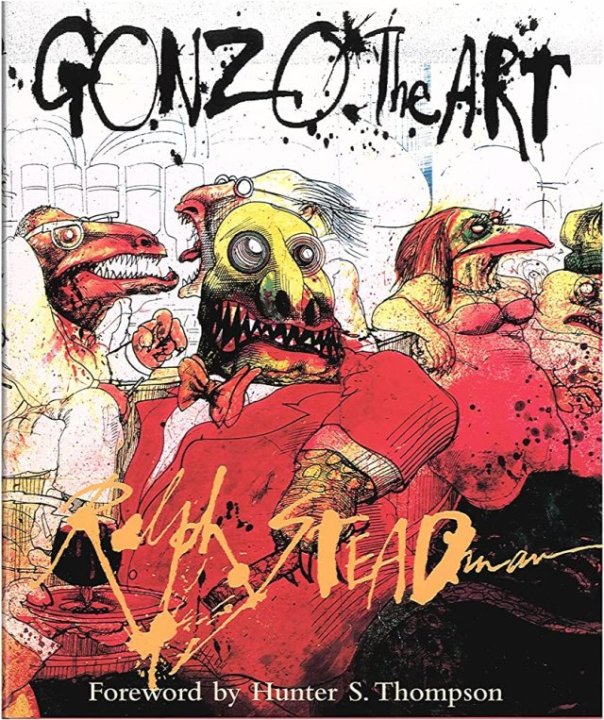
Reading Is Dangerous!

dianeravitch's avatarDiane Ravitch's blog

Read!

If you want to open your mind, read!

If you want to travel through time and space, read!

If you want to learn about other people and other cultures, read!

If you want to supercharge your creativity and imagination, read!

If you want to learn how other people see the world, read!

If you want to travel through time and space, read!

If you want to understand history, read!

Some people think these are dangerous activities. They want to control what students think. They censor books. They remove them from school libraries and public libraries. They forget that young people today have access to the Internet, which is not censored.

Live dangerously! Read books!

View original post

John Ashbery “Sings a Song of Thingness”: On Marianne Moore and the Hudson House

1960s: Days of Rage's avatar1960s: Days of Rage

Hudson: Lamps of different shapes and sizes and decorative wallpaper from numerous small collections. Master bedroom.

“John Ashbery has been having a virtual conversation with Marianne Moore about the ideal relationship between people and things ever since the publication of his first book, Some Trees (1956). An admitted admirer of Moore’s poetry, Ashbery directly revises Moore’s poetry and ideas even in that first volume. The volume flirts with Moore-like precision, but in its own way, focusing instead on ‘some precision’ (‘Popular Songs’), ‘dissolving’ (‘Errors’), and ‘Arranging by chance’ (‘Some Trees’). This interest in identifying poems’ exactnesses as an accident allows Ashbery to begin a long process of contemplating not only the way a poet views a thing, but also how that complex vision comes together in a poem and in a poet. In Some Trees, Ashbery responds to Moore’s preoccupation with people and things by challenging some of her…

View original post 218 more words

Bob Shepherd: Are Trump and His Allies Fascists?

dianeravitch's avatarDiane Ravitch's blog

Bob Shepherd is a polymath and a daily reader of the blog. He has been involved in every aspect of educational publishing, and most recently, he was a teacher in Florida. He graciously offered to help me with two of my books—The Language Police and Slaying Goliath—by carefully editing them before they were turned in to the publisher. And we have never met!

He wrote on his own blog:

A few years back, a friend, someone whom I respect, challenged me on Facebook, saying that Trump might be a lot of things, but he wasn’t an actual Fascist. Well, I beg to differ. If it steps like a goose, . . .

Here are a few of the clear signs that, yes, Fascist is precisely the term to describe Trump, his supporters, and those who wish to assume the orange mantle:

Alliance with other Fascists/Authoritarians. D.T. allied himself…

View original post 2,066 more words

Editorial: In Florida, It’s Best to Be Woke

dianeravitch's avatarDiane Ravitch's blog

The editorial boards of the Orlando Sentinel and the South Florida Sun Sentinel published this commentary on Governor DeSantis’ campaign to demonize being “woke.” What does it mean to be woke? It means being aware of systemic injustice. Did systemic injustices occur in the past? Yes. Do they occur now? Yes. Should we banish teaching or learning about systemic injustices, as DeSantis demands? No. That would mean teaching lies. Can we blame teachers or schools for the drop in scores on NAEP (the National Assessment of Educational Progress) when politicians like DeSantis require teachers to teach their students lies?

The editorial says it’s good to be woke:

Have you noticed? Gov. Ron DeSantis doesn’t smile enough. His brand is anger, especially at anything he can ridicule as “woke.”

Disney is “woke.” Diversity is “woke.” His obsession to cleanse Florida classrooms of discussions of racism was the “Stop W.O.K.E. Act.”

He…

View original post 812 more words

Radical Bodies: Anna Halprin, Simone Forti, and Yvonne Rainer in California and New York, 1955-1972

1960s: Days of Rage's avatar1960s: Days of Rage


“For decades, the tumultuous period in art history that followed abstract expressionism has been explained through a proliferation of labels. Pop art and Earth art, minimalism and postmodernism, performance art and conceptual art — all these terms and more have been used in various attempts to organize the chaotic impulses that revolutionized the art world beginning in the late 1950s. With Radical Bodies: Anna Halprin, Simone Forti, and Yvonne Rainer in California and New York, 1955-1972, UCSB professors Bruce Robertson and Ninotchka Bennahum have overturned these labels in favor of a new interpretation of history that puts women, dance, California, and the ‘radical body’ on an even footing with men, painting, New York, and the ‘anxious objects’ of postmodern art. It’s a daring and richly evocative revision that challenges received ideas while championing some of the most interesting and neglected work of the period in any medium. Fittingly for…

View original post 197 more words

Gavin Newsom Fires Back at DeSantis Insult

dianeravitch's avatarDiane Ravitch's blog

When Ron DeSantis held a press conference to celebrate his latest attacks on academic freedom, he sneeringly said, “If you want to study gender ideology, go to Berkeley,” because universities in Florida will focus on workforce preparation (which he thinks is a “classical education,” a sure sign that he never had one).

California Governor Gavin Newsom enjoys trading punches with DeSantis, and he sent out this reply:

Diane –

Ron DeSantis says if people want to study “niche subjects” they should go to Berkeley, but down in Florida they are going to focus on “the basics.”

His supporters chuckled. They thought it was a sick burn.

But some education is in order:

Six of the top ten public universities are located in California and the most popular majors at UC Berkeley are Cellular Biology, Computer Science, and Quantitative Economics.

That’s Math, Science and Technology.

It also probably explains why California…

View original post 41 more words

Thom Hartmann on the Durham Report

dianeravitch's avatarDiane Ravitch's blog

In May 2019, Attorney General Bill Barr asked John Durham, the U.S. Attorney for Connecticut to investigate the origins of the FBI inquiry into Trump’s ties to Russia in 2016. In December 2020, Barr elevated Durham to Special Counsel so he could continue his inquiry into what Trump called a witch-hunt, the crime of the century. After four years, the Durham report was issued a few days ago.

Blogger Thom Hartmann reviewed the Durham report:

Imagine you’re in the FBI overseeing national security and a candidate for President for the United States hired to run his campaign a man who’d:

taken $66 million from Russian intelligence services via Putin-friendly oligarchs,
— helped Russia install their own puppet government in Ukraine in 2010,
— was paid $1 million a year to help the corrupt dictator Mobutu Sese Seko of Zaire (now Democratic Republic of the Congo) fight against democracy and…

View original post 1,371 more words

Magic in Service of Truth

1960s: Days of Rage's avatar1960s: Days of Rage


By “Gabo lives. The extraordinary worldwide attention paid to the death of Gabriel García Márquez, and the genuine sorrow felt by readers everywhere at his passing, tells us that the books are still very much alive. Somewhere a dictatorial ‘patriarch’ is still having his rival cooked and served up to his dinner guests on a great dish; an old colonel is waiting for a letter that never comes; a beautiful young girl is being prostituted by her heartless grandmother; and a kindlier patriarch, José Arcadio Buendía, one of the founders of the new settlement of Macondo, a man interested in science and alchemy, is declaring to his horrified wife that ‘the earth is round, like an orange.’ We live in an age of invented, alternate worlds. Tolkien’s Middle-earth, Rowling’s Hogwarts, the dystopic universe of ‘The Hunger Games,’ the places where vampires and zombies prowl: These places…

View original post 181 more words

All Architectures I Am: The (Unintended) Legacy of Charles Olson’s Projective Verse

1960s: Days of Rage's avatar1960s: Days of Rage


“Do you care about 20th-century American poetry? If so, you may be embarrassed to admit it. In our culture, too many regard poetry, and especially the poetry of the last century, as having all the real-world utility of underwater basket-weaving. That reputation, though unfortunate, may be well deserved. A quick glance at Ezra Pound’s sprawling, self-indulgent, showily allusive Cantos will reinforce this impression. Another glance at his political screeds may solidify it. Pound isn’t all of it, of course — and that raises another issue. What does one mean by 20th-century American poetry? Where does one start? Robert Frost’s rugged philosophizing or Wallace Stevens’s imaginative dreamscapes? And what binds Claude McKay’s socialist realist sonnets to the L=A=N=G=U=A=G=E poets’ scientistic abstractions? Can we really expect to sort through so many different voices from so many different backgrounds? In fact, there are many points of entry. And one of the most…

View original post 170 more words