Auerhahn Press

1960s: Days of Rage's avatar1960s: Days of Rage


While he was stationed with the Army in Germany during the 1950s, David Haselwood conceived the idea of becoming a publisher. At the time he was corresponding with Michael McClure in San Francisco—who needed a publisher for his Hymns to St. Geryon. When Haselwood, a native of Wichita, Kansas, was released from the Army ca. 1958, he came to live in San Francisco’s North Beach and joined the Beats. He became familiar with all the poets and the new poetry being created at that time—some of it live, some in manuscript form—and saw that a small press would be a kind of surrogate wish fulfillment. He too had dreamed of becoming a poet. The first book under the Auerhahn Press imprint was John Wieners’s The Hotel Wentley Poems in 1958. An unfortunate experience with a commercial printing firm led Haselwood to decide to study the rudiments of printing…

View original post 156 more words

Kathryn Joyce: How Sarasota County Became Florida’s Laboratory for Far-Right Extremism

dianeravitch's avatarDiane Ravitch's blog

If you read one article today, make it this one.

Kathryn Joyce is an outstanding journalist who has written several excellent articles about the far-right conspiracy to destroy public education. In this important article, published by both the Hechinger Report and Vanity Fair, she examines the rightwing takeover of public schools in Sarasota, Florida, by the extremist Moms for Liberty and their hero Governor DeSantis.

Joyce begins:

SARASOTA COUNTY, Fla. — On a Sunday afternoon in late May 2022, Zander Moricz, then class president of Sarasota County’s Pine View School, spent the moments before his graduation speech sitting outside the auditorium, on the phone with his lawyers. Over the previous month, the question of what he’d say when he stepped to the podium had become national news. That March, Florida Governor Ron DeSantis had signed the Parental Rights in Education Act, quickly dubbed the “Don’t Say Gay” law for…

View original post 1,300 more words

MoMA Collects: Simone Forti’s Dance Constructions

1960s: Days of Rage's avatar1960s: Days of Rage


Slant Board. 1961

“Before moving to New York in 1959, choreographer Simone Forti spent four heady, formative years in San Francisco. There, she trained with the postmodern dance pioneer Anna Halprin, who rejected the stylistic constraints of ballet and modern dance. On Halprin’s outdoor dance deck in wooded Marin County, Forti explored improvisation, her motions guided by a keen alertness to the body’s anatomy. She also organized open-work sessions with her then husband, the Minimalist artist Robert Morris, gathering artists for communal, multidisciplinary explorations of movement, objects, sound, and light. At the end of the decade, Forti and Morris moved east. In New York, she began developing the pieces she eventually called Dance Constructions: dances based around ordinary movement, chance, and simple objects like rope and plywood boards. First performed in 1960 at the Reuben Gallery in Soho, and then in Yoko Ono’s loft the following year, they marked ‘a…

View original post 166 more words

it’s all Greek to me… and academic writing

pat thomson's avatarpatter

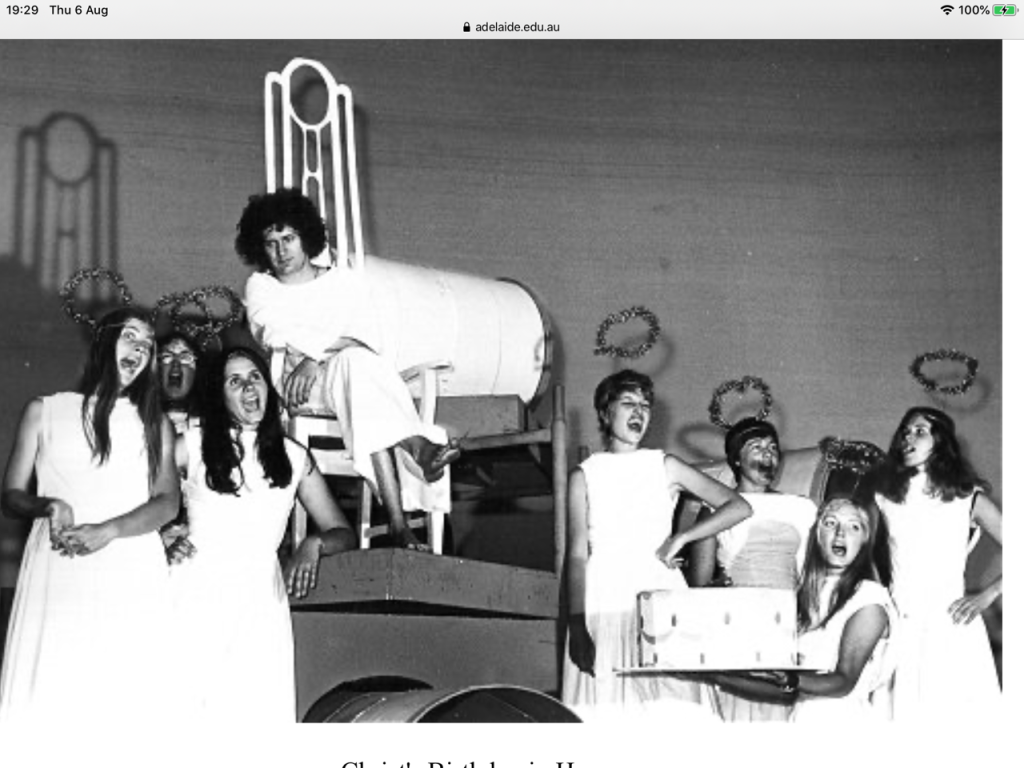
Well it’s not very often you hear me referring to Greek drama. My main connection was being involved in productions of Aristophanes’ plays when I was at university. Yes, yes, I pranced about the stage in some kind of draped confection that bore no resemblance to any known historical wardrobe. As above. Why were we wearing tinsel halos I wonder? And I think this must have been a rehearsal as everyone has their hair down, not up, I’m wearing specs and I always went myopic for actual performances. And thank the Goddess I’m being right royally upstaged and I cant’t actually see the costume on me.

Enough of that. Back to now. So why am I thinking about Greek drama…? Well a lot of the ways we think about writing can be traced back to Greek traditions. And today I’ve been thinking about The Chorus.

So here’s how I know…

View original post 863 more words

Rivendell

1960s: Days of Rage's avatar1960s: Days of Rage


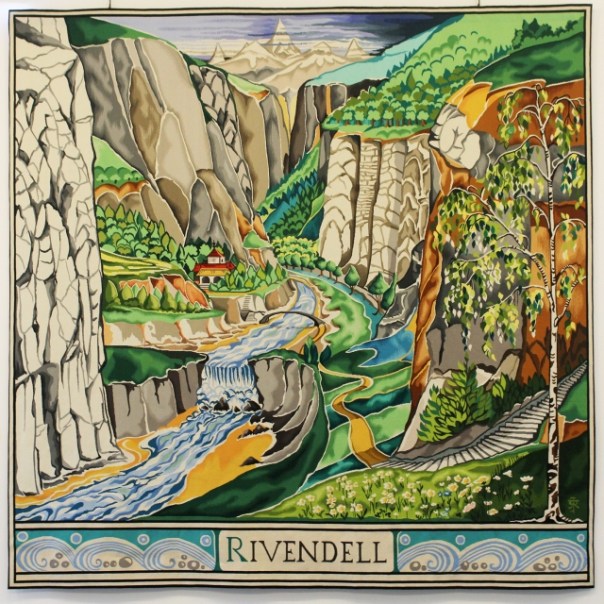
J. R. R. Tolkien’s 1937 painting of Rivendell

Rivendell is a valley in J. R. R. Tolkien‘s fictional world of Middle-earth, representing both a homely place of sanctuary and a magical Elvish otherworld. It is an important location in The Hobbit and The Lord of the Rings, being the place where the quest to destroy the One Ring began. Rivendell’s feeling of peace may have contributed to the popularity of The Lord of the Rings during the war-troubled 1960s. … The house of Elrond in Rivendell is also called The Last Homely House East of the Sea, alluding to the wilderness (Rhovanion) that lies east of the Misty Mountains. Rivendell lay in eastern Eriador at the edge of a narrow gorge of the river Bruinen (one of the main approaches to Rivendell comes from the nearby Ford of Bruinen), well hidden in…

View original post 246 more words

Delaney & Bonnie, “On Tour With Eric Clapton” (1970)

1960s: Days of Rage's avatar1960s: Days of Rage


“By the time On Tour with Eric Clapton was released in 1970, the husband/wife pairing of Delaney and Bonnie Bramlett could loosely be placed in the category of ‘seasoned veterans’ within the music industry, despite the fact that they had only been recording as a unit for a very short period of time. … Working on the television show would bring Bramlett in contact with Leon Russell (also a member of the Shindig! band) and Russell would play a very important role in Delaney’s musical future (and the pair also filtered into a potent scene of musicians featuring former Byrds members Gram Parsons and Chris Hillman that would eventually spawn The Flying Burrito Brothers). Bonnie Lynn O’Farrell was climbing her own ladder in the music industry, putting two notable notches onto her musical resume at a very early age, singing with blues legend Albert King and later, the Ike and…

View original post 277 more words

Heather Cox Richardson: The Indictment of Trump

dianeravitch's avatarDiane Ravitch's blog

I thought I would ignore the story you have read about in every publication: the unprecedented indictment of a former President of the United States. Special Counsel Jack Smith released the indictment yesterday, and I read every word. It is a dramatic narrative of a man who was determined to hold onto state secrets, storing them in public spaces, hiding them when necessary, completely indifferent to the law governing classified documents. The irony, as the indictment points out, is that Trump repeatedly lambasted Hillary Clinton in 2016 for being careless with state secrets and promised to enforce the law if elected.

If you haven’t read the indictment, please do so. At the least, it may make you wonder how Republicans can bring themselves, even now, to echo Trump’s claims that he is the victim of a witch-hunt.

Heather Cox Richardson summarizes the events of the past 24 hours and the…

View original post 1,667 more words

Azar Nafisi: James Baldwin, Iranian Women, and America’s Totalitarian Trend

dianeravitch's avatarDiane Ravitch's blog

Azar Nafisi was teaching American literature in Iran at the time of the revolution in 1979. Because she refused to wear the mandated head covering, she was forced to leave the university. She continued to teach her students in her home. She moved to the United States in 1997. In 2003, she published Reading Lolita in Teheran, which was a huge bestseller. She became an American citizen in 2008. Please open the link and read the interview in full. It appeared on the website of American Purpose.

Since the 1979 Iranian Revolution, Azar Nafisi has championed literature as an act of resistance against threats to freedom and imagination. To read dangerously, as Nafisi puts it, is to arouse curiosity and challenge the status quo.

Sahar Soleimany sat down with the critically acclaimed Iranian-American author to talk about the importance of resistance writers at a time of heightened threats to…

View original post 846 more words