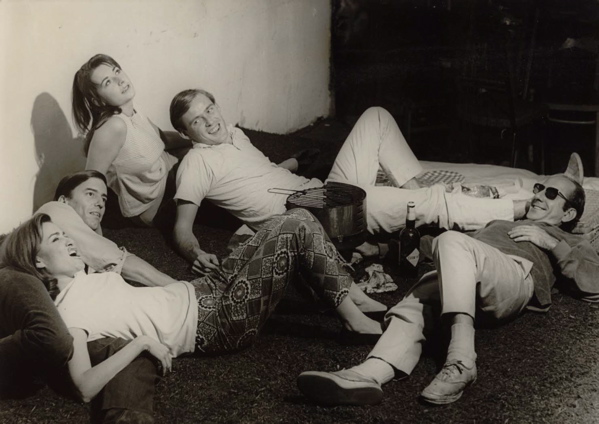
Bernardine Dohrn Was Called The Most Dangerous Woman In America. Now, Her Son Reconsiders Her Legacy.

1960s: Days of Rage's avatar1960s: Days of Rage


“Zayd Dohrn still vividly remembers the most striking moment of his childhood. ‘Coming down the stairs in our fifth-floor walk-up in Harlem,’ he told me from his living room in Chicago, ‘seeing these two guys leaning on a car, and knowing right away that they were federal agents.’ His parents, on the run from the FBI, had schooled him on telltale signs that they were being watched. ‘It had a nightmare quality,’ the 44-year-old playwright and Northwestern University professor said. ‘Definitely a moment of realizing your life is going to change, and realizing that all the things you’d been worried about or been thinking about as a kid were actually happening.’ Dohrn is the son of Bernardine Dohrn and Bill Ayers, two of the most notorious, mediagenic leaders of a radical wing of the late ’60s New Left: the Weather Underground. In Mother Country Radicals, his new podcast with…

View original post 165 more words

TCS: Have You Forgotten What We Were Like Then?

wordcloud9's avatarFlowers For Socrates

Good Morning!

__________________________________________

The present changes the past. Looking back,
you do not find what you left behind.
Kiran Desai, Indian author
of The Inheritance of Loss
_____________

“If your daily life seems poor, do not
blame it; blame yourself that you are
not poet enough to call forth its riches;
for the Creator, there is no poverty.”
Rainer Maria Rilke
_____________

View original post 3,098 more words

a letter from your writing

pat thomson's avatarpatter

This is a little exercise from my workshops and retreats. I don’t always do it. And I only do it with people who won’t think it’s really silly. But if people are prepared to go with it, then it can be interesting.

So what is it then? Well, I sometimes ask people to pause and take five or ten minutes to write a letter to themselves from their writing. Yes, that’s right. A letter to the writer from their writing.

I ask, What does your writing need you to do? What does your writing want from you now, at this minute? Sometimes I also ask if the writing has any advice about how to proceed.

OK, this sounds dopey. But there is a kind of method in its peculiarity. Switching your headset to become your writing is also often a switch to a more distanced perspective. And /or a more…

View original post 446 more words

Icarus’s Mother – Sam Shepard (1965)

1960s: Days of Rage's avatar1960s: Days of Rage

Cynthia Harris, Jim Barbosa, Lee Worley, John Kramer, and John Coe in “Icarus’s Mother”

Edward Albee wrote for the November 25, 1965, issue of The Village Voice. For those of you who are busy people, facts first, implications later. (And by facts I mean, of course, nothing closer to the truth than my opinions.) Sam Shepard is one of the youngest and most gifted of the new playwrights working off-Broadway these days. The signature of his work is its unencumbered spontaneity—the impression Shepard gives of inventing drama as a form each time he writes a play. His new theatre piece, ‘Icarus’s Mother,’ is presently on view at the Caffe Cino. Sad to say, it gives the impression of being a mess. Implications and general ruminations (for those of you who have the time): The playwright in the United States doesn’t have a particularly healthy environment to work in these…

View original post 231 more words

Nu Yorica! Culture Clash In New York City: Experiments In Latin Music 1970-77

1960s: Days of Rage's avatar1960s: Days of Rage


“This is the 20th anniversary expanded edition of one of Soul Jazz Records earliest definitive releases: ‘Nu Yorica : Culture Clash In New York City – Experiments in Latin Music 1970-77’, a stunning and ground-breaking collection of music bringing together Latin, Soul, Jazz, Funk and more from the melting pot of New York City in the 1970s. Out-of-print for more than ten years this new edition has been fully digitally remastered with new tracks, additional photography and is released as a deluxe 2CD pack + large outsize booklet, as well as a new edition of two super-loud super-heavy separate volumes of double vinyl. The album is also available for the first time as a worldwide digital release. Nu Yorica! is one of Soul Jazz Records most critically acclaimed albums of all time. The album features seminal Latin artists such as Eddie Palmieri, Joe Bataan, Machito, Ocho, Grupo Folklorico, Cortijo…

View original post 29 more words

Russia: How a Fish Became an Anti-War Symbol

dianeravitch's avatarDiane Ravitch's blog

As you surely know, any kind of protest against the war is forbidden in Russia. Anyone who dares to speak against the war is immediately arrested and jailed. Even calling the war a war is illegal. Protestors may be sent away for years. In this climate of repression, some bold Russians have found a way to express their anti-war views. The New York Times published some examples of these tiny acts of rebellion. Learn how a fish became an anti-war symbol.

Last year in St. Petersburg, an artist uploaded a few images of tiny clay figurines in a public space to Instagram under the account Malenkiy Piket, meaning Small Protest. In a separate post, he invited others to join him in his silent demonstration.

A yellow clay figurine raises a blank purple poster.

One of Malenkiy Piket’s first posts.

Since that post, he has received almost 2,000 images containing homemade figurines, many holding posters of protest with curious symbology…

View original post 516 more words

How the CIA Tricked the World’s Best Writers

1960s: Days of Rage's avatar1960s: Days of Rage

A distinguished roster of speakers attend the opening day of the General Conference of the Congress for Cultural Freedom in West Berlin June 16, 1960.
“‘The past is a foreign country,’ L.P. Hartley famously wrote as he opened The Go–Between. There is a pretty tristesse in the line, as Hartley intended, and it holds if the topic is lost love, the joys and errors of youth, all the roads not traveled. But anyone who thinks the thought applies to our institutions, ideologies, and policies, as we are incessantly encouraged to assume, needs to think again. In the political context we must revert to the other noted mot (Faulkner’s) on the topic: The past is not even past. It would be hard to bring this point home more saliently now than Joel Whitney does in Finks: How the CIA Tricked the World’s Best Writers. Whitney’s topic is “the instrumentalization…

View original post 295 more words

Stan Brakhage: Filmmaker

1960s: Days of Rage's avatar1960s: Days of Rage

… Edited David E. James “Workonthis collectionoftexts began some three years ago, whenwehoped to publish it in2003to celebrate Stan Brakhage’s seventieth birthday. Instead, belatedly, it mourns his death. The baby who would become James Stanley Brakhagewasborn on 14January 1933 in an orphanage in Kansas City, Missouri.Hewasadopted and named by a young couple, Ludwig, a college teacherofbusiness, and his wife, Clara, who had herself been raised by a stepmother. The family moved from town to town in the Middle West and, sensitive to the stressesofhis parents’ unhappy marriage, Stanleywasa sickly child, asthmatic and overweight. … He attempted to write a novel and renewed his friendship with the Gadflies, attending movies with them and beginning to read some of the classics of film theory. Especially taken with Cocteau’s Orpheus and

View original post 185 more words

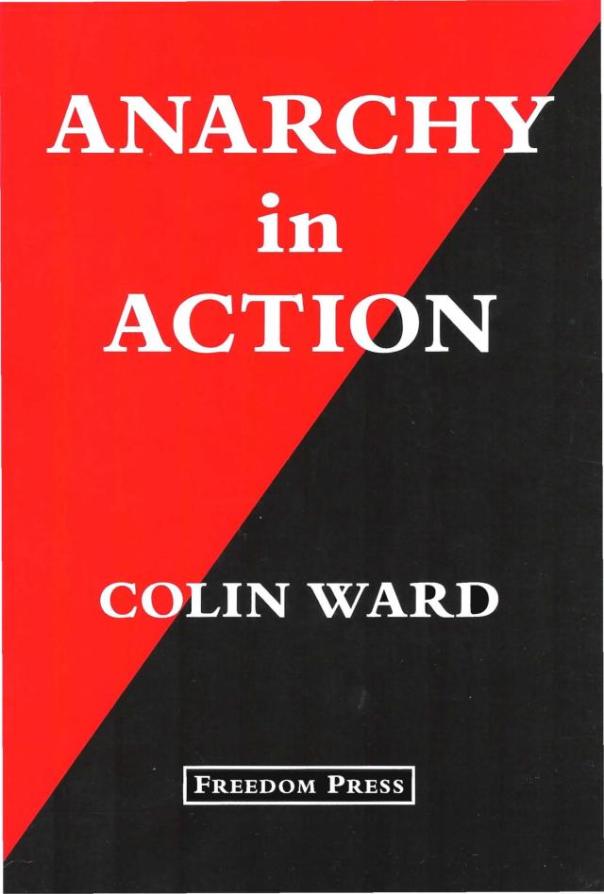
Anarchy in Action – Colin Ward (1973)

1960s: Days of Rage's avatar1960s: Days of Rage


“The argument of this book is that an anarchist society, a society which organizes itself without authority, is always in existence, like a seed beneath the snow, buried under the weight of the state and its bureaucracy, capitalism and its waste, privilege and its injustices, nationalism and its suicidal loyalties, religious differences and their superstitious separatism. Anarchist ideas are so much at variance with ordinary political assumptions and the solutions anarchists offer so remote, that all too often people find it hard to take anarchism seriously. This classic text is an attempt to bridge the gap between the present reality and anarchist aspirations, ‘between what is and what, according to the anarchists, might be.’ Through a wide-ranging analysis—drawing on examples from education, urban planning, welfare, housing, the environment, the workplace, and the family, to name but a few—Colin Ward demonstrates that the roots of anarchist practice are not so alien…

View original post 143 more words