Nancy Bailey: “The Truth About Reading” Isn’t True

dianeravitch's avatarDiane Ravitch's blog

Nancy Bailey is a retired teacher who battles misinformation and propaganda. In this post, she dissects a new film called “The Truth About Reading,” which is riddled with half-truths and omissions. It is yet another alarmist film that calls parents to the barricades to engage in another round of The Reading Wars.

She begins:

Americans are getting primed with a trailer for a new documentary called The Truth About Reading. It’s said there needs to be a grassroots movement of parents and educators who are angry and say enough is enough.

Wouldn’t it be better if teachers and parents met and shared their concerns about reading at their schools? Schools do various reading programs that might need review, especially if students have difficulty learning.

Open the link and read on.

View original post

A Schuyler of urgent concern

1960s: Days of Rage's avatar1960s: Days of Rage

James Schuyler in Calais, VT, late 1960s. Photo by Joe Brainard.

“Just a little more than twenty years after his death, James Schuyler seems to be doing well, thank you. The bulk of his work is in print (his collected and uncollected poems, three of his novels, and his letters), while the out of print materials (his art criticism, his diaries) are easy and still relatively cheap to come by. The reception of his unpublished poems, Other Flowers, two years ago was hugely positive and offered reviewers an opportunity to make big claims for Schuyler’s achievement, such as Dan Chiasson’s lovely statement that ‘James Schuyler is a supreme poet of articulated consciousness’ or Ange Mlinko’s judgment that ‘the weight of the world is a ballast against the levitating effect of James Schuyler’s courteous English, which made him our most angelic poet: full of air, intelligence, light.’ Nevertheless, Schuyler still doesn’t…

View original post 251 more words

TCS: Everything Remains Unchanged, but Nothing Stays the Same

wordcloud9's avatarFlowers For Socrates

. . Good Morning!

______________________________

Welcome to The Coffee Shop, just for you early risers
on Monday mornings. This is an Open Thread forum,
so if you have an off-topic opinion burning a hole in
your brainpan, feel free to add a comment.
______________________________

      Raise your words, not your voice.
It is rain that grows flowers, not thunder.
. . . . . . . . . . . . .– Rumi

View original post 2,301 more words

Hanging Out With Joan Didion: What I Learned About Writing From an American Master

1960s: Days of Rage's avatar1960s: Days of Rage


“I arranged to meet Joan Didion in 1971 after reading Slouching Toward Bethlehem. I found her essays hypnotic, in a voice I’d never heard, expressing ideas I knew were true but couldn’t have articulated. I was reporting for several magazines and asked a colleague who’d met her to introduce us. He gave me her number and when I was in LA, I took a deep breath, dialed it, and her husband, John Gregory Dunne, picked up the phone. I asked for Joan Didion. … Although she’s shy and can be reticent with strangers, we had much in common: we’d grown up in California, gone to Berkeley, joined a sorority and quit, majored in English and studied with Mark Schorer but in different decades—she in the 1950s, I in the 60s. We talked and laughed until the early hours, and in the many dinners and visits that followed, over more…

View original post 239 more words

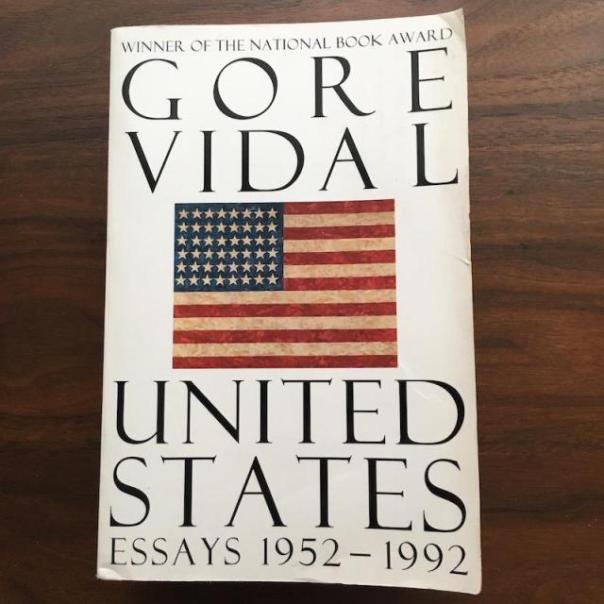
United States: Essays, 1952-1992 – Gore Vidal

1960s: Days of Rage's avatar1960s: Days of Rage

United States collects 114 essays written by Gore Vidal over the last four decades. Despite the reproduction of Jasper Johns’s forty-eight-star flag on the dust jacket, less than half of them are about politics. The rest describe books, places, and people he has known. Johnson’s Dictionary had hard words for the essay: ‘an irregular indigested piece; not a regular and orderly composition.’ Vidal serves the form better than that. He found his range when Eisenhower was president, and stuck to it. Most of these pieces are anchored to a discussion of some book. If it is a book he likes, Vidal provides a summary that is both detailed and interesting. He favors a bright, staccato prose, which draws its variety from the length of its sentences. Short fragments. Good for facts. These will be followed by long, elliptical tendrils of analysis or appraisal, occasionally wise, often witty, and…

View original post 235 more words

A Prince of Darkness and Election Fraudits

wordcloud9's avatarFlowers For Socrates

by IRENE FOWLER, Contributor


Democracy is like the sun;
it reaches and touches every individual.

– Irene Fowler

__________________________

Good morning everyone and welcome.

Whatever your preferred flavour of life is – sweet, savoury, spicy or somethin’ else, welcome to the melting pot. I am on West African time, so ‘servez-vous.’
Even though we are helpless to change things on a macro scale, we can in our own small ways, align with love and the positive. As we contribute our quota, we are building towards a critical mass which can force change/s for good.
__________________________

Something has fundamentally changed in the world when one of the leaders of the European Union mentions the American president among the top threats to European unity, along with Russian aggression, radical Islamic terrorism, and civil wars in the Middle East. On Tuesday, European Council President Donald Tusk did just that.” 

View original post 460 more words

The Hospital Occupation That Changed Public Health Care

1960s: Days of Rage's avatar1960s: Days of Rage


On July 14, 1970, members of the Young Lords occupied Lincoln Hospital in the South Bronx — known locally as the ‘Butcher Shop.’ A group of activists, many of them in their late teens and 20s, barricaded themselves inside the facility, demanding safer and more accessible health care for the community. Originally a Chicago-based street gang, the Young Lords turned to community activism, inspired by the Black Panthers and by student movements in Puerto Rico. A Young Lords chapter in New York soon formed, agitating for community control of institutions and land, as well as self-determination for Puerto Rico. Their tactics included direct action and occupations that highlighted institutional failures. Through archival footage, re-enactments and contemporary interviews, the documentary above shines a light on the Young Lords’ resistance movement and their fight for human rights. The dramatic takeover of Lincoln Hospital produced one of the first Patient’s…

View original post 77 more words

PBS: “Muhammad Ali” Four-part documentary series

1960s: Days of Rage's avatar1960s: Days of Rage

Like many aspects of Muhammad Ali’s life, this photo of him defeating Sonny Liston in 1965 transcended boxing. A new documentary assesses Ali’s impact inside the ring and out.

“There it was, legendary frame by legendary frame, frozen in time — continual snapshots when gladiators armed with red gloves and the power to persuade either championed the twisted hearts of this country, or drew the endless ire of it. And to think: This film reel of immortals was rescued from being dispatched to a landfill. If not for one Pennsylvania archivist, 38 reels of 16mm color reversal film of the best, most brutal boxing match in history would’ve landed in a sea of rubbish. Untouched, unseen, unfulfilled. Years earlier, Janice Allen salvaged a number of boxes tossed in a dumpster outside a film lab that had recently shut up shop for good. One box had ‘Ali’ written on it. She…

View original post 336 more words

The Tangier Diaries, 1962-1979 – John Hopkins

1960s: Days of Rage's avatar1960s: Days of Rage


“A writer’s perfunctory yet absorbing diary of his life in Tangiers. Lifelong ÇmigrÇ and novelist Hopkins (The Flight of the Pelican, 1984 etc.), fresh out of Princeton and convinced that Wall Street and the professions were not for him, jaunted around South America and Europe before finally pitching up in Morocco. There, on and off for 17 years, he pursued with gathering success his literary ambitions. Cheap, exotic, permissive, Morocco (especially Tangiers) was one of the places to be in the early ’60s, especially for writers and artists and American millionaires. Now it all seems almost mythic, a great, outlandish American Bloomsbury. Hopkins delivers all the expected goodies and more: the requisite desert meditations (‘This is what the desert does. It leaves you with a terrible nostalgia for the purity you left behind. That purity was you”), the kef-censed evenings in the kasbah, the celebrity sightings. Beyond the…

View original post 161 more words

Albert Camus on the Responsibility of the Artist: To “Create Dangerously” (1957)

1960s: Days of Rage's avatar1960s: Days of Rage


“Literary statements about the nature and purpose of art constitute a genre unto themselves, the ars poetica, an antique form going back at least as far as Roman poet Horace. The 19th century poles of the debate are sometimes represented by the dueling notions of Percy Shelley — who claimed that poets are the ‘unacknowledged legislators of the world’ — and Oscar Wilde, who famously proclaimed, ‘all art is quite useless.’ These two statements conveniently describe a conflict between art that involves itself in the struggles of the world, and art that is involved only with itself. In the mid-twentieth century, Albert Camus put the question somewhat differently in a 1957 speech entitled ‘Create Dangerously:Of what could art speak, indeed? If it adapts itself to what the majority of our society wants, art will be a meaningless recreation. If it blindly rejects that society, if…

View original post 271 more words