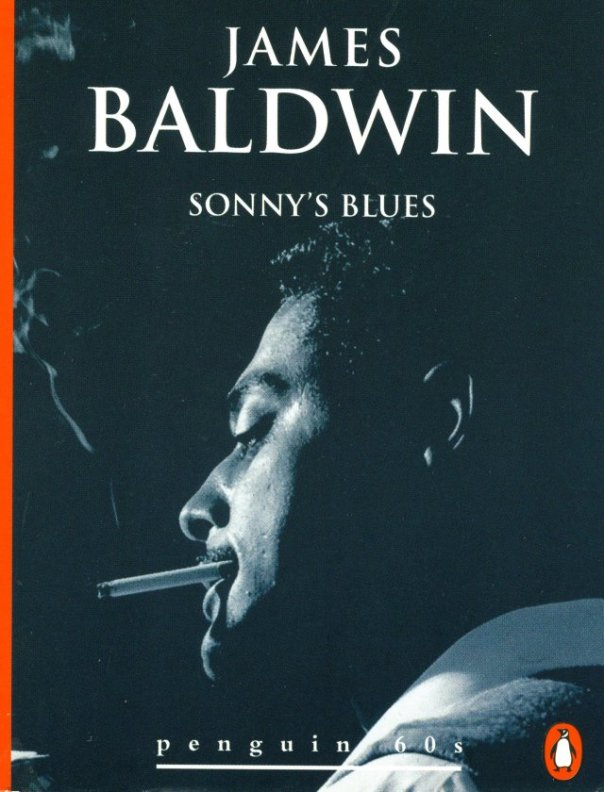
“Sonny’s Blues” – James Baldwin (1957)

1960s: Days of Rage's avatar1960s: Days of Rage


“‘Sonny’s Blues’ is a 1957 short story written by James Baldwin, originally published in Partisan Review. The story contains the recollections of a black algebra teacher in 1950s Harlem as he reacts to his brother Sonny’s drug addiction, arrest, and recovery. Baldwin republished the work in the 1965 short story collection Going to Meet the Man. ‘Sonny’s Blues’ is a story written in the first-person singular narrative style. The story opens with the unnamed narrator reading about a heroin bust resulting in the arrest of a man named Sonny, his brother. The narrator goes about his day as an algebra teacher at a high school in Harlem, but begins to ponder Sonny’s fate and worry about the boys in his class. After school, he meets a friend of Sonny, who laments Sonny will struggle with loneliness even after his detox and release. After the narrator’s…

View original post 264 more words
The 1968 Kerner Commission Report Still Echoes Across America

1960s: Days of Rage's avatar1960s: Days of Rage

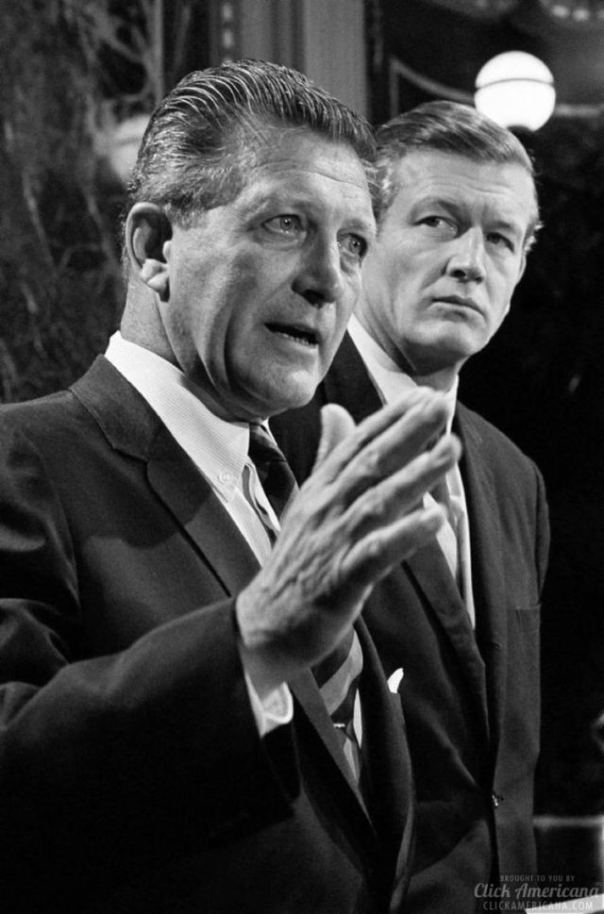
Then Illinois governor Otto Kerner, left, and New York mayor John Lindsay report on the National Advisory Commission on Civil Disorders in October 1967.

“A young African-American is killed by a white police officer in full view of others. Angry people take to the streets — unrest that goes on night after night, with scores injured and hundreds arrested. Sound familiar? But this was back in July 1964, in the Harlem and Bedford-Stuyvesant neighborhoods of New York. And far worse lay ahead. More racial rioting erupted the following summer in Los Angeles’s Watts section. In 1966 there was yet more, this time in Cleveland. Then came the disastrous summer of 1967. Chaos enveloped more than 160 American cities and towns, the most ruinous riots leading to 43 deaths in Detroit and 26 in Newark. With the nation reeling that summer, President Lyndon B. Johnson created a task force to explore…

View original post 256 more words

The Collected Works of Billy the Kid: Left-Handed Poems – Michael Ondaatje (1970)

1960s: Days of Rage's avatar1960s: Days of Rage


The Collected Works of Billy the Kid: Left-Handed Poems is a verse novel by Michael Ondaatje, published in 1970. It chronicles and interprets important events in the life of William Bonney, aka Billy the Kid, and his conflict with Sheriff Pat Garrett. The book presents a series of poems not necessarily in chronological order which fictionalize and relate Bonney’s more famous exploits, after the end of the Lincoln County War. The narrative includes his relationship with John and Sallie Chisum, his formation of a gang with Tom O’Folliard and Charlie Bowdre, his standoff with Garrett in Stinking Springs, his arrest and escape from Lincoln, New Mexico, his escape and the ensuing murder of James Bell and Robert Olinger, and finally his death at the hands of Garrett. Technical and stylistic elements:Makes use of free verse vignettes, mostly from Bonney’s perspective…

View original post 184 more words

An Introduction to E.A.T. – Engineers, the Avant-Garde and a Tennis Court

1960s: Days of Rage's avatar1960s: Days of Rage

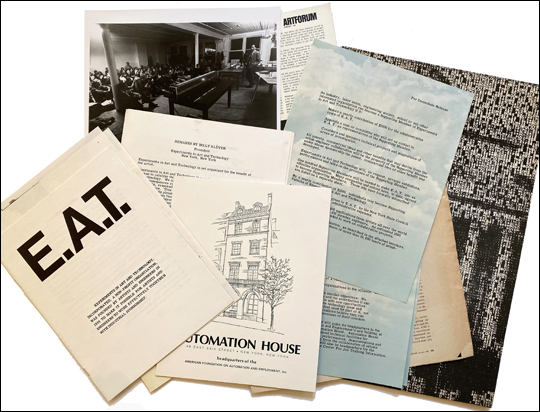
Set of Documentation of the Workings of Experiments in Art and Technology (E.A.T.) between 1966 and 1968

“On March 18th, 1960, a sculpture on the roof of New York’s Museum of Modern Art began to destroy itself. Engines attached to old baby carriages sent them careening through the space, mechanical arms banged out a dissonant tune on a piano and a paintbrush colored an unfurling paper that just as quickly caught on fire. The piece, titled Homage to New York and built by the French sculptor Jean Tinguely alongside engineer Billy Klüver, was created in order to self-destruct. The performance was the beginning of a series of collaborations that would bring together the worlds of art and technology in ways that were unimaginable in mid-century America. Klüver, originally from Sweden, was a technician at Bell Laboratories, whose innovations in the ’60s and ’70s paved the way for the digital age…

View original post 238 more words

Los Angeles Times: The “Unentitled Kids”: California’s New Generation of College-Bound Stars

dianeravitch's avatarDiane Ravitch's blog

Teresa Watanabe wrote a wonderful story about kids in a public school in Los Angeles who are college-bound, despite their demographic profiles. They don’t have college-educated parents or SAT tutors. What they do have is a school—the DowntownMagnets High School— where the professionals are dedicated to their success. Read about this school and ask yourself why Bill Gates is not trying to replicate it? Why is it not a model for Michael Bloomberg or Reed Hastings or the Waltons? Why do the billionaires insist, as Bloomberg said recently, that public education is “broken”? Despite their investing hundreds of millions to destroy public schools like the one in this story, they are still performing miracles every day.

They represent the new generation of students reshaping the face of higher education in California: young people with lower family incomes, less parental education and far more racial and ethnic diversity than college applicants…

View original post 998 more words

Edith Sedgwick (1943 – 1971)

1960s: Days of Rage's avatar1960s: Days of Rage


Edith Minturn Sedgwick Post (April 20, 1943 – November 16, 1971) was an American actress and fashion model. She is best known for being one of Andy Warhol’s superstars. Sedgwick became known as ‘The Girl of the Year’ in 1965 after starring in several of Warhol’s short films in the 1960s. … Despite her family’s wealth and high social status, Sedgwick’s early life was troubled. … In the fall of 1962, at her father’s insistence, Sedgwick was committed to the private Silver Hill psychiatric hospital in New Canaan, Connecticut. As the regime was very lax, Sedgwick easily manipulated the situation at Silver Hill, and her weight kept dropping. She was later sent to Bloomingdale, the Westchester County, New York division of the New York Hospital, where her anorexia improved markedly. Around the time she left the hospital, she had a brief relationship with a Harvard

View original post 303 more words

Edie Sedgwick: The life and death of the Sixties star

1960s: Days of Rage's avatar1960s: Days of Rage


Factory Girl Edie Sedgwick Painting, Dane Shue

“‘Her fog, her amphetamine, and her pearls…’ With three nouns, in ‘Just Like a Woman’ (said to have been inspired by her), Bob Dylan deftly summed up his friend Edie Sedgwick, the wayward princess of Andy Warhol’s multimedia Factory. More than 30 years after her short, tumultuous life ended, Edie is still causing ructions. Last month, Dylan threatened to sue the makers of Factory Girl, a movie starring Sienna Miller as Edie, claiming that he is defamed by Hayden Christensen’s portrayal of a singer whose rejection drives her to suicide. This week, Edie’s brother claimed that despite Dylan’s insistence that he and Edie never had a relationship, she became pregnant with his child and had an abortion. The producers describe the harmonica-playing character (named ‘Quinn’ in the press notes, but never called by name in the movie and identified only as “musician” in…

View original post 263 more words

“Stand by Your Man” – Tammy Wynette (1968)

1960s: Days of Rage's avatar1960s: Days of Rage


“‘Stand by Your Man’ is a song recorded by American country music artist Tammy Wynette, co-written by Wynette with Billy Sherrill. It was released on September 20, 1968 as the first single and title track from the album Stand by Your Man. It proved to be the most successful record of Wynette’s career, and is one of the most familiar songs in the history of country music. The song was placed at number one on CMT’s list of the Top 100 Country Music Songs. Released as a single, it stayed number one on the U.S. country charts for three weeks. ‘Stand by Your Man’ crossed over to the U.S. pop charts, peaking at number nineteen. It elevated Wynette—then one of many somewhat successful female country recording artists—to superstar status. … Vocal accompaniment is provided by The Jordanaires, who provided background vocals on…

View original post 252 more words

A Roundup of Round-Number Anniversaries Comes Around Again

Dave Astor's avatarDave Astor on Literature

With the dawning of the new year, thoughts again turn to round-number anniversaries of memorable novels. Let’s do this chronologically, shall we?

Daniel Defoe (pictured above) had quite a 1722 — exactly three centuries ago. Fresh off the success of 1719’s Robinson Crusoe, Defoe came out in 1722 with both Moll Flanders (which I’ve read) and A Journal of the Plague Year (which I haven’t yet). Among the reasons protagonist Moll Flanders is fascinating is that she’s a resourceful, law-breaking, “low-born” woman — certainly an unusual lead character for literature of that time.  

Jumping to 1822 — 200 years ago — there’s The Pirate by Sir Walter Scott. I’ve read quite a few Scott novels, but not that one. The Pirate got mixed reviews, making it less well-received than some of the author’s other historical-fiction works such as Ivanhoe, Rob Roy, and Old Mortality.

Many…

View original post 386 more words

TCS: Above All Shadows Rides the Sun

wordcloud9's avatarFlowers For Socrates

 Good Morning!

____________________________

Welcome to The Coffee Shop, just for you early risers
on Monday mornings. This is an Open Thread forum,
so if you have an off-topic opinion burning a hole in
your brainpan, feel free to add a comment.
____________________________

“We have a long way to go, and
there is time ahead for thought.”

— Treebeard, Lord of the Rings by J.R.R. Tolkien

View original post 1,784 more words