All posts by Dr. Dean Albert Ramser

Unknown's avatar

About Dr. Dean Albert Ramser

Slava Ukraine! Supporting student success in Ukraine. Retired educator (English / Education: GED2EdD; "Ми будемо поруч один з одним як члени людства в найкращому сенсі цього слова". (Горан Перссон) Слава Україна 🇺🇦 "We will be there for one another as fellow members of humanity, in the finest sense of the word." (Goran Persson) https://cal.berkeley.edu/DeanRamser

academic writing knowhow – setting the scene

pat thomson's avatarpatter

That first sentence. Your first thought. An opening gambit. Setting the scene. Attracting the reader. Aaargh. Starting a new piece of writing can be daunting. It’s no wonder that so many writers worry about how to begin.

But academic writers are comparatively lucky when it comes to starting off. Unlike fiction writers who must pull a brilliant beginning from the void, academic writers have something to fall back on. An established genre which they can use, if they wish.

What is this “established genre” I hear you ask? Well. Many academic texts begin with some contextual scene-setting. Papers, books, proposals often start with context. Then, once the scene is set, the writer goes on to say exactly what this particular text will be about.

Contextual scene setting can be comparatively slight in word terms, but a few sentences can do a lot of work. Scene-setting accomplishes five key things.

  1. It…

View original post 1,154 more words

The Grinding Down by Paul Blackburn

1960s: Days of Rage's avatar1960s: Days of Rage


“In the summer of 1963, poet Paul Blackburn wrote an essay in Kulchur 10 entitled ‘The Grinding Down,’ which mapped the contemporary landscape of the Mimeo Revolution and lamented for those beloved days of yore when Robert Creeley’s editorial vision surveyed the literary fringe from the lofty heights of Black Mountain Review (which itself rose from the broad shoulders and bushy brow of the 6 foot 7 inch Charles Olson). As Graham Rae would say, I am chuckling here. Let’s be honest, this is a dubious nostalgia. Black Mountain Review only folded six years earlier, a mere blip in terms of literary history. Although the beginnings of the Mimeo Revolution can be traced back to Waldport during World War II, things really only heated up when Black Mountain Review went down in flames in late 1957, along with the Howl Trial, the San Francisco Scene of Evergreen Review, and…

View original post 199 more words

S/Z – Roland Barthes (1970)

1960s: Days of Rage's avatar1960s: Days of Rage


S/Z, published in 1970, is Roland Barthes‘ structural analysis of ‘Sarrasine‘, the short story by Honoré de Balzac. Barthes methodically moves through the text of the story, denoting where and how different codes of meaning function. Barthes’ study made a major impact on literary criticism and is historically located at the crossroads of structuralism and post-structuralism. Barthes’s analysis is influenced by the structuralist linguistics of Ferdinand de Saussure; both Barthes and Saussure aim to explore and demystify the link between a sign and its meaning. But Barthes moves beyond structuralism in that he criticises the propensity of narratology to establish the overall system out of which all individual narratives are created, which makes the text lose its specificity (différance) (I). Barthes uses five specific ‘codes’ that thematically, semiotically/semiologically, and otherwise make a literary text reflect structures that are interwoven, but…

View original post 200 more words

Florida: Why Did Ron DeSantis Fire an Elected Local Prosecutor?

dianeravitch's avatarDiane Ravitch's blog

Florida Governor Ron DeSantis has a problem: he cannot tolerate dissent or what he sees as disobedience to his wishes. He seems to think that he can order or legislate complete subservience to his beliefs.

DeSantis fired Hillsborough County’s state attorney, Andrew Warren, who was twice elected to his post by the voters of the county. Warren has sued to have his position restored. The trial began this week.

The firing of Warren, like DeSantis’ firing of elected local school board members, suggests a man with an authoritarian temperament who recognizes no limits on his power.

The Miami Herald reported:

Lawyers will square off this week in a Tallahassee courtroom for a politically charged trial that’s expected to center on one question:

What was Gov. Ron DeSantis’ motive for yanking Andrew Warren from office? In a surprise move in August that made national headlines, Warren, Hillsborough County’s twice-elected state attorney…

View original post 431 more words

Gilbert Sorrentino: The Lost Laureate of Brooklyn

1960s: Days of Rage's avatar1960s: Days of Rage


“The last thing Gilbert Sorrentino did before he left California was sell his car. The novelist, a favorite of other writers if not the average American reader, called it the happiest day of his life: like many a native New Yorker, Sorrentino didn’t drive, not really. He had finally learned at the age of 52, the year before the born-and-bred Brooklynite and long-time Gothamite took a job teaching writing at Stanford. He stayed there 20 years, though his novels never lost their disparaging references to California, its culture and its weather. When he retired from teaching in 2002, he did something most people of his generation who left Brooklyn never did — he came back, back to Bay Ridge, the neighborhood where he’d grown up, the childhood setting that had occupied much of his literary imagination. Most people who have heard of that guitar pick-shaped neighborhood in the southwest corner of Brooklyn…

View original post 231 more words

Ed Sanders – Tales of Beatnik Glory

1960s: Days of Rage's avatar1960s: Days of Rage


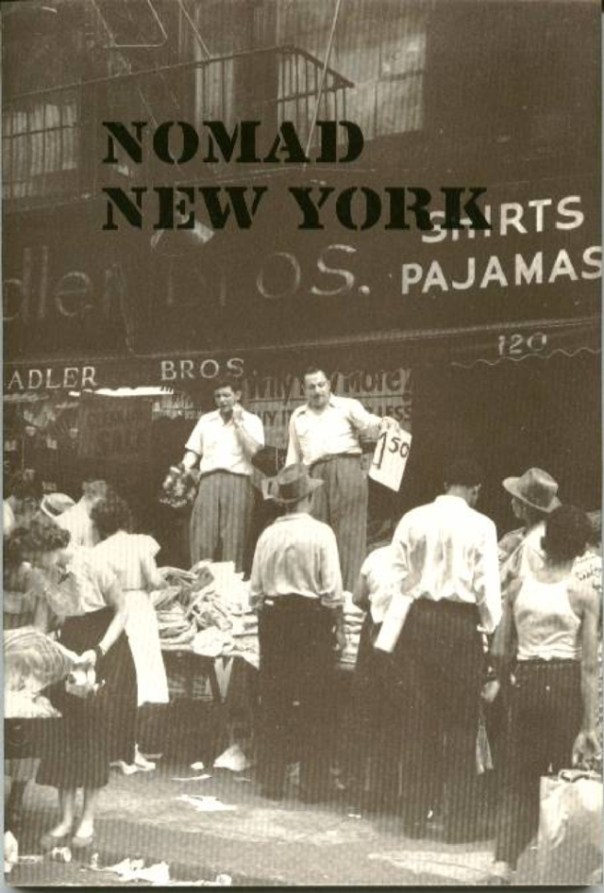
“… Foremost, it was [Ed] Sanders’s time, most certainly—Tales of Beatnik Glory proves it. As the owner of the Peace Eye bookstore, publisher of the legendary Fuck You: A Magazine of the Arts, and founding member of The Fugs, Ed Sanders was a central figure and originator on the beatnik-hippie scene. This new edition of his mammoth ode to the ’60s, written over a 30-year span, contains two new volumes in addition to the earlier two volumes published in 1975 and 1990, and brings the ‘interlocking story-flow to the end of 1969.’ It is both sweet, thrilling, and sad to be reading the completed work in my apartment in the East Village, Sanders’s old stomping grounds, where four-room tenement apartments sell for $400,000 and up. Diners and cheap eats have been replaced by faux Belgium bars hawking steak frites that, if it were 1965 again,would set you back…

View original post 192 more words

The Wanderers – Richard Price (1973)

1960s: Days of Rage's avatar1960s: Days of Rage


“This is a superbly written book about coming of age in a section of the Bronx. The Wanderers are not the only gang in this world. The most feared are the Ducky Boys, hundreds of stunted Irish madmen who suddenly appear from the trees and doorways like ‘foaming rats’ with old-fashioned straight razors and baseball bats studded with razors. Yet the book is not about teen-age gangs, but about survival and the groping for answers to unformulated questions. It is also about the breakdown of The Wanderers as its members drift, lunge and fumble into the larger world far from the security of the gang and the Big Playground. Although there is violence here, the violence of gang fights, of fear, of death and rape, the people in “The Wanderers” are part of middle-class America, the backbone of our nation. This is the most terrifying aspect of this book. The…

View original post 182 more words

Brewster McCloud – Robert Altman (1970)

1960s: Days of Rage's avatar1960s: Days of Rage


Brewster McCloud is a 1970 American black comedy film directed by Robert Altman. The film follows a young recluse (Bud Cort, as the title character) who lives in a fallout shelter of the Houston Astrodome, where he is building a pair of wings in order to fly. He is helped by his comely and enigmatic ‘fairy godmother,’ played by Sally Kellerman, as he becomes a suspect in a series of murders, of which a vain, haughty hot-shot detective lieutenant from San Francisco, played by Michael Murphy, soon becomes hot on his trail. The film opens with the usual MGM logo, but with a voice-over by René Auberjonois saying “I forgot the opening line” instead of the lion’s roar. As the opening credits roll, wealthy Houstonian Daphne Heap (Margaret Hamilton) begins to sing ‘The Star-Spangled Banner’ on the field of the Astrodome…

View original post 215 more words

TCS: Freedom is a Dream – Rebels, Refugees, and Romantics

wordcloud9's avatarFlowers For Socrates

    Good Morning!

_____________________________

Welcome to The Coffee Shop, just for you early risers
on Monday mornings. This is an Open Thread forum,
so if you have an off-topic opinion burning a hole in
your brainpan, feel free to add a comment.

 _____________________________

“Those who won our independence … valued
liberty as an end and as a means. They believed
liberty to be the secret of happiness and courage

to be the secret of liberty.”
            – Justice Louis D. Brandeis

“I think of a hero as someone
who understands the degree
of responsibility that comes
with his freedom.”
         – Bob Dylan

View original post 3,991 more words

March to Montgomery

1960s: Days of Rage's avatar1960s: Days of Rage

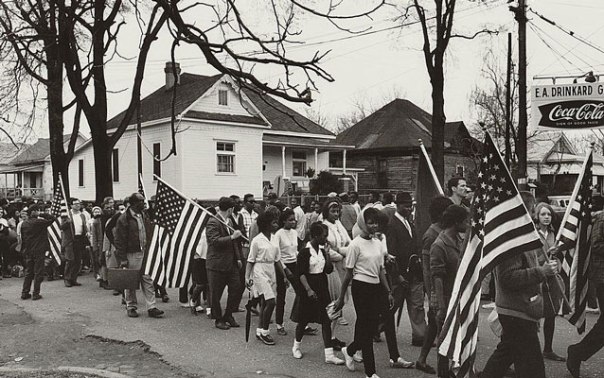
Participants, some carrying American flags, marching in the civil rights march from Selma to Montgomery, Alabama in 1965

“A week after [James] Reeb’s death, on Wednesday March 17, Judge Johnson ruled in favor of the protesters, saying their First Amendment right to march in protest could not be abridged by the state of Alabama: The law is clear that the right to petition one’s government for the redress of grievances may be exercised in large groups . … These rights may … be exercised by marching, even along public highways. Judge Johnson had sympathized with the protesters for some days, but had withheld his order until he received an iron-clad commitment of enforcement from the White House. President Johnson had avoided such a commitment in sensitivity to the power of the state’s rights movement, and attempted to cajole Governor Wallace into protecting the marchers himself, or at least giving the…

View original post 243 more words