All posts by Dr. Dean Albert Ramser

Unknown's avatar

About Dr. Dean Albert Ramser

Slava Ukraine! Supporting student success in Ukraine. Retired educator (English / Education: GED2EdD; "Ми будемо поруч один з одним як члени людства в найкращому сенсі цього слова". (Горан Перссон) Слава Україна 🇺🇦 "We will be there for one another as fellow members of humanity, in the finest sense of the word." (Goran Persson) https://cal.berkeley.edu/DeanRamser

New York: 1962-1964

1960s: Days of Rage's avatar1960s: Days of Rage


“A historical exhibition aims to show us past life, but sometimes the retrospective becomes reflective, a two-way mirror seeing through to the present. So it is with New York 1962–1964 at The Jewish Museum, certainly at the moment our fair city’s most enveloping visual and aural museum experience. With more than 150 works spanning vanguard fine art, outré fashion, cult film, political periodicals, and documentary videos of radical dance and news, the real stars of the show are its wranglers. Selldorf Architects’s contextualized installation design is thrilling. At the entry, the stage is set: we are invited to imagine ourselves within a mural photograph of office workers attired in fitted suits and dresses at the lunch counter—its rear sign announcing a bank of phone booths—then, at a lurid juke box in front of it, to punch in the number of our favorite tune of the era, no coin required. That’s…

View original post 240 more words

The Young Insurgent’s Commonplace-Book: Adrienne Rich’s “Snapshots of a Daughter-in-Law”

1960s: Days of Rage's avatar1960s: Days of Rage


“I wish I could remember when I first read ‘Snapshots of a Daughter-in-Law.’ It could have been in 1963, when the eponymous book appeared, but if it had, it would have been a revelation (which I did not have for some years) that other women poets were grappling with the issues I was at twenty, that there might be dialogue and exchange, if not in conversations and letters, in the way a poem in a book calls another poet back to notebook and pen. Like Rich herself at twenty, my literary dialogues on and off the page were largely with men: on one hand, Auden, Lowell, Berryman, on the other, the acolytes of the ‘San Francisco Renaissance‘ talking of and reading the work of Jack Spicer and Robert Duncan to their East Coast juniors. I read Ariel in 1963, and like other women poets of…

View original post 163 more words

Starting From Scratch: Cornelius Cardew and the Orchestra as Insurgency

1960s: Days of Rage's avatar1960s: Days of Rage


“… A newspaper ad appealing for witnesses even misidentified the victim. The deceased was a member of the Central Committee of the Revolutionary Communist Party of Britain (Marxist-Leninist). Over the preceding years he had clashed numerous times with far-right political groups in East London. Just six weeks before his death he had been arrested at the House of Commons for scattering leaflets and shouting, ‘This house stinks of racism!’ during a speech by the Ulster Unionist MP (and former Conservative Health Minister) Enoch Powell. In the coded communications of his Party, the dead man had been known as Ernest. But he was born Cornelius Cardew, in Winchcombe, Gloucestershire, in 1936, and he was one of the most fascinating composers of the 20th century. Michael Nyman had first spoken of musical ‘minimalism’ in a review of one of his works; Brian Eno was a fan. So was Robert Wyatt, who called…

View original post 201 more words

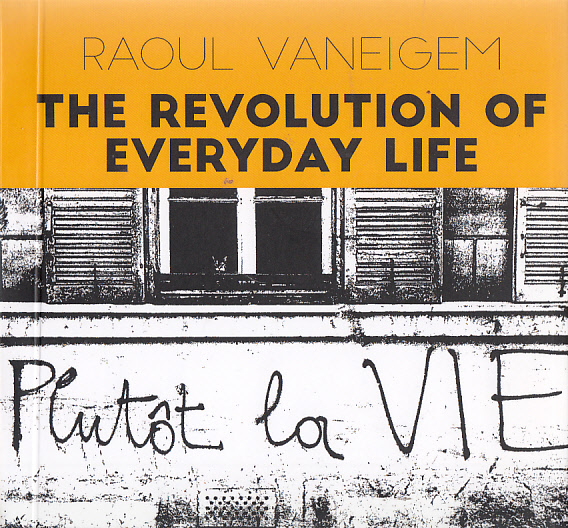
The Revolution of Everyday Life – Raoul Vaneigem (1967)

1960s: Days of Rage's avatar1960s: Days of Rage


“The Belgian-born writer, scholar and theorist Raoul Vaneigem (b. 1934) is best known as the author of the 1967 essay The Revolution of Everyday Life, a wide-ranging inquiry into the alienation of the individual under capitalism and an animated call for a post-capitalist society, grounded in radical self-management and non-hierarchical social relations. He wrote the book during his prolific involvement in the notorious and influential Situationist International (SI, 1957-1972). Born out of various surrealist avant-gardes of inter- and postwar Europe, the Situationists were a diverse, conspicuously small, but always strident transnational group of Marxian-inspired artists and writers, whose initial pursuit was to suspend the separation of art from the lived everyday. They consciously constructed ‘situations’ that were intended to subvert the bourgeois mundane of consumer capitalism, an order they described as spectacular society — a concept later fully elaborated by Guy Debord — that precluded authentic living and inevitably…

View original post 183 more words

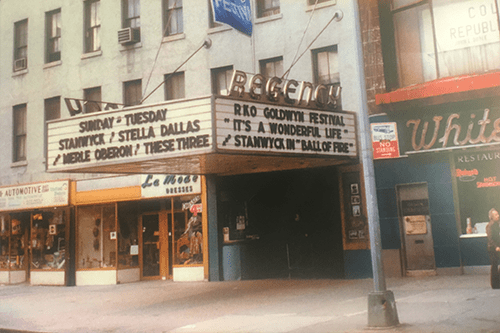
Repertory Movie Theaters of New York City: Havens for Revivals, Indies and the Avant-Garde, 1960-1994

1960s: Days of Rage's avatar1960s: Days of Rage


“Ben Davis’ excellent new book thoroughly explores the history, culture and importance of the repertory movie theaters that influenced the art film scene in New York City from the 1960s into the 1990s. In this well organized and impressively researched monograph, the author explains and analyzes the ways that the major repertory film theaters contributed to the film scene and to the creation of a cinephilic community – both casual and extreme- among a diverse group of filmgoers in New York City. Part One focuses on the First Wave of Repertory Theaters that took place in New York City during the 1960s. Davis begins this section with a clear explanation of the historical and cultural context in which these theaters emerged. He examines the larger art scene and the demographic changes taking place in New York and across the nation as part of a significant cultural revolution. He clearly defines…

View original post 219 more words

Mississippi: Ethics Commission Rules that State Legislature Is Not a “Public Body”

dianeravitch's avatarDiane Ravitch's blog

Imagine a crusading news site in Mississippi, one of the poorest and most corrupt states in the nation. That news site is the Mississippi Free Press. It recently filed a complaint with the state ethics commission after it was excluded from a meeting of the GOP caucus, which is so large that it constitutes a quorum.

The ethics commission ruled that the state legislature is not a “public body.”

The Mississippi Ethics Commission held its likely final discussion on the Mississippi Free Press’ complaint against the State House of Representatives today, restating their disagreements over the commission’s decision to declare the Mississippi Legislature not a public body under the Open Meetings Act. The Zoom stream of today’s meeting had high attendance of up to 70 viewers at one time, including representatives of multiple media outlets.

The Mississippi Free Press first filed a complaint in April 2022, after this reporter was…

View original post 365 more words

The National Archives Is About to Release More JFK Files. Here’s What to Expect.

1960s: Days of Rage's avatar1960s: Days of Rage


“For this nation’s army of conspiracy theorists, few long-secret government documents have whipped up so much suspicion in the 59 years since President John F. Kennedy’s death as the CIA’s massive, multivolume background file on assassin Lee Harvey Oswald. White House officials hope at least a little of that suspicion will be lifted later today, when President Biden is expected to order the National Archives to release once-classified information from about 8,000 documents related to the assassination, including many drawn from the so-called 201 ‘personality’ file the CIA maintained on Oswald before and after Kennedy’s murder. Officials involved in negotiations this fall among the White House, the National Archives and the CIA tell POLITICO Magazine the document release will be the most significant since 2017, when then-President Donald Trump waived a supposedly concrete legal deadline to declassify all secret government documents related to the JFK assassination. The 2017 deadline was…

View original post 178 more words

The Schools That Indoctrinate Students

dianeravitch's avatarDiane Ravitch's blog

The claim that public schools “indoctrinate” their students is an integral part of the rightwing attack on public schools . This is a canard, a bald-faced lie.

The rightwingers insist that any efforts to teach tolerance and acceptance of others is “indoctrination.” Teaching children the importance of justice, they say, is “woke.”

This is the mission of public schools: to teach children academic skills and knowledge, of course, but also to teach them to work with people who are different from them and their family.

Teaching children to live, work, and play with others and to respect others is important to the functioning of our democracy. We are a people of many diverse origins, different nationalities, different religions. One of the implicit functions of public schools is to help bind us together as one nation, one people who share civic values.

Do you know which schools truly indoctrinate students? Religious…

View original post 358 more words

A Bronx Tale: The Story Of The Ghetto Brothers

1960s: Days of Rage's avatar1960s: Days of Rage


“Benjy Melendez bounds down a staircase at the entrance to the Prospect Avenue elevated subway station in the South Bronx, looks around at the buildings dotting the intersection and sweeps his left arm for emphasis as he declares, ‘This used to be paradise for The Ghetto Brothers!’ These days, the 60-year-old Melendez lives in Harlem, but as the 60s rolled over into the 70s, the South Bronx area he’s revisiting became the setting for a drama that saw a member of Melendez’s gang, The Ghetto Brothers, brutally bludgeoned and then stabbed to death – a loss that kick-started a peace-treaty between Bronx gangs and reinforced Melendez’s conviction to reposition his crew as a force for local good, shunting drug dealers out of the area and organising food and clothing drives. This broad redemption story also happened to play out against a curious musical backdrop of intermingling local Latin rhythms and…

View original post 217 more words

Against Completism: On Sylvia Plath’s New Short Story

1960s: Days of Rage's avatar1960s: Days of Rage


“When I heard that a previously unpublished Sylvia Plath short story would appear in January 2019, I requested an electronic galley and then let the file sit unopened in my inbox for several weeks. I felt apprehensive, even frightened of it. I love Plath’s poetry, but what if I didn’t like this story? I read The Bell Jar so long ago, when I was fourteen or so, that I couldn’t remember anything about it. But I read The Catcher in the Rye at around the same time, and I remember that book clearly. Had I only meant to read The Bell Jar, and never finished it? Oh God, I thought, what if none of Plath’s fiction is good? I decided to read The Bell Jar again before addressing the new old short story. … The Bell Jar is also not just autobiographical but meta, which may be the defining…

View original post 215 more words