All posts by Dr. Dean Albert Ramser

Unknown's avatar

About Dr. Dean Albert Ramser

Slava Ukraine! Supporting student success in Ukraine. Retired educator (English / Education: GED2EdD; "Ми будемо поруч один з одним як члени людства в найкращому сенсі цього слова". (Горан Перссон) Слава Україна 🇺🇦 "We will be there for one another as fellow members of humanity, in the finest sense of the word." (Goran Persson) https://cal.berkeley.edu/DeanRamser

George F. Will: Is FOX News Entertainment or Journalism?

dianeravitch's avatarDiane Ravitch's blog

No major media outlet did more to spread the lie that Trump won the 2020 election than FOX NEWS. It gave a platform to election deniers, including those who baselessly claimed that Dominion Voting Systems rigged the vote to favor Biden. Dominion is suing FOX and some of the leading exponents of this view. The case will be heard in April.

We now know, after publication of the depositions, that no one at FOX believed Trump’s lies. They agreed to spread them to protect their ratings. We will be watching to see if FOX is held accountable for allowing liars to undermine our democracy.

George Will wrote about the case. He does not defend FOX.

Five days after the 2020 presidential election, Sidney Powell, the fabulist lawyer, appeared on Maria Bartiromo’s Fox News show to say there has been “a massive and coordinated” effort to “delegitimize and destroy” Trump votes…

View original post 771 more words

Analysis of Paul Bowles’s Novels

1960s: Days of Rage's avatar1960s: Days of Rage


“Bowles holds a unique place in American literature. As an exile, he shared with 1920’s expatriate novelist Gertrude Stein, among others, a distanced perspective on his native culture. Through his translations, he earned an international reputation as an author with a North African sensibility. His fiction reflects a world akin to that written about by existentialists Jean-Paul Sartre or Albert Camus, and indeed he has been described as America’s foremost existentialist writer, a label more likely to restrict him to a time period than to characterize his fiction accurately. Although his nihilism does strike one as a bit pretentious, it also has a modern application, reflecting as it does a dark vision of the world as contemporary as the times demand. Bowles became a guru of sorts to the Beat generation, although Bowles’s attraction for them was as much for his writings about drugs as for his generally pessimistic…

View original post 199 more words

Psychogeography

1960s: Days of Rage's avatar1960s: Days of Rage

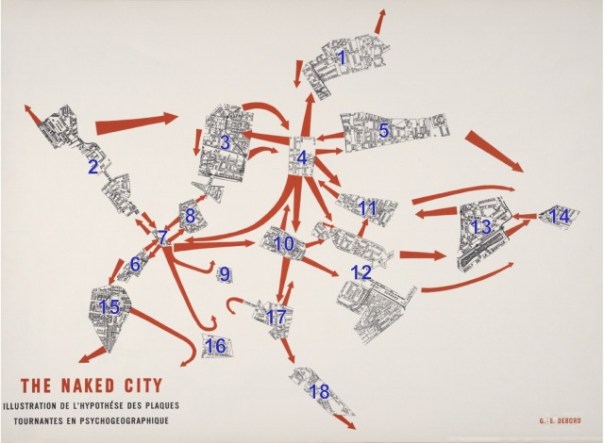
Guy Debord’s “Naked City”, map of Paris
Psychogeography is the exploration of urban environments that emphasizes interpersonal connections to places and arbitrary routes. It was developed by members of the Letterist International and Situationist International, which were revolutionary groups influenced by Marxist and anarchist theory as well as the attitudes and methods of Dadaists and Surrealists. In 1955, Guy Debord defined psychogeography as ‘the study of the precise laws and specific effects of the geographical environment, consciously organized or not, on the emotions and behavior of individuals.’ One of the key tactics for exploring psychogeography is the loosely defined urban walking practice known as the dérive. As a practice and theory, psychogeography has influenced a broad set of cultural actors, including artists, activists and academics. … The Lettrists’ reimagining of the city has its precursors in aspects of Dadaism and Surrealism. The concept of the flâneur

View original post 165 more words

Russian Exiles Plan Demonstrations Against the War in Ukraine

dianeravitch's avatarDiane Ravitch's blog

As many as one million Russians have fled their country in protest against Putin’s unprovoked invasion of Ukraine. The exiles include intellectuals, journalists, and high-tech workers, as well as draft-age men who refused to go to war for Putin’s territorial ambitions. This weekend, exiles plan to demonstrate against the war in 44 countries.

Russian opposition groups in more than 100 cities in 44 countries around the world — from Berlin to Seoul to Los Angeles — plan to mark the anniversary of the Kremlin’s full-scale invasion of Ukraine on Friday with three days of demonstrations outside of Russian diplomatic missions or on public squares.

The organizers are calling the protests a test of whether their historically fractious groups, which operate outside of Russia, can work in a coordinated manner to oppose the Kremlin. The groups are hoping to achieve “an unprecedented level of cooperation within the diaspora,” said one coordinator…

View original post 256 more words

Timothy Snyder: 15 Reasons Why the World Needs a Ukrainian Victory

dianeravitch's avatarDiane Ravitch's blog

Timothy Snyder, the noted historian of democracy and tyranny at Yale University, wrote a post listing fifteen reasons why the world needs Ukraine to win and defeat Russian aggression against its very existence as a nation. Most important is to stop the genocidal slaughter of Ukrainians. The New York Times documented 339 significant cultural sites—museums, performing arts centers for theater, music, and dance, historical sites, and other cultural treasures—that have been destroyed in the Russian effort to eliminate Ukrainian existence as a nation.

He writes:

Why does the world need a Ukrainian victory?

1. To halt atrocity. Russia’s occupation is genocidal. Wherever the Ukrainians recover territory, they save lives, and re-establish the principle that people have a right not to be tortured, deported, and murdered.

2. To preserve the international legal order. Its basis is that one country may not invade another and annex its territory, as Russia seeks…

View original post 771 more words

Allan Kaprow

1960s: Days of Rage's avatar1960s: Days of Rage


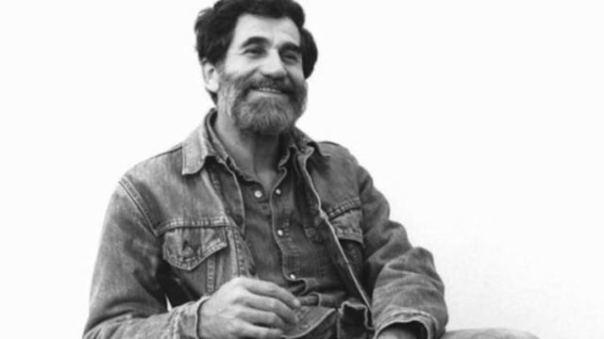
Allan Kaprow (August 23, 1927 – April 5, 2006) was an American painter, assemblagist and a pioneer in establishing the concepts of performance art. He helped to develop the ‘Environment‘ and ‘Happening‘ in the late 1950s and 1960s, as well as their theory. His Happenings — some 200 of them — evolved over the years. Eventually Kaprow shifted his practice into what he called ‘Activities’, intimately scaled pieces for one or several players, devoted to the study of normal human activity in a way congruent to ordinary life. Fluxus, performance art, and installation art were, in turn, influenced by his work. … It was here that he started with a style of action painting, which greatly influenced his Happenings pieces in years to come. He went on to study composition with John Cage in his class at the New School…

View original post 215 more words

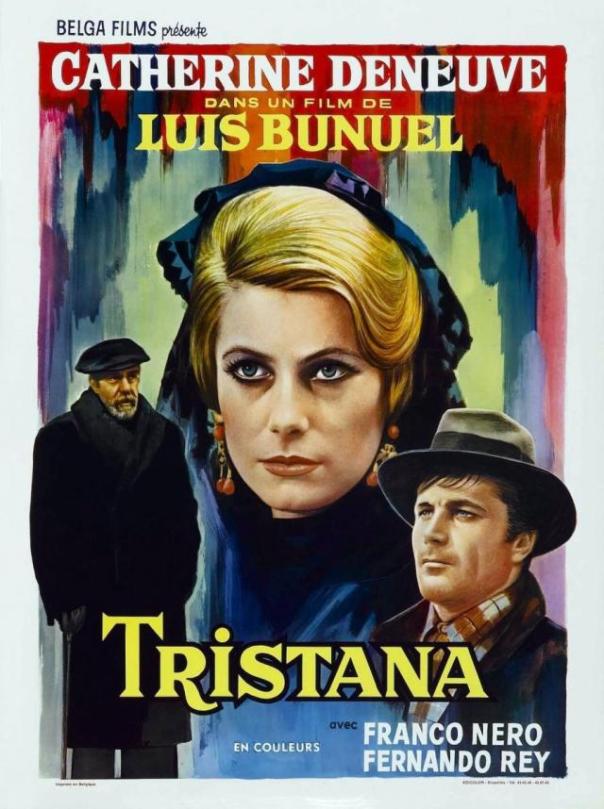
Tristana – Luis Buñuel (1970)

1960s: Days of Rage's avatar1960s: Days of Rage

“The journal entry above, dated October 4, 1969, was written during the second week of shooting Tristana (1970), Catherine Deneuve’s second—and final—collaboration with Luis Buñuel after the enormous success of Belle de Jour (1967). Abounding in bizarre detail, the jotting succinctly captures Tristana’s impeccable balance of precision and perversion. As in Belle de Jour—in which Deneuve’s character, Séverine, a YSL-clad haute bourgeoise, finds erotic liberation through byzantine psychosexual fantasies and part-time work at a boutique bordello, where she is christened with the nom de pute of the title—Tristana hinges on the defilement of its eponymous character. When the film opens, Tristana is all in black, still in mourning for her recently deceased mother. The innocent, timid, orphaned teenager becomes the ward of Don Lope (Buñuel regular Fernando Rey), a lecherous, hypocritical, overweening Manchegan aristocrat who wastes no time in seducing her. ‘I’m your father and your husband,’ the…


View original post 176 more words

Ezra Pound, The Art of Poetry No. 5 (1962)

1960s: Days of Rage's avatar1960s: Days of Rage


Interviewed by Donald Hall : “Since his return to Italy, Ezra Pound has spent most of his time in the Tirol, staying at Castle Brunnenburg with his wife, his daughter Mary, his son-in-law Prince Boris de Rachewiltz, and his grandchildren. However, the mountains in this resort country near Merano are cold in the winter, and Mr. Pound likes the sun. The interviewer was about to leave England for Merano, at the end of February, when a telegram stopped him at the door: ‘Merano icebound. Come to Rome.’  Pound was alone in Rome, occupying a room in the apartment of an old friend named Ugo Dadone. It was the beginning of March and exceptionally warm. The windows and shutters of Pound’s corner room swung open to the noises of the Via Angelo Poliziano. The interviewer sat in a large chair while Pound shifted restlessly from another chair to a sofa and…

View original post 149 more words

five focusing questions to kick off some writing

pat thomson's avatarpatter

So you’re about to write a paper. Or a chapter. You’ve gathered together all of the stuff you think you need – analysed data, a short list of references to cite, some early jottings. Now you begin to think about doing some free writing to get into the swing of it. Or perhaps you might get straight to an outline or aTiny Text

Hang on a bit. Before you put the timer on, or start writing about context (the first move in an outline or Tiny Text) it might be quite helpful to consider a bit more structured writing-thinking work. It often helps to focus on what you want to say, why, how and to whom, right at the outset. So to that end, here are some relevant questions to ask yourself. I’ve adapted these from David Labaree, and added to them.

These five sets of questions…

View original post 556 more words

Folksangere TV: A Danish TV documentary on the London folk scene of 1966/67.

1960s: Days of Rage's avatar1960s: Days of Rage


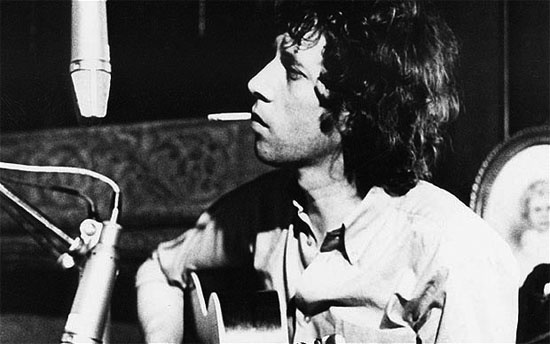
Bert Jansch

“… It’s no surprise that in 1967, when a team from Denmark’s Folksangere TV programme arrived in London looking for the epicentre of the folk guitar explosion, they were swiftly sent to see Bert (Jansch) and John (Renbourn). The resulting footage has survived and the passing years have only conspired to make it seem more amazing. We see John, making light work of I Know My Babe from his second album Another Monday. Then we get to see a little history being made. Bert and John face each other and work out – possibly even improvise – a new composition. If you had everything they’d recorded at that point, you wouldn’t have recognised it. Between them, on the settee, John’s then-wife Judy is immersed in the Telegraph crossword, indifferent to what’s going on around her. You can’t help but be impressed by her show of insouciance. In…

View original post 206 more words