All posts by Dr. Dean Albert Ramser

Unknown's avatar

About Dr. Dean Albert Ramser

Slava Ukraine! Supporting student success in Ukraine. Retired educator (English / Education: GED2EdD; "Ми будемо поруч один з одним як члени людства в найкращому сенсі цього слова". (Горан Перссон) Слава Україна 🇺🇦 "We will be there for one another as fellow members of humanity, in the finest sense of the word." (Goran Persson) https://cal.berkeley.edu/DeanRamser

Socialist feminism

1960s: Days of Rage's avatar1960s: Days of Rage


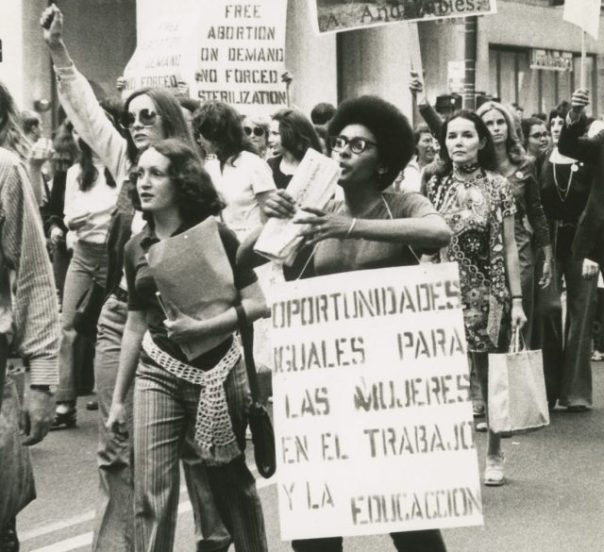
Socialist feminism rose in the 1960s and 1970s as an offshoot of the feminist movement and New Left that focuses upon the interconnectivity of the patriarchy and capitalism. However, the ways in which women’s private, domestic, and public roles in society has been conceptualized, or thought about, can be traced back to Mary Wollstonecraft‘s A Vindication of the Rights of Woman (1792) and William Thompson‘s utopian socialist work in the 1800s. Ideas about overcoming the patriarchy by coming together in female groups to talk about personal problems stem from Carol Hanisch. This was done in an essay in 1969 which later coined the term ‘the personal is political.’ This was also the time that second wave feminism started to surface which is really when socialist feminism kicked off. Socialist feminists argue that liberation can only be achieved by working to end both the economic and cultural

View original post 195 more words

Story and research writing

pat thomson's avatarpatter

You often hear that writing about research is story telling. This is partly right and partly not. Partly not, because a lot of academic writing is better thought of as argument. Argument relies on evidence to make a case for a particular research result. And partly not story, because some research writing is reporting results. Reports rely on a standard order of content. So here then is the question, how is research writing like telling a story?

And one answer to this question is man in hole. Man in hole is an answer which can guide your writing. Man in hole is attributed to the late Kurt Vonnegut. Vonnegut developed five classic story structures. Now, Vonnegut is not the only person to develop universal story structures. But let’s stick with Vonnegut and his man in hole structure for now.

So if you’ve watched this little video, you’ve probably worked out…

View original post 165 more words

The Walls Speak: Art And The Revolution In May ’68

1960s: Days of Rage's avatar1960s: Days of Rage

“Marx had always theorized that socialist revolution would take place in advanced, industrialized societies before spreading to the less-developed corners of the globe.”
“The streets have always been where the masses bring their voices and grievances. It is a practice as old as Ancient Rome. It is when the city rises and a sense of social war penetrates the air that even art itself cannot help but be transformed. This year marks a half century since the great convulsions of 1968, when art itself became the vehicle of capturing and giving voice to the emerging, clashing ideals of that heroic generation. The tail-end of the sixties featured much of the imagery, cultural shifts and pop evolution that define the decade in the world consciousness. Acid rock was in, fashion was taking leaps so colorful and free that trends were established which have not gone out of style. But an aesthetic not…

View original post 240 more words

Gonzo: The Art – Ralph Steadman

1960s: Days of Rage's avatar1960s: Days of Rage


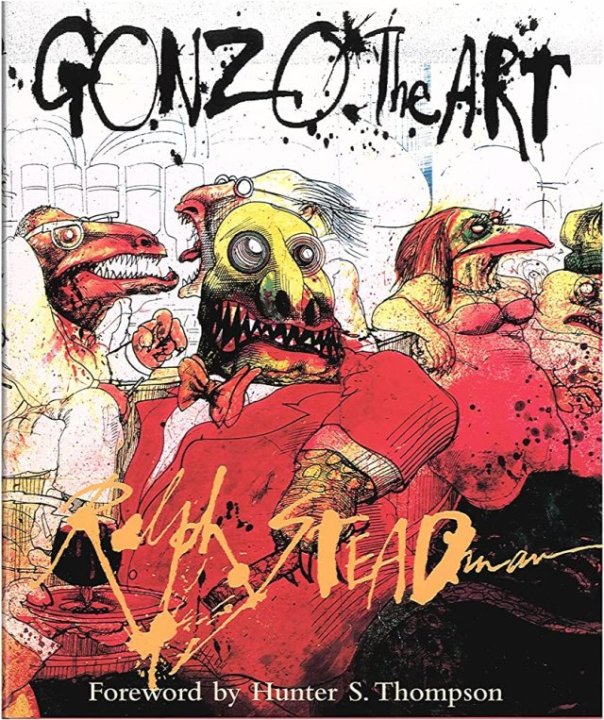
“… One of the many facets that sets Hunter S. Thompson’s 70s works apart from other forms of classic American literature are the growling, snarling, punch-between-the-eyeballs illustrations of Ralph Steadman. Roaring from the pages, his pictures visualise the horrors of corporate America, ripping the surface to reveal the political greed and other grotesqueries that contort and degrade the human forms within his pictures. With his method of isolating and focusing on a physical idiosyncrasy, he explodes his subjects, capturing a hidden truth that was hitherto unseen; it’s as if Steadman sees with the naked eye of a schizophrenic. Bloodsucking business men, venal politicians, dollar drugged gamblers, archetypal beholders of negation and power transmogrified into grinning reptilia, squarking sharp-beaked birds, gorgons of sheer inhuman greed. In the ferocious stroke of a few simple lines he trans-atlantically expresses all the negative facets of the human condition to a terrifyingly hilarious degree. If…

View original post 203 more words

Greg B.: The Confederacy Lives On!

dianeravitch's avatarDiane Ravitch's blog

Greg B. is a regular commenter on the blog. He lives in Ohio. He is deeply knowledgeable about German history and literature. I enjoy his comments.

He wrote:

As much as many Americans crow about being the land of the free, etc., they don’t like to do the work of being citizens, much less engaged. With citizenship comes responsibility. When one is engaged with the history of this nation, one understands that the enslavement of Africans who were transported here and their descendants literally built this country. While we learn about elites, it was enslaving Americans that created capitalism and wealth for whites around the world. The descendants of those whites have benefitted immeasurably from the status quo and keeping status regardless of quo. Even those who weren’t direct descendants, yes even people who immigrated to the US in the 19th through 21st century have benefitted by virtue of not…

View original post 255 more words

A Delay in Seeing the Light of Day

Dave Astor's avatarDave Astor on Literature

Georgette Heyer. (National Portrait Gallery, London.)

When I prepared last week to read a 1979 edition of a 1925 novel by English author Georgette Heyer, I was fascinated by a brief foreword by her son. Richard Rougier said his mother never wanted the book — Simon the Coldheart, written in her early 20s — to be reprinted. Yet here it was being reprinted, and making its U.S. debut, in 1979 — five years after Heyer’s death. Richard said the 15th-century-set novel was not as “mature” as Georgette’s later work, but he approved its reprinting because the book had “a quick eye for historical detail and an ability to paint a scene from another age” that would mark his mother’s peak efforts.

I agree. I enjoyed Simon the Coldheart as Heyer — who I was reading for the first time — depicted the coming of age and life of her…

View original post 455 more words

Reading Is Dangerous!

dianeravitch's avatarDiane Ravitch's blog

Read!

If you want to open your mind, read!

If you want to travel through time and space, read!

If you want to learn about other people and other cultures, read!

If you want to supercharge your creativity and imagination, read!

If you want to learn how other people see the world, read!

If you want to travel through time and space, read!

If you want to understand history, read!

Some people think these are dangerous activities. They want to control what students think. They censor books. They remove them from school libraries and public libraries. They forget that young people today have access to the Internet, which is not censored.

Live dangerously! Read books!

View original post

John Ashbery “Sings a Song of Thingness”: On Marianne Moore and the Hudson House

1960s: Days of Rage's avatar1960s: Days of Rage

Hudson: Lamps of different shapes and sizes and decorative wallpaper from numerous small collections. Master bedroom.

“John Ashbery has been having a virtual conversation with Marianne Moore about the ideal relationship between people and things ever since the publication of his first book, Some Trees (1956). An admitted admirer of Moore’s poetry, Ashbery directly revises Moore’s poetry and ideas even in that first volume. The volume flirts with Moore-like precision, but in its own way, focusing instead on ‘some precision’ (‘Popular Songs’), ‘dissolving’ (‘Errors’), and ‘Arranging by chance’ (‘Some Trees’). This interest in identifying poems’ exactnesses as an accident allows Ashbery to begin a long process of contemplating not only the way a poet views a thing, but also how that complex vision comes together in a poem and in a poet. In Some Trees, Ashbery responds to Moore’s preoccupation with people and things by challenging some of her…

View original post 218 more words

Bob Shepherd: Are Trump and His Allies Fascists?

dianeravitch's avatarDiane Ravitch's blog

Bob Shepherd is a polymath and a daily reader of the blog. He has been involved in every aspect of educational publishing, and most recently, he was a teacher in Florida. He graciously offered to help me with two of my books—The Language Police and Slaying Goliath—by carefully editing them before they were turned in to the publisher. And we have never met!

He wrote on his own blog:

A few years back, a friend, someone whom I respect, challenged me on Facebook, saying that Trump might be a lot of things, but he wasn’t an actual Fascist. Well, I beg to differ. If it steps like a goose, . . .

Here are a few of the clear signs that, yes, Fascist is precisely the term to describe Trump, his supporters, and those who wish to assume the orange mantle:

Alliance with other Fascists/Authoritarians. D.T. allied himself…

View original post 2,066 more words