All posts by Dr. Dean Albert Ramser

Unknown's avatar

About Dr. Dean Albert Ramser

Slava Ukraine! Supporting student success in Ukraine. Retired educator (English / Education: GED2EdD; "Ми будемо поруч один з одним як члени людства в найкращому сенсі цього слова". (Горан Перссон) Слава Україна 🇺🇦 "We will be there for one another as fellow members of humanity, in the finest sense of the word." (Goran Persson) https://cal.berkeley.edu/DeanRamser

The Adventures of Tintin: Destination Moon (1953), Explorers on the Moon (1954)

1960s: Days of Rage's avatar1960s: Days of Rage


Destination Moon is the sixteenth volume of The Adventures of Tintin, the comics series by Belgian cartoonist Hergé. The story was initially serialised weekly in Belgium’s Tintin magazine from March to September 1950 and April to October 1952 before being published in a collected volume by Casterman in 1953. The plot tells of young reporter Tintin and his friend Captain Haddock who receive an invitation from Professor Calculus to come to Syldavia, where Calculus is working on a top-secret project in a secure government facility to plan a crewed mission to the Moon. … Tintin, Snowy, and Captain Haddock travel to join Professor Calculus, who has been commissioned by the Syldavian government to secretly build a spacecraft that will fly to the Moon. Arriving at the Sprodj Atomic Research Centre, they meet the centre’s managing director, Mr. Baxter, and Calculus’ assistant, the…

View original post 181 more words

Greg Olear: Leonard Leo, the Man Who Stacked the Supreme Court

dianeravitch's avatarDiane Ravitch's blog

Greg Olear is a novelist and journalist who writes a blog called PREVAIL. The following post appeared there. I post only part of it. If you want to see his complete list of Leonard Leo’s claque, open the link and continue reading. This is part one of a two-part report.

Greg Olear writes:

He’s one of the most powerful individuals in the country. His spiderweb of connections is extensive. But most Americans, including many working in Washington, have never heard of him.

Occupying the center of an intricate web of political, legal, religious, and business connections, Leonard Leo is the quintessential Man in the Middle, a veritable dark-money spider. Like a spider, he is patient, painstaking, relentless, and much more powerful that he appears. And like a spider, he prefers to stay hidden.

I first wrote about him in February 2021, in a piece called “Leo the Cancer.” Leo, who…

View original post 720 more words

Herbert Marcuse and the Student Revolts of 1968: An Unpublished Lecture

1960s: Days of Rage's avatar1960s: Days of Rage

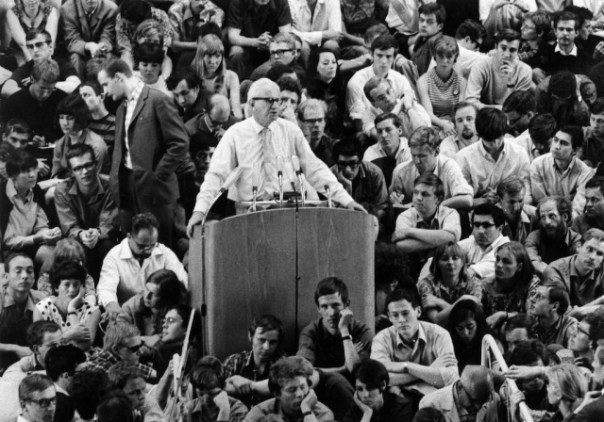
Herbert Marcuse giving a lecture in Berlin, 1967.

“In May 1968, the neo-Marxist philosopher Herbert Marcuse visited Paris and Berlin at the height of the student movements that were making news around the world. The text presented here is the transcript of a two-hour talk about those events that Marcuse delivered on May 23, 1968, shortly after his return to the United States, while the outcome of the May movement in France was still very much in doubt. It offers unique insights into the way a thinker often credited with providing the European student movements of 1968 with much of their ideological energy viewed them as they unfolded. Marcuse had gone to Paris to participate in an academic conference on ‘The Role of Karl Marx in the Development of Contemporary Scientific Thought.’ By the time he arrived in Paris, the student movement was already under way and the French press…

View original post 209 more words

1970 Jazz: Free, Avant-Garde and Experimental

1960s: Days of Rage's avatar1960s: Days of Rage

Ed Blackwell, Dewey Redman, Ornette Coleman, Charlie Haden at 131 Prince Street, May 1971.

“In previous articles about jazz music recorded in 1970, we featured albums on major jazz labels including Atlantic, Impulse! and Blue Note, with some of the releases showcasing free and experimental jazz by artists such as Chick Corea’s Circle Quartet, Pharoah Sanders, Alice Coltrane and Rahsaan Roland Kirk. In this article we will review other recordings of the esoteric sides of jazz, all recorded in 1970 and released on various labels. We open with a free jazz royalty. In April 1968, as a shareholder in a co-op that purchased an old seven-story factory at 131 Prince Street in Soho, just south of Greenwich Village in New York, Ornette Coleman became the owner of the street-level and third floors in the building. “I was just trying to find a place where I could go and make music…

View original post 308 more words

writing conclusions – getting the stuff sorted

pat thomson's avatarpatter

Conclusions are hard. It might seem that all you have to do is go back to your research question and simply provide an answer. But the reality is that much more is needed. Much more. And that much more comes at the end of your research project, and when you are likely to be at your most tired.

Hey Ho. You have to summon up enough energy to do the last bit. Whether you are working on a funded research project or a doctoral thesis, the very last part of the text you are writing still needs your time and some clever thinking. After all, it’s what readers are likely to most remember.

One way to kick off conclusion thinking is via some planning. Just like any other piece of your writing, your conclusion can benefit from some pre-composition work. I say work because the most important part of conclusion…

View original post 739 more words

Neo-noir

1960s: Days of Rage's avatar1960s: Days of Rage

Le Samourai (1967)

Neo-noir is a revival of film noir, a genre that had originally flourished during the post-World War II era in the United States—roughly from 1940 to 1960. The French term, film noir, translates literally to English as ‘dark film’, because they were quite dark both in lighting, but also indicating sinister stories often presented in a shadowy cinematographic style. Neo-noir has a similar style but with updated themes, content, style, and visual elements. The neologism neo-noir, using the Greek prefix for the word new, is defined by Mark Conard as ‘any film coming after the classic noir period that contains noir themes and noir sensibility’. Another definition describes it as later noir that often synthesizes diverse genres while foregrounding the scaffolding of film noir. The classic film noir era is usually dated from the early 1940s to the late 1950s. The…

View original post 250 more words

Reeling in the Tears

Dave Astor's avatarDave Astor on Literature

Parts of some novels make you cry. It could be tears of sorrow when a character (human or animal) dies or gets severely injured or there’s an unrequited-love situation, tears of happiness when there’s a long-delayed reunion or a character gets long-delayed justice or appreciation, etc.

If the author handles such scenes right, reader weeping is often a good thing. Our emotions have been engaged — to the max. One of the reasons why we love literature.

I thought about this last week while blubbering through the final chapters of Kristin Hannah’s superb 2018 novel The Great Alone, about a family that moves to a remote section of Alaska in the 1970s as the father tries to deal with trauma from being a prisoner of war in Vietnam — only to continue traumatizing his wife and teen daughter with physical and mental abuse. The whole book is emotionally intense…

View original post 323 more words

Towards an African Revolution: Fanon and the New Popular Movement (Hirak) Engulfing Algeria

1960s: Days of Rage's avatar1960s: Days of Rage


“During the upheavals that the North African and West Asian region witnessed a decade ago – what has been dubbed the ‘Arab Spring’- Fanon’s thought proved to be as relevant as ever. Not only relevant, but insightful in helping to grasp the violence of the world we live in, and the necessity of a sustained rebellion against it. Fanon’s wrote during in a period of decolonisation in Africa and elsewhere in the Global South. Born in Martinique, a French colony in the Caribbean, though Algerian by choice, he wrote from the vantage point of the Algerian revolution against French colonialism and of his political experiences on the African continent. … For me, as an Algerian activist, Fanon’s dynamic and revolutionary thinking, always about creation, movement and becoming, remains prophetic, vivid and committed to emancipation from all forms of oppression. He strongly and compellingly argued for a path to a future…

View original post 134 more words

Change: #1, Fall/Winter 1965: Archie Shepp

1960s: Days of Rage's avatar1960s: Days of Rage


“CHANGE was a magazine designed to take on the overflow of reviews and information that couldn’t be handled in issues of Work that now became almost too thick to be stapled. The emphasis in CHANGE was The New Thing, The New Music, The New Wave, etc., a world that was undergoing a spiritual revolution, a new consciousness  reflected in art and music. The cover of CHANGE featured a photo by Leni Sinclair of Archie Shepp, printed on bright orange boards. CHANGE was a forum for FIRE MUSIC of all kinds; the most advanced Jazz magazine of New Music in the country, perhaps in the world. CHANGE was international. It reviewed important live performances: Tam Fiofori on Ornette Coleman, George Tysh on Steve Lacy in Paris and many others. Recordings, interviews and reviews included; Albert Ayler,  Charles Mingus, Wayne Shorter, Eric Dolphy, Sun Ra, and Ali Akbar Khan…

View original post 182 more words