All posts by Dr. Dean Albert Ramser

Unknown's avatar

About Dr. Dean Albert Ramser

Slava Ukraine! Supporting student success in Ukraine. Retired educator (English / Education: GED2EdD; "Ми будемо поруч один з одним як члени людства в найкращому сенсі цього слова". (Горан Перссон) Слава Україна 🇺🇦 "We will be there for one another as fellow members of humanity, in the finest sense of the word." (Goran Persson) https://cal.berkeley.edu/DeanRamser

7/18/2023 – This war is far more than just “a conflict between Russia and Ukraine…”

Dal Stanton's avatarVoice of Ukraine

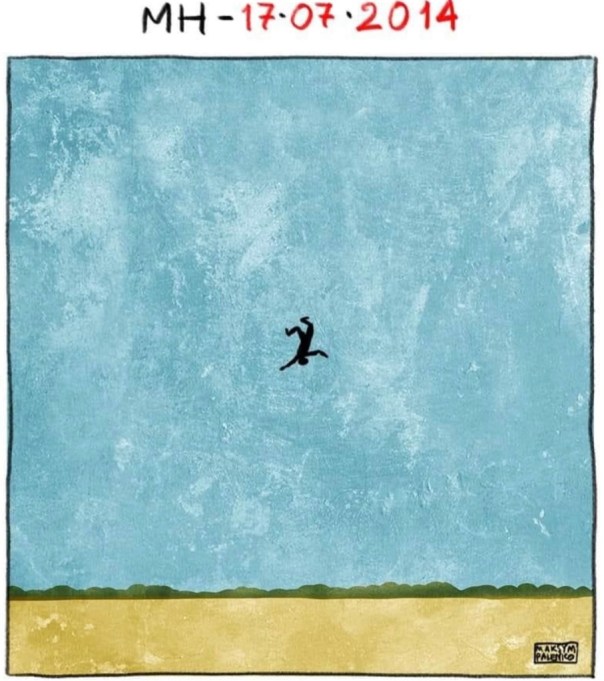
Today’s picture is an illustration by Maksym Palenko. We remember the victims of the MH17 tragedy and hope for justice.

From Ira Kapitonova in Kyiv (Day 509):

Deliver me from my enemies, O my God; protect me from those who rise up against me; deliver me from those who work evil, and save me from bloodthirsty men.
Psalm 59:1‭-‬2

On this day 9 years ago (July 17, 2014), Russia shot down Malaysia Airlines Flight MH17 from Amsterdam to Kuala Lumpur over the East of Ukraine. All 298 people on board, including 80 children, were killed. Last year, the District Court of The Hague established that an aircraft was hit by a Russian-made Buk anti-aircraft missile system, transported from Russia to the temporarily occupied parts of the Donetsk region, where the Russia-backed criminals launched the missile. While the trial found three men guilty and sentenced them to life imprisonment in absentia…

View original post 189 more words

7/17/2023 – I know we are never able to forget about this war, but we surely cannot let it destroy us…

Dal Stanton's avatarVoice of Ukraine

From Ira Kapitonova in Kyiv (Day 508):

Let them vanish like water that runs away;
when he aims his arrows, let them be blunted.
Psalm 58:7

As a kid, I heard WWII stories and wondered how people lived during those days. Were they always mourning? Did they wear only gray clothes because they had no joy in life? Did they eat only bread and water? I had lots of stereotypical images in my mind and couldn’t believe people could laugh, get married, or have children during the war.

The war in Ukraine started over nine years ago, and the past 500+ days were bound to happen sooner or later. How does one cope with something like this? How do you keep on living when someone is dying for you?

I’ve seen this question addressed by several people over the last couple of days. One said it took her a few…

View original post 377 more words

7/16/2023 – I feel like we live in the never-ending Groundhog Day…

Slava Ukraine!!

Dal Stanton's avatarVoice of Ukraine

Today’s picture – a boy plays on the ruins of his grandma’s house. Kupiansk, fall of 2022. Photo by Anastasia Vlasova (Reuters)

From Ira Kapitonova in Kyiv (Day 507):

Be merciful to me, O God, be merciful to me,
for in you my soul takes refuge;
in the shadow of your wings I will take refuge,
till the storms of destruction pass by.
Psalm 57:1

Some days, I feel like we live in the never-ending Groundhog Day. Missiles and kamikaze drones come again and again, and I get lost in the names of the cities that are attacked. Some of them are attacked daily, so I am often confused if it’s something new or something I already know about.

Today, I read that the Ukrainian government has opened an evacuation train route from Sumy. People will be able to get to Kyiv and get settled in a temporary refugee camp…

View original post 133 more words

The Theatre of Images: The Early Years

1960s: Days of Rage's avatar1960s: Days of Rage

“byrdwoMAN” at Robert Wilson’s Loft in 1968.

“‘The Theatre of Images’—a term coined in the early 1970s by Michel Guy, director of the Avignon Festival in France, and popularized by Bonnie Marranca in Performing Arts Journal—was, along with performance art, the major development in the live arts of the ’70s. The surge of theatricality in the postwar avant-garde had opened tremendous reservoirs of collective feeling across the performing arts of Lower Manhattan, climaxing in the visionary theatre collectives of SoHo, the capstone of one of the great eras in 20th-century American theatre history. It was an era of formal precision, ritual enchantment, therapeutic play, and public participation, reflecting powerful communal urges in a world that seemed to many to be on the verge of some cataclysmic upheaval. … Equal parts countercultural fantasist, wild child, and visionary saint, [Meredith] Monk at age 25 was an American original. Her theatrical vision…

View original post 192 more words

Heather Cox Richardson: The GOP Crazies Sabotage the Defense Budget

dianeravitch's avatarDiane Ravitch's blog

Heather Cox Richardson wrote early today about the GOP’s irresponsible politicization of the defense budget. Typically the defense budget passes with a bipartisan vote. But not this year because the House GOP majority is completely cowed by the hard-right extremists. The Republican crazies inserted all their anti-WOKE priorities into the bill, which will not be passed by the Senate. Marjorie Taylor Greene owns House Speaker Kevin McCarthy.

Richardson writes:

Traditionally, the National Defense Authorization Act (NDAA), which funds the annual budget and appropriations of the Department of Defense, passes Congress on a bipartisan basis. Since 1961 it has been considered must-pass legislation, as it provides the funding for our national security. For all that there is grumbling on both sides over one thing or another in the measure, it is generally kept outside partisanship.

Late last night, House Republicans broke that tradition by loading the bill with a wish list…

View original post 676 more words

Sweet Sweetback’s Baadasssss Song – Melvin Van Peebles (1971)

1960s: Days of Rage's avatar1960s: Days of Rage

Sweet Sweetback’s Baadasssss Song: “I’m Gonna Say a Black Ave Maria For You”. “My mother was not having it. Still not having it. Her memories of being dragged to see Sweet Sweetback’s Baadasssss Song (1971) by my father (of course) remain quite visceral, and I adore her attempt to sleep it away. For many, the film is still difficult to process, and that may very well have everything to do with its seemingly irreconcilable assertion of both revolution and pornography. Arguably, the film—and all Black films, for that matter—may be best appreciated with a deliberate suspension of authenticity fantasies or demands for definitive answers about Black life. Black film criticism needs more productive ambivalence than truth claims or approaches strictly governed by Sociology 101. Messy and riveting, Sweet Sweetback’s Baadasssss Song’s style and politics continue to compellingly challenge assumptions about the idea of Black film and American film history. The film…

View original post 176 more words

Masked Racism: Reflections on the Prison Industrial Complex by Angela Davis

1960s: Days of Rage's avatar1960s: Days of Rage


“Imprisonment has become the response of first resort to far too many of the social problems that burden people who are ensconced in poverty. These problems often are veiled by being conveniently grouped together under the category ‘crime’ and by the automatic attribution of criminal behavior to people of color. Homelessness, unemployment, drug addiction, mental illness, and illiteracy are only a few of the problems that disappear from public view when the human beings contending with them are relegated to cages. Prisons thus perform a feat of magic. Or rather the people who continually vote in new prison bonds and tacitly assent to a proliferating network of prisons and jails have been tricked into believing in the magic of imprisonment. But prisons do not disappear problems, they disappear human beings. And the practice of disappearing vast numbers of people from poor, immigrant, and racially marginalized communities has literally become big…

View original post 165 more words

’50s progression

1960s: Days of Rage's avatar1960s: Days of Rage

Pretty Little Angel Eyes – Curtis Lee (1961)

“The 50s progression (also known as the ‘Heart and Soul’ chords, the ‘Stand by Me’ changes, the doo-wop progression and the ‘ice cream changes’) is a chord progression and turnaround used in Western popular music. The progression, represented in Roman numeral analysis, is: I–vi–IV–V. For example, in C major: C–Am–F–G. As the name implies, it was common in the 1950s and early 1960s and is particularly associated with doo-wop. The first popular song to use the progression was Blue Moon, written in 1934. This inspired Heart and Soul in 1938 and Blueberry Hill in 1940. In Western classical music during the common practice period, chord progressions are used to structure a musical composition. The destination of a chord progression is known as a cadence, or two chords…

View original post 278 more words

In a Free State – V. S. Naipaul (1971)

1960s: Days of Rage's avatar1960s: Days of Rage


“There appears to have been some contestation in the published form In a Free State was to assume. Subtitled A Novel with Two Supporting Narratives, V. S. Naipaul’s 1971 masterpiece features the eponymous novel, two stories which he calls ‘supporting narratives,’ and the bookends of a prologue and an epilogue, taken from his own journal during his travels. It is, therefore, more accurately, a novel with four supporting narratives. … I am of the view that Naipaul’s earlier decision was the correct one: it had resulted in a formally original and dazzling book, over and above being a remarkable, clear-eyed, truthful and brutal meditation on exile and displacement. Because form seems to have historically been considered—and is still seen as—a white guy’s thing, and because Naipaul never strayed from the realist mode, In a Free State was never acknowledged for the ways it pushed the boundaries. It seems too late…

View original post 207 more words

Environmentalism in The Lord of the Rings

1960s: Days of Rage's avatar1960s: Days of Rage


Pastoral vision of an unspoilt England: the Old Mill at Hobbiton, reconstructed for the filming of Peter Jackson’s The Lord of the Rings

“The theme of environmentalism in The Lord of the Rings has been remarked upon by critics since the 1970s. The Hobbits‘ visions of Saruman‘s industrial hell of Isengard and Sauron‘s desolate polluted land of Mordor have been interpreted as comments on modern society, while the destruction of Isengard by the tree-giant Ents, and ‘The Scouring of the Shire‘ by the Hobbits, have a strong theme of restoration of the natural environment after such industrial pollution and degradation. However, Tolkien’s love of trees and unspoilt nature is apparent throughout the novel. J. R. R. Tolkien was brought up as a boy first in rural Warwickshire at Sarehole, at that time just outside Birmingham, and then inside that industrial…

View original post 261 more words