All posts by Dr. Dean Albert Ramser

Unknown's avatar

About Dr. Dean Albert Ramser

Slava Ukraine! Supporting student success in Ukraine. Retired educator (English / Education: GED2EdD; "Ми будемо поруч один з одним як члени людства в найкращому сенсі цього слова". (Горан Перссон) Слава Україна 🇺🇦 "We will be there for one another as fellow members of humanity, in the finest sense of the word." (Goran Persson) https://cal.berkeley.edu/DeanRamser

Spiritual jazz

1960s: Days of Rage's avatar1960s: Days of Rage

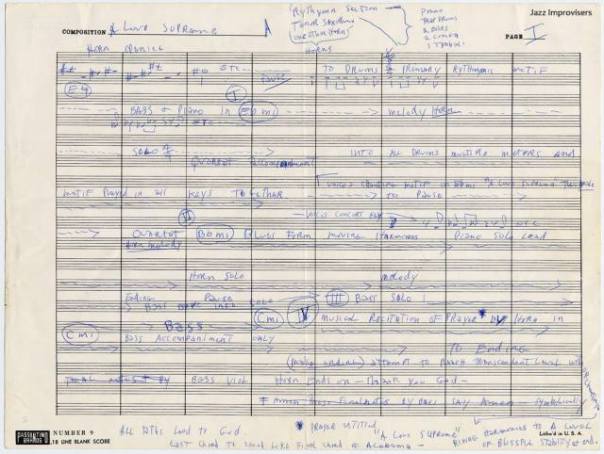
John Coltrane Handwritten – A Love Supreme (1965)

Spiritual jazz (or astral jazz) is a sub-genre of jazz that originated in the United States during the 1960s. The genre is characterized by its chaotic and noisy version on jazz that focuses on transcendence and spirituality. John Coltrane‘s A Love Supreme (1965) is considered a landmark album in the genre. During the 1960s in the United States, the civil rights movement was occurring,[2] causing societal change, political movements, and the desire of the marginalized to have their voices heard. As a result, African-American people were given more freedom to celebrate their culture and to express themselves religiously.[2] This lead to a desire to push the conventions of jazz, with some artists choosing to search for transcendence and spirituality in their music. John Coltrane released A Love Supreme in 1965, which was generally considered the birthplace…

View original post 186 more words

Diane Arbus (1923-1971)

1960s: Days of Rage's avatar1960s: Days of Rage

Taxicab driver at the wheel with two passengers, N.Y.C. 1956

“Diane Arbus (… March 14, 1923 – July 26, 1971) was an American photographer. Arbus’s imagery helped to normalize marginalized groups and highlight the importance of proper representation of all people. She photographed a wide range of subjects including strippers, carnival performers, nudists, people with dwarfism, children, mothers, couples, elderly people, and middle-class families. She photographed her subjects in familiar settings: their homes, on the street, in the workplace, in the park. ‘She is noted for expanding notions of acceptable subject matter and violates canons of the appropriate distance between photographer and subject. By befriending, not objectifying her subjects, she was able to capture in her work a rare psychological intensity.’ In his 2003 New York Times Magazine article, ‘Arbus Reconsidered,’ Arthur Lubow states, ‘She was fascinated by people who were visibly creating their own identities—cross-dressers…

View original post 255 more words

New York Times: The Rise of Christian Nationalism

dianeravitch's avatarDiane Ravitch's blog

The New York Times brings news that is not new to anyone who reads this blog. A movement is rising to revive Christian domination of public and private life, and it is a movement fueled by racists. It is specifically opposed to the separation of church and state, and it seeks to destroy public education, ban abortion, censor teaching about race and racism, as well as gender and sexuality.

This movement was behind Trump’s election and used this irreligious man as their instrument to gain power and control of the Supreme Court.

The article begins:

Three weeks before he won the Republican nomination for Pennsylvania governor, Doug Mastriano stood beside a three-foot-tall painted eagle statue and declared the power of God.

“Any free people in the house here? Did Jesus set you free?” he asked, revving up the dozens before him on a Saturday afternoon at a Gettysburg roadside hotel.

View original post 413 more words

Literary Tourism: Jack Kerouac’s New York

1960s: Days of Rage's avatar1960s: Days of Rage

In this Oct. 21, 1969, photo is author Jack Kerouac who only lived in St. Petersburg, Fla., a handful of years before he died there in 1969. But the Sunshine City still claims him as its own. One hundred years ago on March 12, Kerouac was born in Lowell, Mass.

“In this silent five minutes of 16mm film, Jack Kerouac is considering Lower Manhattan. He’s on 3rd Avenue and 6th Street with Ginsberg, Lucien Carr and the Carr family, appearing to be partaking in the hippest meal of the day, brunch, in all his casual glory. While Ginsberg takes care of pleasantries and corrals all in attendance, he makes special check-ins with his notoriously moody friend, coming up to him here and there to speak quietly and closely. Maybe it’s my imagination, but Kerouac seems to be appeasing Ginsberg with this midday family outing. It seems he might feel uncomfortable…

View original post 269 more words

Project Plowshare

1960s: Days of Rage's avatar1960s: Days of Rage

The 1962 “Sedan” plowshares shot displaced 12 million tons of earth and created a crater 320 feet (98 m) deep and 1,280 feet (390 m) wide

Project Plowshare was the overall United States program for the development of techniques to use nuclear explosives for peaceful construction purposes. The program was organized in June 1957 as part of the worldwide Atoms for Peace efforts. As part of the program, 31 nuclear warheads were detonated in 27 separate tests. A similar program was carried out in the Soviet Union under the name Nuclear Explosions for the National Economy. Successful demonstrations of non-combat uses for nuclear explosives include rock blasting, stimulation of tight gas, chemical element manufacture, unlocking some of the mysteries of the R-process of stellar nucleosynthesis and probing the composition of the Earth’s deep crust, creating reflection seismologyvibroseis data which has helped geologists and follow-on…

View original post 220 more words

Vietnam War A collection of documents related to Ellsberg’s interest and participation in the Vietnam War.

1960s: Days of Rage's avatar1960s: Days of Rage


“Daniel Ellsberg went to Vietnam for the first time in September 1961 as part of a Pentagon fact-finding task force. He hoped to learn that the South Vietnamese government of Ngo Dinh Diem, with U.S. backing, was defeating the Communist-led insurgency of the Viet Cong. After all, Ellsberg was a dedicated cold warrior, a foreign policy hawk. He discovered, instead, that Saigon was losing the war; a Communist victory seemed virtually inevitable. Returning to his job at the RAND corporation think tank in Santa Monica, California, he advised colleagues to avoid studying Vietnam–it might taint their careers. Ellsberg himself went back to his work on nuclear war plans. Three years later, a call came from Robert McNamara’s Pentagon. … His first full day on the job was August 4, 1964–the very day President Lyndon Johnson ordered American warplanes to attack North Vietnam in ‘retaliation’ for what he described as an…

View original post 202 more words

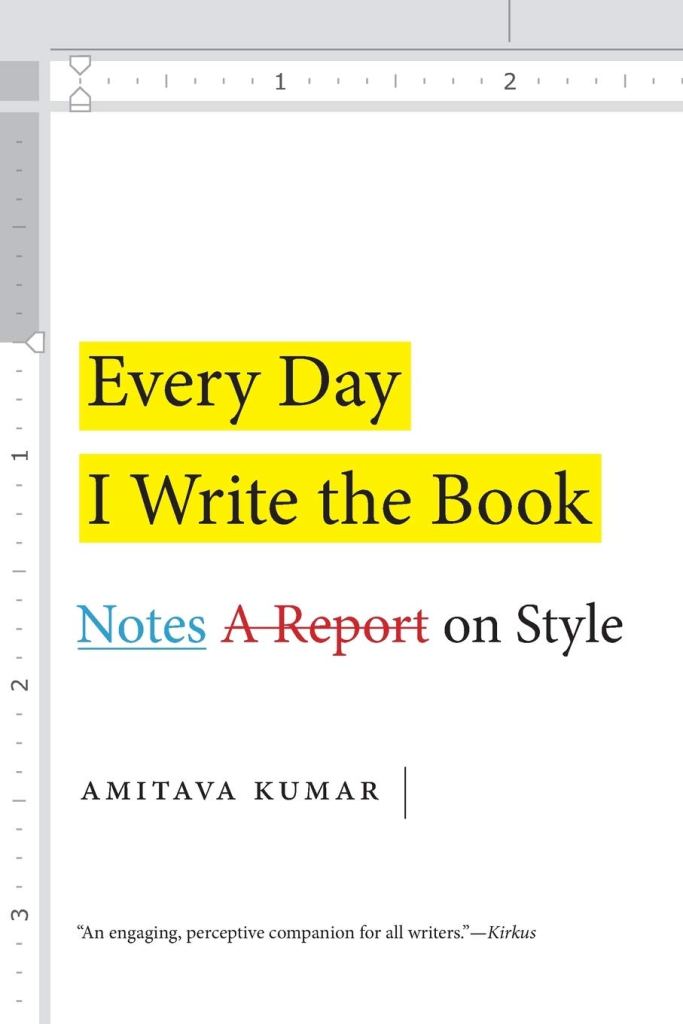
a book about style and form

pat thomson's avatarpatter

I read at least one book about writing every month. Because nobody sends me these for free, this means I buy at least one book about writing each month. I know you are imagining my bookshelves, but rest easy, most of these are now ebooks. Slightly cheaper and much easier to transport. 

The books are not always great reads and there are some I wouldn’t recommend for that reason. Others I don’t recommend simply because they are a little more niche than I imagine most people who read this blog would want. In other words, they are not advice. They are either based in formal research or the result of professional experience. So yes I buy books by language scholars, which I’m not, and by writers, which I might be sometimes – in between teaching and researching and administrative duties. 

Last month I particularly enjoyed reading Amitava Kumar’s (2020)

View original post 896 more words

At the End of Love’s Road with Michelangelo Antonioni

Great director/auteur!

1960s: Days of Rage's avatar1960s: Days of Rage


“Michelangelo Antonioni’s L’eclisse is about the end of one love affair and the beginning of another. It’s also about how hard it is to believe in relationships and create meaning out of them. This is the Antonioni film that hits me the hardest—in spite of the fact that I can’t describe the intricacies of the plot in detail. It has maybe my favorite opening and ending in any movie, but apart from that I couldn’t tell you what happens. It’s not that the scenes are forgettable; rather, they’re incidental. L’eclisse is not as contained a movie as La notte or L’avventura, which have more identifiable arcs. But it’s such amazing filmmaking. I first saw L’eclisse in the nineties on a VHS I’d ordered from a British company. I was probably still in my late teens, but I knew I wanted to make movies. Of course you should see the film…

View original post 255 more words

Frantz Fanon – The Political Writings from Alienation and Freedom

1960s: Days of Rage's avatar1960s: Days of Rage

Fanon Can’t Save You Now: “The 23 essays that appear in The Political Writings were extracted from the collection of recently discovered writings by Frantz Fanon called Alienation and Freedom, first published in French in 2015. Edited by Jean Khalfa and Robert J. C. Young and translated by Steven Corcoran, The Political Writings largely draws from Fanon’s contributions to the radical Algerian independence newspaper El Moudjahid, and they date from August 1957 to February 1961. Each was written in direct response to events in an ongoing anticolonial revolution, at the center of which was May 13, 1958, and its aftermath. Featuring 21 essays from El Moudjahid, The Political Writings functions as a long-lost companion to Toward the African Revolution, first published in 1964, three years after Fanon’s death. There are lingering questions and controversies surrounding the authorship of these essays — all of them unsigned and…
View original post 172 more words

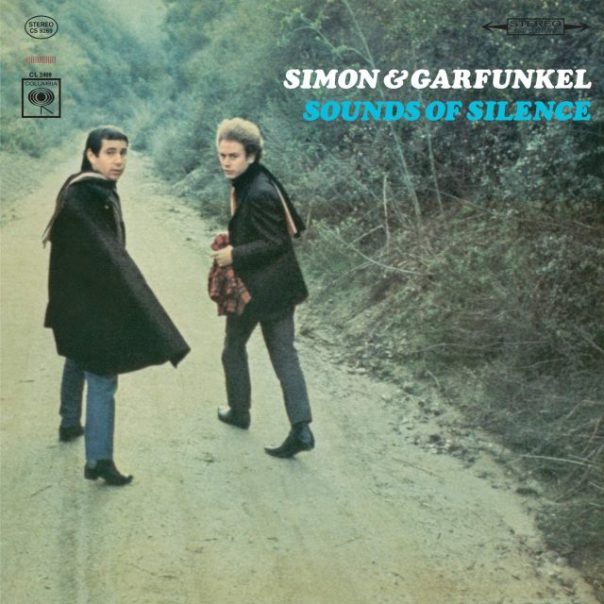
Sounds of Silence – Simon & Garfunkel (1966)

1960s: Days of Rage's avatar1960s: Days of Rage


Sounds of Silence is the second studio album by American folk rock duo Simon & Garfunkel, released on January 17, 1966. The album’s title is a slight modification of the title of the duo’s first major hit, ‘The Sound of Silence‘, which originally was released as ‘The Sounds of Silence’. The song had earlier been released in an acoustic version on the album Wednesday Morning, 3 A.M., and later on the soundtrack to the movie The Graduate. Without the knowledge of Paul Simon or Art Garfunkel, electric guitars, bass and drums were overdubbed by Columbia Records staff producerTom Wilson on June 15, 1965. This new version was released as a single in September 1965, and opens the album. ‘Homeward Bound‘ was released on the album in the UK, placed at the beginning of Side 2 before ‘Richard Cory‘…

View original post 222 more words